Zwilling Nottingham 16-Piece Review: Legit German Steel or Just Paying for the Logo?
There is a specific kind of sensory nightmare that keeps me up at night. It’s not a ticket machine printing non-stop at 8 PM. It’s the metallic taste of cheap flatware. You know the type: forks with tines so thin they bend when you try to stab a piece of steak, or spoons with edges so sharp they feel like they’re going to give you a Joker smile. It ruins the food. I don’t care if I just seared an A5 Wagyu to perfection—if you eat it with a stamped piece of sheet metal that tastes like pennies, the dish is garbage.
I worked with a Front of House manager years ago who tried to save budget by buying bulk, unbranded cutlery. Within three weeks, we had rust spots. The servers were embarrassed, the kitchen team was furious, and the guests noticed. It was a disaster.
So when I see the Zwilling J.A. Henckels “Nottingham” set, with the famous “Twin” logo, my immediate reaction is skepticism. This is a massive brand. Are you paying for the engineering, or are you paying for the box? I’m breaking down the metallurgy, the mouthfeel, and the grind to see if this set belongs on a dining table or in the scrap metal bin.
The Specs: What Exactly Are You Buying?
Before we talk about how pretty it looks, we need to do a material audit. In the world of stainless steel, there are two numbers that matter: 18/10 vs. 18/0.
The “18” refers to Chromium percentage. This gives the steel its hardness and basic rust resistance. The second number is Nickel. Nickel is expensive. It gives the steel its silvery luster and, more importantly, protects against acidic corrosion (think tomato sauce and vinaigrettes). 18/0 steel contains zero nickel. It is magnetic, dulls quickly, and will rust if you look at it wrong.
The Zwilling Nottingham is, thankfully, 18/10 Stainless Steel. This is the industry standard for anything considered “premium.” It’s non-magnetic (mostly) and should hold a polish.
The Inventory Breakdown:
- 4 Dinner Knives
- 4 Dinner Forks
- 4 Table Spoons
- 4 Coffee Spoons
The finish here is a high-polish mirror style. It looks impressive out of the box, but let’s be real: mirror finishes are fingerprint magnets. If you have kids, or if you just hate wiping down your cutlery with a microfiber cloth before dinner, this finish will show every smudge.
The Geometry & Feel: An Ergonomic Autopsy
In the kitchen, we obsess over the balance point of a Chef’s knife. The same logic applies to a fork. Cheap cutlery feels hollow; it “floats” in the hand because there is no mass. When you pick up a utensil, you want the center of gravity to sit near the neck (where the handle meets the head).
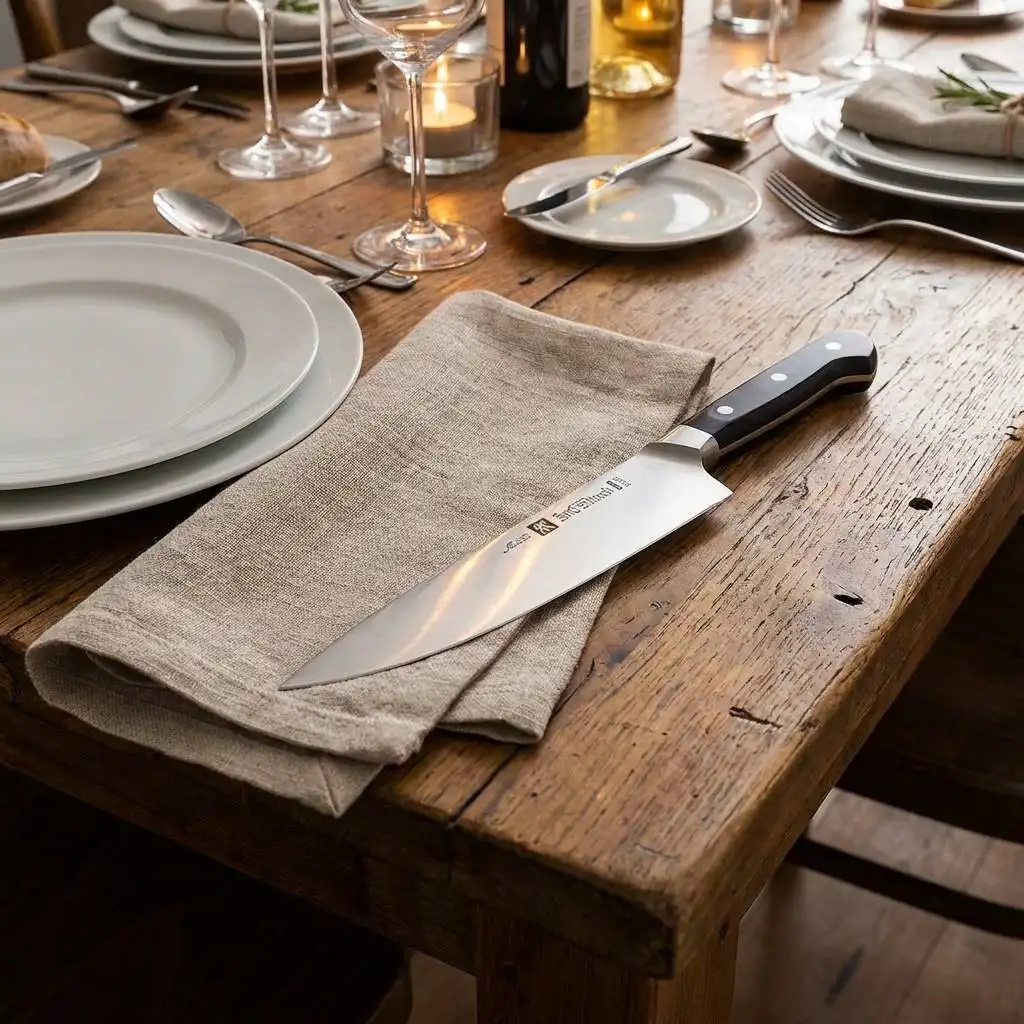
The Nottingham series has a decent heft. It uses a “Monobloc” construction style for the dinner knives, meaning they are forged from a single piece of steel. This adds weight. The handle silhouette is slender and classic, lacking the aggressive curves of modern ergonomic designs. It’s safe, but does it work?
For a quick lunch? Sure. But during a three-course meal, a handle that is too thin can cause hand cramping, specifically in the web of the thumb. The Nottingham walks a fine line here. It’s elegant, but if you have large hands, you might find yourself gripping it harder than necessary to maintain control.

The “Steak Test”: Assessing the Dinner Knife
Most people blame the steak for being tough, when in reality, they’re using a dinner knife with the cutting geometry of a spoon. If a knife can’t cut a medium-rare ribeye in one stroke, it’s useless to me.
Here is the reality of the Nottingham dinner knife:
- The Grind: It utilizes a micro-serration. This is standard for table knives because you can’t sharpen them. The serrations are fine, not the aggressive “saw teeth” you see on cheap steak knives that tear the meat fibers.
- Cutting Performance: On a crusty baguette, it performs well. It bites through the crust without crushing the soft interior. On protein, it’s adequate. It doesn’t “glide” like a straight-edge razor, but it separates the meat cleanly without needing a sawing motion.
- Handle Weight: The knife is significantly heavier than the fork. This is intentional and necessary. It provides the leverage needed to cut without applying massive downward pressure.
Mouthfeel & Tine Alignment
This is where manufacturers hide their cost-cutting measures: Fit and Finish.
The Spoon Bowl: Run your thumb along the edge of the spoon. Is it rounded and smooth? Cheap manufacturing stamps the spoon out of a sheet and barely polishes the edges, leaving them sharp. The Nottingham spoons are properly buffed. They are smooth against the lips—no “cutting” sensation.
The Fork Tines: This is the big one. Look between the tines. In budget sets, this area is rough, gray, and unpolished because the polishing wheel can’t reach it easily. That rough surface traps food bacteria and feels gritty on the tongue. Zwilling clearly tumbles these well; the polish extends to the inner tine surfaces.
Rigidity Test: I pressed the fork tines hard into a wooden cutting board. There was zero flex. If your fork flexes when you stab a potato, it’s garbage. The gauge of steel here is thick enough to withstand abuse.
Durability & The Dishwasher Gauntlet
Let’s talk about the dishwasher. Zwilling claims these are dishwasher safe. Technically, yes, 18/10 steel can handle the heat.
However, “Dishwasher Safe” is not “Dishwasher Invincible.” The high heat and harsh detergents (especially those abrasive tabs) will eventually dull that mirror finish. You will see micro-scratches—swirl marks—develop over six months of daily use.
The “Spotting” Issue: Even high-grade 18/10 steel will spot if you have hard water. This isn’t rust; it’s mineral deposit. If you pull these out of the machine and they look spotted, it’s not a defect in the steel, it’s your water.
Pro Tip: If you want them to look BOH-approved for a dinner party, wipe them down with a little white vinegar and a microfiber cloth. It strips the deposits instantly.
Comparison: Nottingham vs. The Competition
Why spend this money when you can go to a big-box store and pay half?
| Feature | Zwilling Nottingham | Generic Big-Box Set | Zwilling Bellasera |
|---|---|---|---|
| Steel Grade | 18/10 (High Nickel) | 18/0 (Magnetic/Rust Prone) | 18/10 (High Nickel) |
| Weight/Feel | Solid, Heavy Knife | Hollow/Stamped | Very Heavy, Standing Knife |
| Finish | Classic Mirror | Rough Edges | Modern Satin/Mirror |
| Design | Traditional | Basic | Modern/Avant-Garde |
The Nottingham is the “safe” choice compared to the Bellasera. The Bellasera has a standing knife design and a very distinct modern look, but it can feel weird in the hand if you aren’t used to it. The Nottingham is traditional mise en place—it works for everyone.
The Verdict: Final Pass or Fail?
This isn’t surgical equipment, but for a home table, it respects the food. It’s solid, sanitary, and constructed from steel that won’t taste like a battery.
Pros:
- True 18/10 steel composition (verified by lack of magnetism on forks/spoons).
- Excellent polish between tines (no bacteria traps).
- Good weight distribution on the dinner knife.
Cons:
- Mirror finish requires maintenance to look pristine.
- Handles are slightly thin for larger hands.
The BOH Rating: 8.5/10
It loses points for the high-maintenance mirror finish, but gains them back for solid metallurgy and edge finishing. It’s a workhorse set.
FAQ: Questions from the Floor
Is the Zwilling Nottingham set dishwasher safe?
Yes, but with a caveat. Use gel detergents rather than abrasive tablets to preserve the mirror shine. Avoid the “citrus” scented detergents as the acids can be too aggressive on the shine over time.
What is the difference between Zwilling J.A. Henckels and Henckels International?
Look at the logo. If it has two little stick figures (The Twins), it is Zwilling—higher quality steel, better finishing, usually made in Europe or to stricter standards. If it has one stick figure ( The Halberdier), it is Henckels International—this is the budget line, often made in China or Thailand with softer steel. Nottingham is a Zwilling (Two Men) product.
Can I sharpen the dinner knives?
No. The dinner knives have a micro-serrated edge. If you take these to a whetstone or a pull-through sharpener, you will grind off the teeth and ruin the cutting geometry. Once they go dull (which will take years), they are done.
Does the 16-piece set come in a gift box?
Usually, yes. It comes in a branded box with window display slots. It presents well as a wedding or housewarming gift.