Zwilling J.A. Henckels Review: Which Cutlery Sets Survive a Professional Kitchen (and Which are Junk)?
There is a specific kind of disappointment I feel when I walk into a friend’s kitchen or a poorly equipped prep station, spot a shiny block of knives, and realize they bought the wrong ones. You know the look: a massive wooden block taking up half the counter, filled with 18 different handles.
My buddy Dave did this recently. He proudly pointed to his “Henckels” set. I pulled the chef’s knife, tried to slice a ripe heirloom tomato for a caprese salad, and watched the tomato collapse under the pressure. The skin didn’t cut; it burst. Why? because Dave bought the “Single Man” logo, thinking he was getting German engineering. He bought stamped mystery metal made in a factory that prioritizes volume over heat treatment.
I’ve spent 15 years pushing steel through everything from Kabocha squash to tuna loins in high-volume kitchens. I’ve used knives that cost $400 and knives that cost $40. There is a massive difference between a tool and a toy. Today, we are breaking down the Zwilling J.A. Henckels ecosystem so you don’t make the same mistake Dave did.
The “Twin” vs. The “Single Man”: Don’t Get Scammed
This is where 90% of home cooks lose their money. Henckels operates under a tiered branding system that is intentionally confusing. You need to look at the logo etched on the blade.
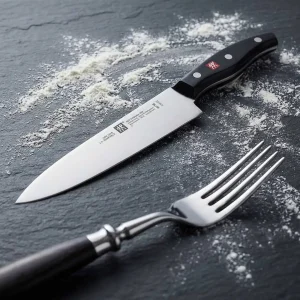
- Zwilling (The Twins): Two stick figures standing side-by-side. This is the premium line. These are typically forged in Solingen, Germany. They use the proprietary “Friodur” ice-hardening process. This is professional-grade gear.
- Henckels International (The Halberdier): A single stick figure holding a spear (halberd). This is the budget line. These are usually stamped from sheets of metal, often manufactured in Spain, China, or Thailand. The steel is softer, the edge retention is poor, and the balance is nonexistent.
The Verdict: For this review, I am ignoring the “International” line. Those are disposable commodities, not culinary instruments. If you want a knife that lasts a lifetime, you look for the Twins. Everything else is just noise.
The Metallurgy: Decoding the “German Steel” Formula
Marketing departments love terms like “Surgical Steel.” That means absolutely nothing in the metallurgical world. Zwilling uses a specific formula known as X50CrMoV15. Let’s translate that alphanumerical soup.
- 0.5% Carbon: This is relatively low compared to Japanese steels (which often hit 1.0% or higher). Carbon dictates hardness.
- 15% Chromium: This is high. It makes the steel stainless and highly resistant to rust.
- Molybdenum & Vanadium: Trace elements that improve structural integrity and grain structure.
The Hardness Factor (HRC): Zwilling runs their knives soft, usually around 55-57 on the Rockwell Hardness C scale. My Japanese Aogami (Blue Paper) steel knives run at 62-63 HRC.
Why does this matter? Hard steel holds an edge longer but chips easily. Soft steel (Zwilling) loses its edge faster but is incredibly tough. You can drop a Zwilling on a tile floor or hack through a chicken joint, and the edge will roll rather than shatter. A rolled edge can be fixed with a steel rod; a chipped edge requires a grindstone repair.
Friodur (Ice Hardening): This isn’t just fluff. Zwilling heats the steel, then freezes it to sub-zero temperatures. This aligns the carbide structure, making the blade more corrosion-resistant and slightly tougher. It’s a solid heat treat for this type of steel.
The Ergonomics: Bolsters, Balance, and The Pinch Grip
If you grip a knife like a hammer, stop reading and go buy a saw. Professionals use the “Pinch Grip”—thumb and index finger pinching the blade spine just in front of the handle. This gives you control. The handle is just there for your remaining three fingers to stabilize.
This is where the design of the Bolster (the metal junction between blade and handle) becomes critical.
The Bolster Debate
There are two main camps in the German knife world: the Full Bolster and the Curved (or Half) Bolster. I have a strong bias here.
I despise full bolsters. A full bolster runs all the way down to the heel of the edge. It acts as a finger guard, sure, but it prevents you from sharpening the entire length of the blade. Over time, as you sharpen the knife, the blade recedes, but the bolster doesn’t. You end up with a recurve profile where the heel doesn’t touch the cutting board. It makes the knife useless for chopping herbs.
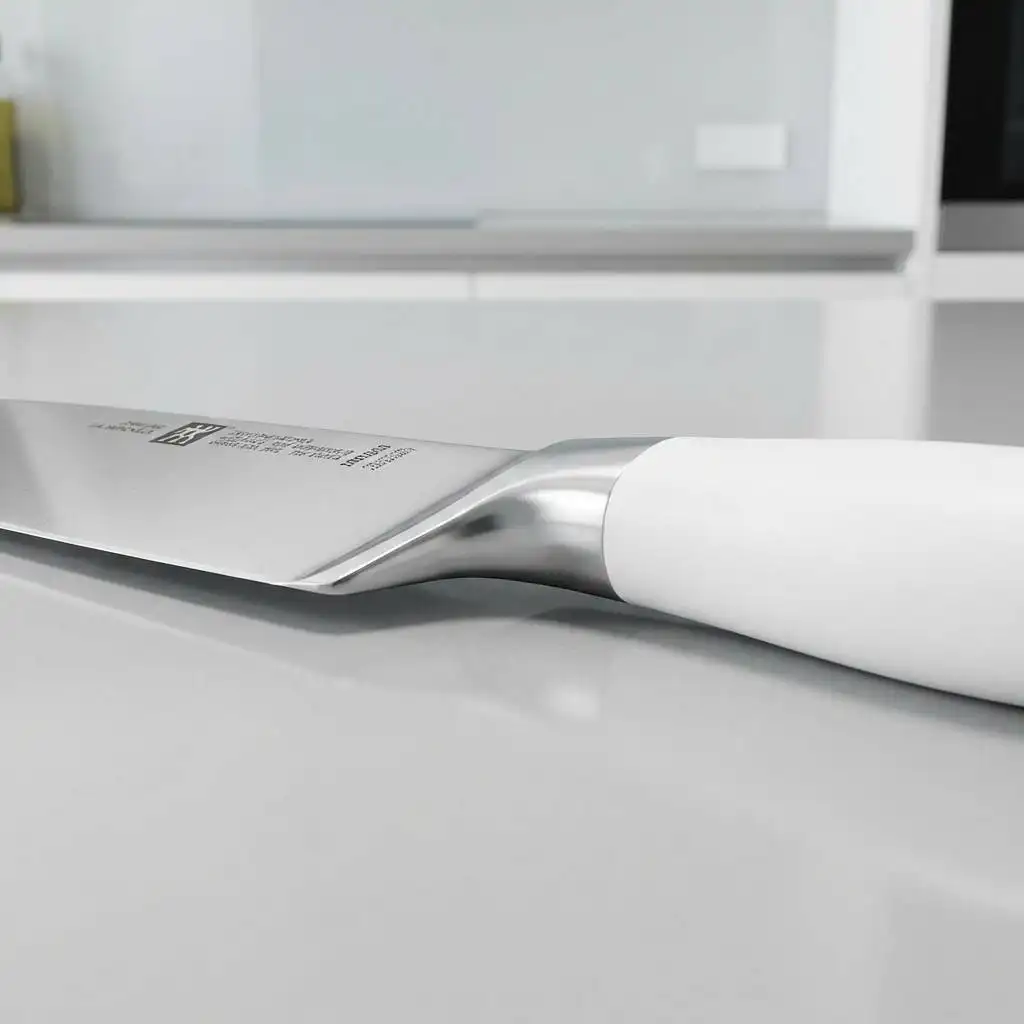
The Curved Bolster found on the Zwilling Pro line is an ergonomic masterpiece. It is angled to support the thumb in a pinch grip, feels smooth against the skin (no calluses after 40 pounds of onions), and allows for full-blade sharpening.

The Top Contender: Zwilling Pro Set Review
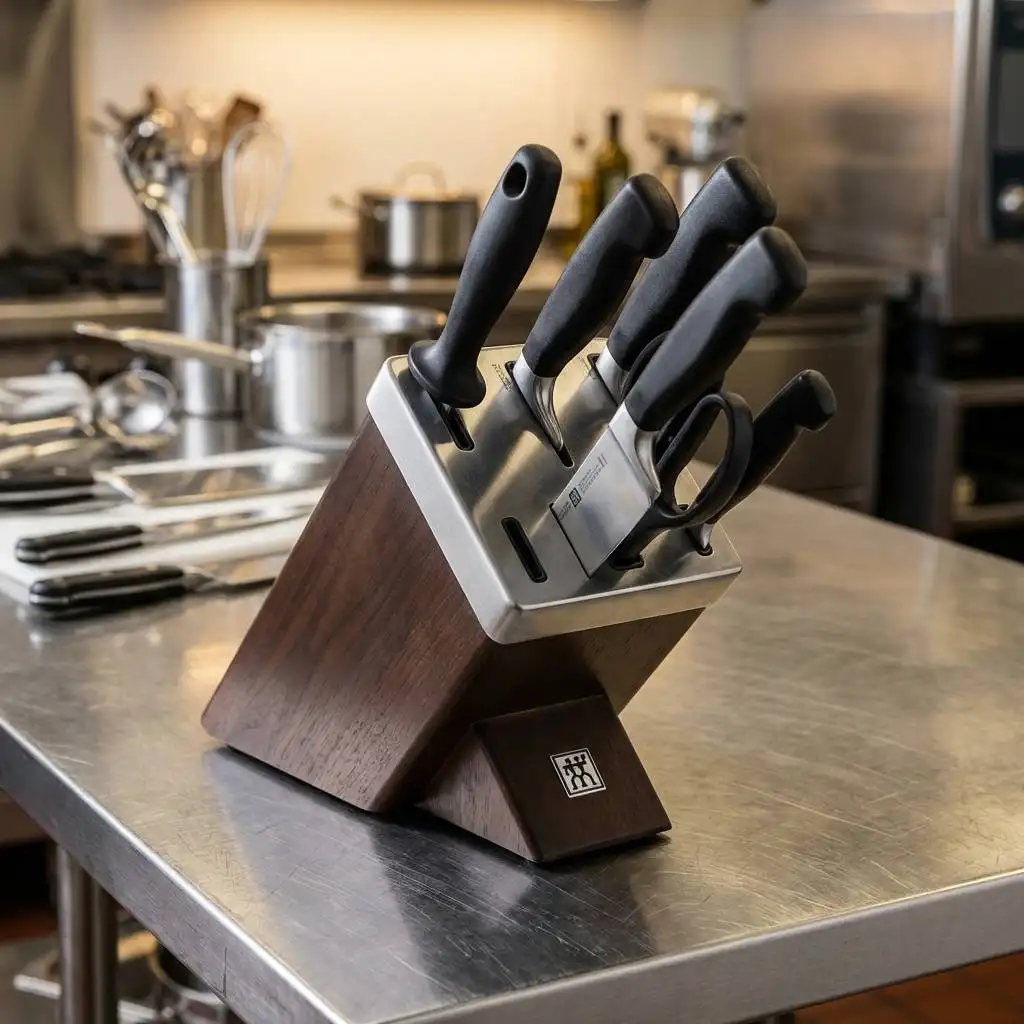
If you are going to buy a set, this is the one. The Zwilling Pro was designed by Matteo Thun and it addresses almost every complaint I have about traditional German knives.
- The Specs: X50CrMoV15 Steel, Curved Bolster, Full Tang, 3-rivet polymer handle.
- The Feel: The blade profile has a drastic curve in the belly. It is designed for the “rocking motion” of cutting. It feels heavy in the hand, but the balance point is right at the pinch.
- The Board Test:
- Carrots: Because German knives are thick at the spine, you will experience some “wedging.” It tends to crack the carrot open at the bottom of the cut rather than gliding through like a laser.
- Herbs: The rocking motion shines here. You can mince parsley into dust without lifting the tip off the board.
The Verdict: This is the best workhorse set for people who don’t want to baby their tools. It survives family members, dishwashers (though you shouldn’t), and accidental drops.
The Old Guard: Zwilling Professional “S” Set Review
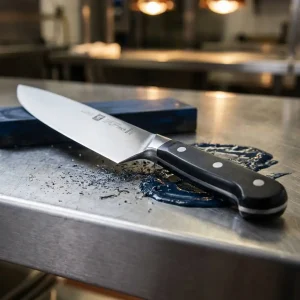
Walk into any culinary school, and you will likely see the Professional “S” in the kit. It has the same steel and the same handle material as the Pro, but it uses the traditional straight geometry and that dreaded full bolster.
The Critique: It feels solid, I’ll give it that. The full tang construction makes it feel indestructible. However, the balance is more handle-heavy, and that full bolster digs into your finger during long prep sessions. It’s a “safe” knife, but it feels outdated compared to the ergonomic improvements of the Pro line. Once the edge wears down past the bolster, you’re in for a headache trying to grind that steel finger guard down.
Performance Analysis: The “Line Cook” Stress Test
How do these actually perform during a dinner rush? Let’s look at the data.
Edge Retention: In a professional environment, a Zwilling edge lasts about two “covers” (shifts) before it starts to slide on tomato skin. You have to “steel” it (hone it) constantly. The steel is soft, so the edge rolls over microscopically. Honing stands it back up.
Durability: This is where they win. I have seen Japanese VG10 blades chip when they hit a beef bone. The Zwilling takes the abuse. It might dent, but it won’t snap.
| Feature | Zwilling Pro | Wusthof Classic Ikon | Generic Japanese Gyuto |
|---|---|---|---|
| Steel Hardness | 57 HRC (Soft/Tough) | 58 HRC (Medium) | 61+ HRC (Hard/Brittle) |
| Bolster Design | Curved (Ergonomic) | Double Bolster | No Bolster |
| Edge Retention | Moderate (Needs honing) | Moderate | High (Weeks of sharpness) |
| “Wedging” Factor | High (Thick Spine) | Medium | Low (Thin Spine) |
Maintenance: The Reality of Ownership
If you buy a Zwilling set, the most important tool in that wooden block is the Honing Steel (the metal rod). You need to use this every single time you cook.
The Protocol:
1. Place the heel of the blade against the rod at a 15-degree angle.
2. Swipe down, applying light pressure, moving from heel to tip.
3. Do this 4 times per side.
4. Wipe the blade.
The Cardinal Sin: Do not put these in the dishwasher. The detergent is abrasive and high-heat cycles cause the polymer handles to shrink and expand differently than the steel tang. Eventually, you’ll feel the metal ridges of the handle sticking out, or the rivets will corrode. Hand wash, dry immediately.
FAQs: Questions from the Floor
Are Henckels knives made in China?
Henckels International (Single Man logo) products are often made in China, Spain, or Thailand. Zwilling (Twin logo) knives are predominantly made in Germany, though some ceramic and accessory lines are manufactured elsewhere. Check the blade stamp.
Do I really need an 18-piece block?
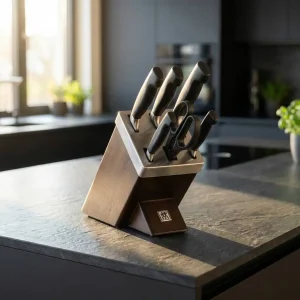
No. Block sets are generally a scam for suckers. You are paying for 12 knives you’ll never use just to get the 3 you actually need. If you must buy a set, buy the smallest Zwilling Pro set available (3-piece) and buy a magnetic strip. Ditch the wooden bacteria block.
Can I sharpen these with a pull-through sharpener?
You can, but you are ripping the steel apart. Those carbide V-notches peel metal off aggressively and leave a jagged edge. Learn to use a whetstone or buy a guided system.
The Final Cut: Who Should Buy This?
Look, steel is a compromise. You can’t have extreme hardness without brittleness. Zwilling chooses toughness over edge retention.
Buy the Zwilling Pro Set If:
You are a home cook who wants a “bomb-proof” tool. You might accidentally hit a bone, you might twist the knife while cutting squash, or you have family members who aren’t careful. You want a comfortable pinch grip and don’t mind honing your knife before dinner.
Pass If:
You are chasing “laser” performance. If you want a knife that falls through a potato by its own weight and stays sharp for three months without touching it, you need Japanese high-carbon steel, not German stainless. But be prepared to chip it if you look at it wrong.
For the vast majority of households, the Zwilling Pro is the ceiling of what you need. Just avoid the “International” garbage, and for the love of food, keep them out of the dishwasher.