Zwilling J.A. Henckels Four Star 12-Piece Review: A Pro Chef’s Autopsy of the “German Workhorse”
I’ve spent the last 15 years in kitchens ranging from high-volume French brasseries to quiet, obsessive Japanese omakase counters. In that time, I’ve seen home cooks suffer from a specific kind of “Analysis Paralysis.” You’re standing in the aisle (or scrolling Amazon), terrified of dropping $300 to $500 on a block set. You’re worried the steel is soft, the handles will get slippery when your hands are covered in chicken fat, or—worst case scenario—you’re buying a block where you’ll use two knives and the other ten will just gather dust and grease.
I cut my teeth—and my fingers—on Zwilling steel back when I was a commis. In the culinary world, the Zwilling Four Star series is the Ford F-150. It’s not a Ferrari. It’s not sexy. It doesn’t have a flashy Damascus pattern that looks like a topographical map. But the question isn’t “is it pretty?” The question is: “Will it hold an edge after prepping 50 pounds of onions?”
Let’s put this German classic on the dissection table and see what’s actually going on under the hood.
The Legacy: Why the Four Star Line Refuses to Die
Zwilling released the Four Star line in 1976. In an industry obsessed with the “new,” the fact that this design hasn’t changed in nearly 50 years is telling. It was revolutionary at the time because it introduced the seamless, molded synthetic handle—essentially fusing the handle to the tang so there were no gaps for bacteria to hide.
If you are looking for a laser-thin Japanese blade that glides through sashimi but chips if you look at it wrong, click away now. This isn’t for you. This set is for the cook who treats their tools like tools, not jewelry. It’s for the person who might accidentally leave a knife in the sink (don’t do that, seriously) or needs to hack through a chicken joint without the blade shattering into a million pieces. This is utilitarian German engineering at its most stubborn.

The Specs: De-Mystifying the Metallurgy
Marketing departments love terms like “Surgical Steel” or “High Carbon No-Stain.” To a metallurgist or a chef, that’s just noise. Let’s look at the data block.
- Steel Type: X50CrMoV15 (German Stainless)
- Hardness: 57 ±1 HRC (Rockwell Scale)
- Construction: Sigmaforge (One-piece precision forged)
- Treatment: Friodur (Ice-hardened)
The Steel: X50CrMoV15
Here is the translation: This is a standard German formula. The “X50” means 0.5% Carbon. That is decent, but low compared to a Japanese VG10 (1% Carbon) or a Powdered Steel (1.5%+). Carbon is what gives a knife hardness and edge retention.
However, the high Chromium content (15%) makes this steel practically rust-proof. You could leave this covered in lemon juice for an hour and it likely wouldn’t pit. That is the trade-off: you sacrifice peak sharpness for extreme durability.
Hardness & The “Friodur” Ice Bath
At 57 HRC, this steel is relatively soft. A Shun or Miyabi sits at 60-61 HRC. Why does this matter? Hard steel holds an edge longer but is brittle (chips). Soft steel loses its edge faster but is tough (rolls).
Zwilling uses “Friodur,” a cryogenic tempering process where they freeze the blade to align the grain structure. Does it work? Yes, it improves corrosion resistance and stability. Does it turn X50 steel into a super-steel? No. It’s still going to roll if you abuse it, but it won’t snap.
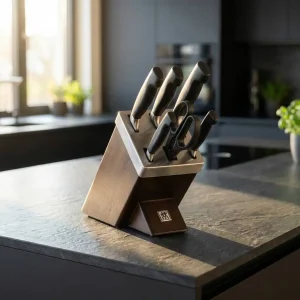
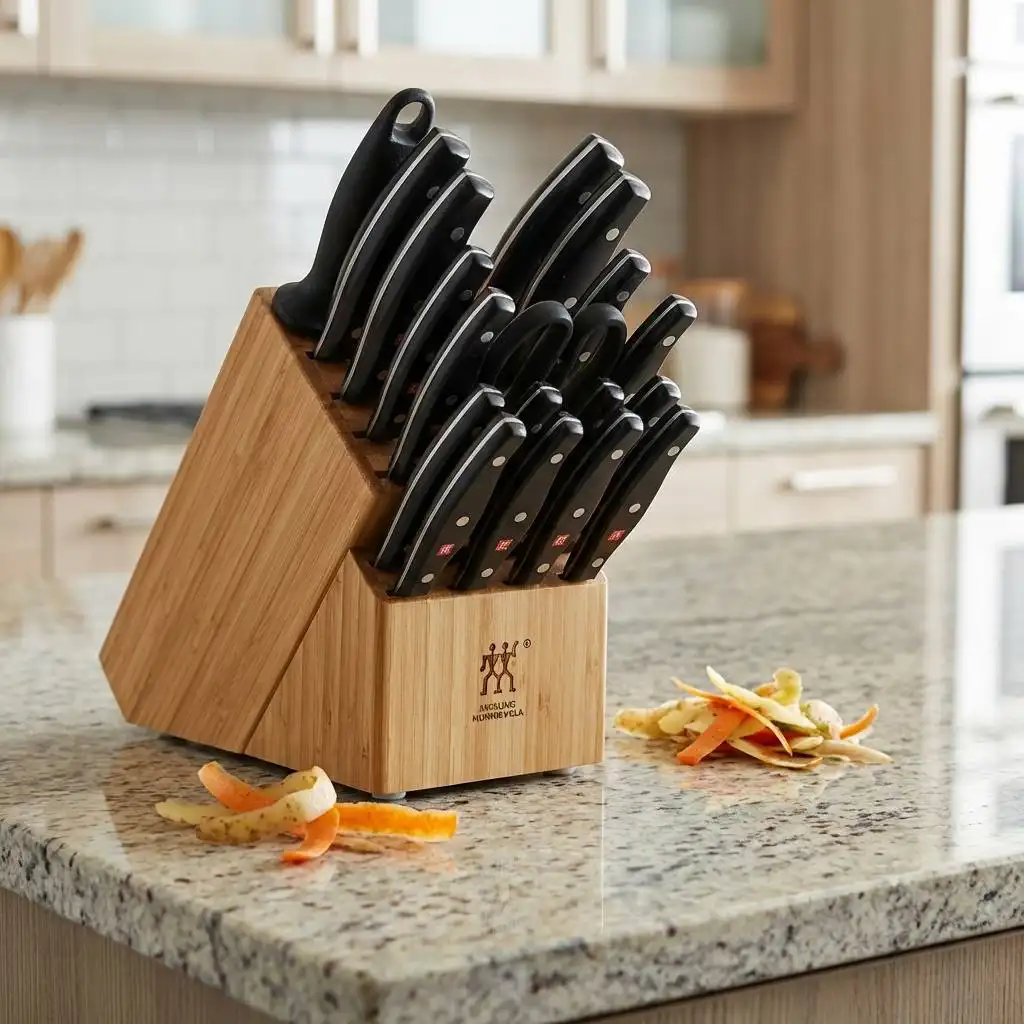
The 12-Piece Breakdown: Essentials vs. Drawer Filler
The biggest scam in the knife industry is the “Piece Count.” A 20-piece set isn’t better than a 7-piece set if 13 of those pieces are useless garbage. Let’s audit the Four Star 12-piece block.
The Core Three (The Workhorses)
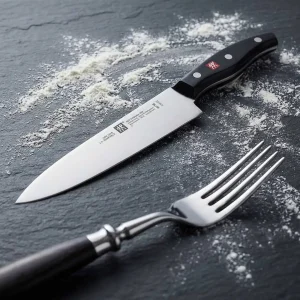
- 8″ Chef’s Knife: The MVP. The belly on this knife is dramatic. It is designed for the “rock chop” (keeping the tip down and rocking the heel). If you are a “push cutter” (up and down motion), you might find the curve annoying.
- 4″ Paring Knife: Solid. The tip geometry is fine enough for coring strawberries or peeling apples, though it lacks the needle-point precision of a petty knife.
- Bread Knife: Zwilling serrations are aggressive. They will tear through a crusty sourdough without compressing the crumb, but don’t expect clean slices on a delicate sponge cake.
The “Inflation” Pieces
- Steak Knives (x4): Usually, in these sets, the steak knives are the weak link. In the Four Star set, they are decent, but check the spine—often these are stamped steel rather than the forged quality of the main knives. They cut meat, but they aren’t the same pedigree as the chef’s knife.
- Honing Steel: This is not filler; it is mandatory. Because the steel is 57 HRC, the edge will roll (bend) microscopically after every heavy prep session. You need this steel to realign the edge. If you don’t use this weekly, your knives will feel dull in a month.
- Kitchen Shears: Zwilling makes great shears. The pivot point is strong, and they generate good torque for cutting through poultry backbones.
Ergonomics & Handle Geometry: The “Love it or Hate it” Grip
The handle is molded polypropylene. It feels like a hard, smooth plastic. The benefit is hygiene. There are no rivets to rust out, and no wood to crack or absorb beet juice. It is arguably the most sanitary handle design on the market, which is why health inspectors love them in commercial kitchens.
However, if you are used to the heavy, organic feel of a Pakkawood or Micarta handle, this can feel “cheap” or “hollow.” It is lightweight. The balance point usually sits right at the bolster, which is technically correct, but the lack of handle weight can make the blade feel forward-heavy to some.
The Bolster Issue: My Main Gripe
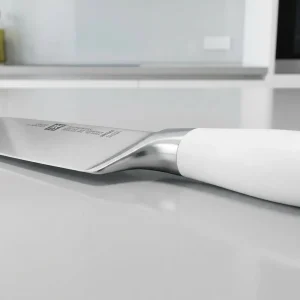
We need to have a serious talk about the “Full Bolster.” This is the thick band of metal that connects the handle to the blade, running all the way down to the heel of the edge.
The Hard Truth: I hate full bolsters. Zwilling claims it’s a finger guard for safety. In reality, it is a design flaw that limits the lifespan of the knife. Because that thick metal assumes the same height as the blade edge, as you sharpen the knife over years and remove metal from the blade, the bolster does not get ground down.
Eventually, the bolster becomes higher than the blade, creating a “recurve.” This means the heel of your knife will hit the cutting board, but the actual sharp edge will hover a millimeter above it. You’ll be trying to cut chives, and they’ll just stay connected like an accordion. It’s a pain to fix unless you have a belt grinder.
Performance Stress Tests (The Board Exam)
I don’t care about paper-cutting tests. Paper isn’t food. Here is how the Four Star behaves in real mise en place.
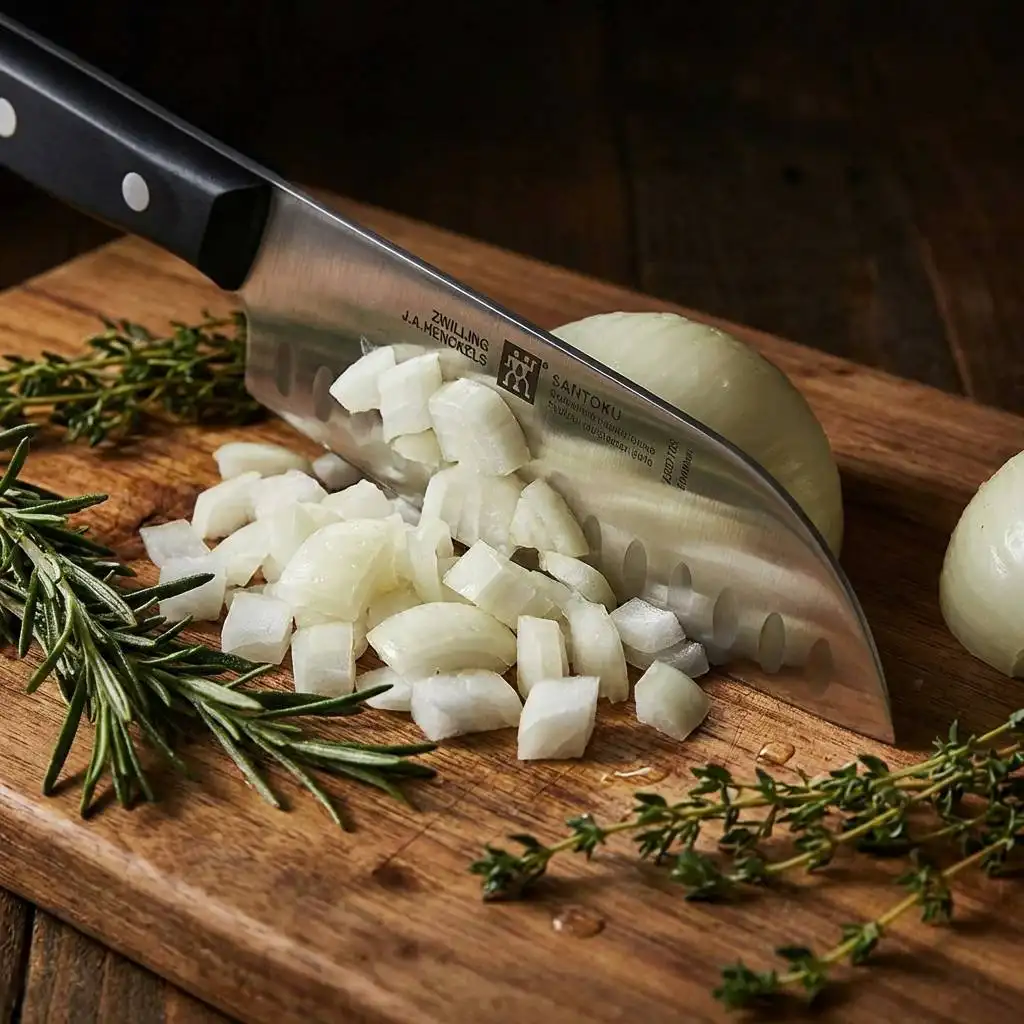
The Onion Test (Geometry)
German knives are generally thicker at the spine than Japanese knives. When you cut a tall onion horizontally, you might feel “wedging.” This is where the thickness of the blade splits the vegetable before the edge actually cuts it. The Four Star wedges slightly on hard root vegetables. It doesn’t glide like a laser, but it separates the food effectively.
The Carrot Test (Sound Check)
When chopping carrots, listen to the sound. A loud “crack” means the geometry is too thick and it’s breaking the carrot. The Four Star produces a dull thud. It cuts well, but requires a bit more force than a thinner blade.
The Chicken Bone Test (Durability)
This is where the 57 HRC shines. I took the heel of the chef’s knife and went through a chicken wing joint. A hard Japanese knife might chip here. The Zwilling went through with a heavy push. The edge rolled slightly (which I fixed in 5 seconds on the steel), but there was zero chipping. It is a tank.
Edge Retention & Maintenance Reality
If you buy this set, you are entering a relationship with your honing rod. You cannot be lazy.
- Sharpening Frequency: In a home kitchen with daily use, you will need to hone (steel) this knife before every heavy session. You will need to actually sharpen it (whetstone or pull-through) about every 4-6 weeks to maintain a “shaving” edge.
- The Feel on the Stone: X50 steel feels “soapy” or “gummy” on a whetstone. It is easy to grind, but difficult to deburr cleanly because the soft steel wants to hang on. It doesn’t take a screaming, glassy edge like high-carbon steel, but it takes a jagged “toothy” edge very well, which is great for gripping tomato skin.
- Dishwasher Safety: The box says “Dishwasher Safe.” I say absolutely not. The detergent is abrasive and will dull the edge. The heat cycling can expand the handle and mess with the steel’s temper over time. Wash it by hand.
The Verdict: Price-to-Performance Ratio
The Zwilling Four Star 12-Piece set is the definition of a safe bet. It is not the highest performer in terms of sharpness or geometry, but it scores a 10/10 on durability and quality control.
Pros:
- Virtually indestructible blade construction.
- Hygienic, molded handles that will never rot.
- Lifetime warranty from a company that isn’t going anywhere.
- Forgiving steel that rolls rather than chips.
Cons:
- The full bolster is a nightmare for long-term sharpening.
- Edge retention is average; requires frequent honing.
- Steak knives are often lower quality than the main knives.
Who Should Buy It: The home cook who wants to buy one set for the next 30 years, wants tools that can handle abuse, and isn’t obsessed with shaving hair off their arm.
Who Should Avoid It: The knife enthusiast who wants to push-cut paper-thin tomato slices or anyone who hates the feeling of a lightweight, synthetic handle.
FAQ: Questions from the Pass
Is the Four Star better than the Zwilling Pro “S”?
They use the exact same steel and ice-hardening process. The difference is the handle and bolster. The Pro “S” has a traditional three-rivet handle and (in newer models) a curved half-bolster. I prefer the Pro specifically because the half-bolster allows you to sharpen the entire length of the blade. The Four Star is strictly for those who prefer the molded handle feel.
Can I sharpen the serrated bread knife?
Technically, yes, but it is a pain. You need a ceramic rod and you have to go into each scallop individually. Honestly? Most people just replace the bread knife every 5-7 years when it stops biting.
Why are my steak knives rusting?
Even “stainless” steel can rust if left wet, but often the steak knives in these blocks are made from a slightly different steel batch than the chef’s knife. Avoid the dishwasher, and dry them immediately after washing.
Is “Made in Germany” still a thing?
Yes. The Four Star line is still manufactured in Solingen, Germany. Zwilling has factories in China and Spain for their lower-tier lines, but the Four Star is still genuine German production.