Zwilling J.A. Henckels 4 Star 7-Piece Review: The Immortal Workhorse or An Outdated Relic?
We need to address the elephant in the room: buying a knife block set is usually a trap. It’s a classic rookie mistake. You see a massive block with 18 slots, and your brain thinks “value.” Then you get it home and realize you paid for six steak knives that tear meat like a chainsaw and a serrated utility knife you’ll literally never use.
So, when we look at the Zwilling J.A. Henckels 4 Star 7-Piece Set, the question isn’t just about the steel. It’s about the roster. Is this a functional culinary kit, or just expensive counter clutter?
I have a long history with the 4 Star series. Back in the early 2000s, when I was grinding on the line in high-volume French kitchens, these were the “house knives.” I’ve seen these handles melted by salamanders (broilers), dropped on quarry tile floors, and thrown into commercial dishwashers by lazy porters. They aren’t pretty. They aren’t sexy. But they simply refuse to die. However, durability doesn’t always equal performance. In a world of laser-sharp Japanese geometries, does this German tank still have a place on your station?

The “4 Star” Legacy: Why It’s Still Around
The 4 Star line was introduced in 1976. Let that sink in. In an industry obsessed with trends—where hammer finishes and exotic handle woods come and go every season—Zwilling hasn’t changed this design in nearly 50 years. That is rare.
If you are confused about the Henckels hierarchy, here is the short version: The 4 Star is virtually identical to the famous Professional “S” in terms of the blade. They use the same Friodur ice-hardened steel and the same forging process. The difference is the handle. The Pro “S” uses the classic three-rivet design with exposed tang scales. The 4 Star uses a seamless, molded polypropylene handle.
Crucial Distinction: We are talking about Zwilling J.A. Henckels (The “Twin” logo), made in Solingen, Germany. Do not confuse this with “Henckels International” (The “Single Guy” logo), which is often stamped out in China or Spain. If it doesn’t say Solingen on the blade, put it back on the shelf.
The Specs: Metallurgy & Hardness Data
Let’s cut through the marketing fluff about “proprietary formulas” and look at the metallurgy. Zwilling uses X50CrMoV15. In the knife world, this is the Toyota Camry of steels.
- Carbon (0.5%): This is on the lower end compared to Japanese VG10 or SG2. It means the steel is softer.
- Chromium (15%): High stain resistance. You can leave a lemon on this blade for an hour and it likely won’t pit.
- Hardness (57 HRC): This is the defining spec.
Most high-end Japanese knives sit around 61-63 HRC (Rockwell Hardness). The 4 Star sits at a modest 57. Is that bad? Not necessarily. Hard steel holds an edge longer but chips easily. Soft steel (57 HRC) rolls over. When you hit a chicken bone or accidentally twist the blade on the cutting board, the edge will dent or roll rather than snapping off.
The Friodur Process: Zwilling uses cryogenic tempering (freezing the blade during heat treatment). This aligns the carbide structure. It essentially stabilizes the grain, making the steel exceptionally tough despite being relatively soft. It’s designed to take a beating.
The Ergonomics: Hate It or Love It
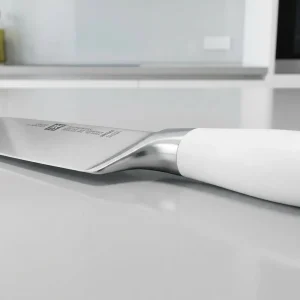
The handle is where the 4 Star divides the room. It features a molded polypropylene grip that fully encases the tang. The tang is still there (it runs about three-quarters back), but you can’t see it.
From a hygiene standpoint, this is brilliant. In a professional kitchen, seams between steel and wood/plastic are where bacteria and chicken juice like to hide. The 4 Star has no seams. It’s incredibly sanitary.
However, the balance is different. Because there is no heavy steel pommel exposed at the back, the balance point pushes slightly forward toward the blade compared to the Pro “S”. It feels lighter and a bit more nimble, but some cooks miss the reassuring heft of a heavy handle.
The 7-Piece Breakdown: Assessing the Roster
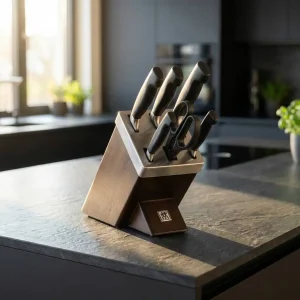
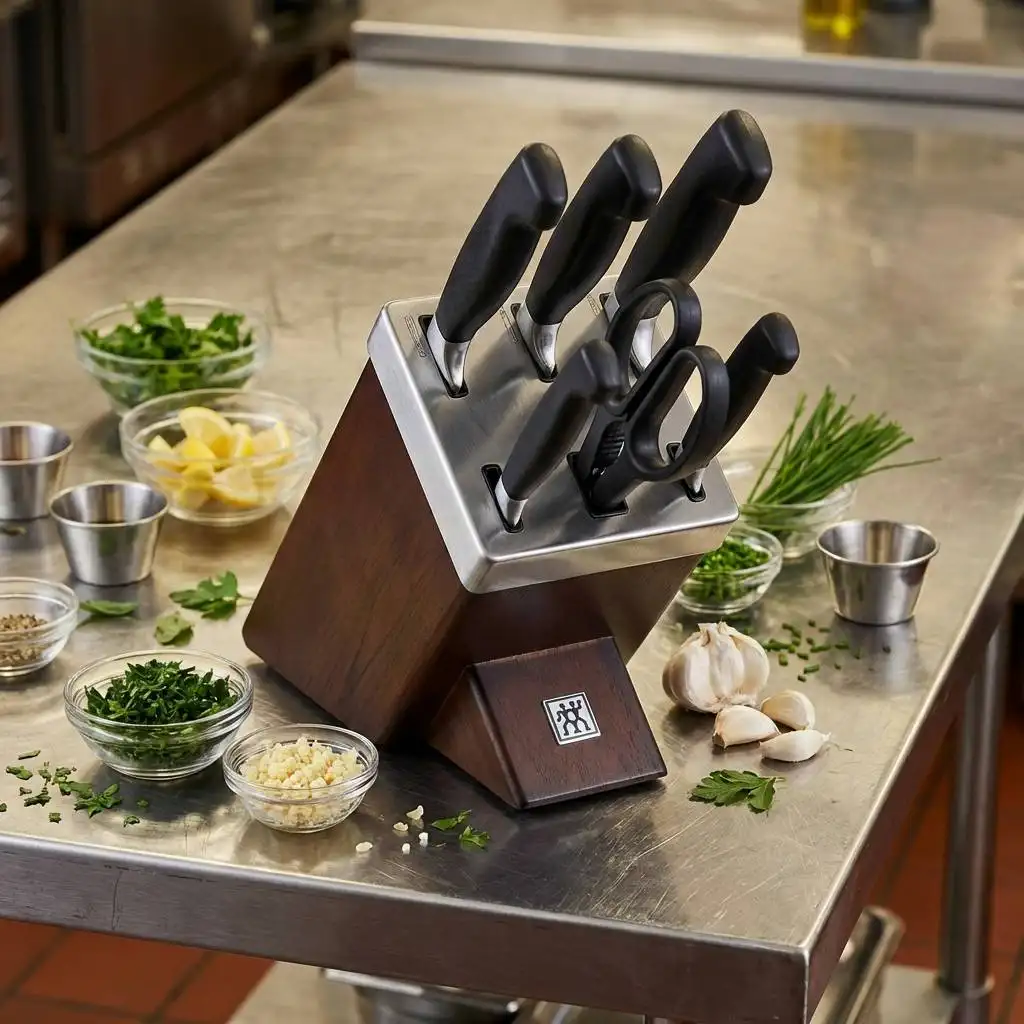
A set is only as good as its weakest tool. Here is the breakdown of what you are actually paying for.
The 8-Inch Chef’s Knife
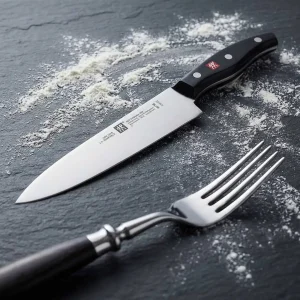
This is the engine. The profile features a dramatic belly, making it ideal for “rock-chopping” herbs and vegetables. If you are a push-cutter (Japanese style), you will hate this profile.
The Bolster Issue: I have to be candid here. The 4 Star features a “full bolster”—that thick band of steel traveling all the way down to the heel of the edge. While it offers a safe resting spot for your finger, it is a nightmare for maintenance. Over years of sharpening, the blade wears down, but the bolster does not. Eventually, the bolster becomes longer than the edge, preventing the heel from touching the cutting board. It creates a “recurve” that leaves your onions attached at the bottom skin. It’s a design flaw that belongs in the 1980s.
The Supporting Blades
- 4″ Paring Knife: A solid performer. The molded handle provides good grip for in-hand work like hulling strawberries or peeling apples. It’s not a laser, but it works.
- 5.5″ Prep Knife (or Serrated Utility): Depending on the specific 7-piece variation, you often get a serrated utility. Most people use this wrong. It’s useless for chopping on a board, but it destroys hard-crusted rolls and tomatoes efficiently.
Bread Knife, Shears, and Steel
The shears in this set are legitimately some of the best in the industry. They separate for cleaning (essential for raw poultry prep) and have a built-in bottle opener. The honing steel is also mandatory. Because this steel is 57 HRC, the edge will roll after 2-3 heavy prep sessions. You must use the steel to realign the burr, or the knife will feel dull instantly.
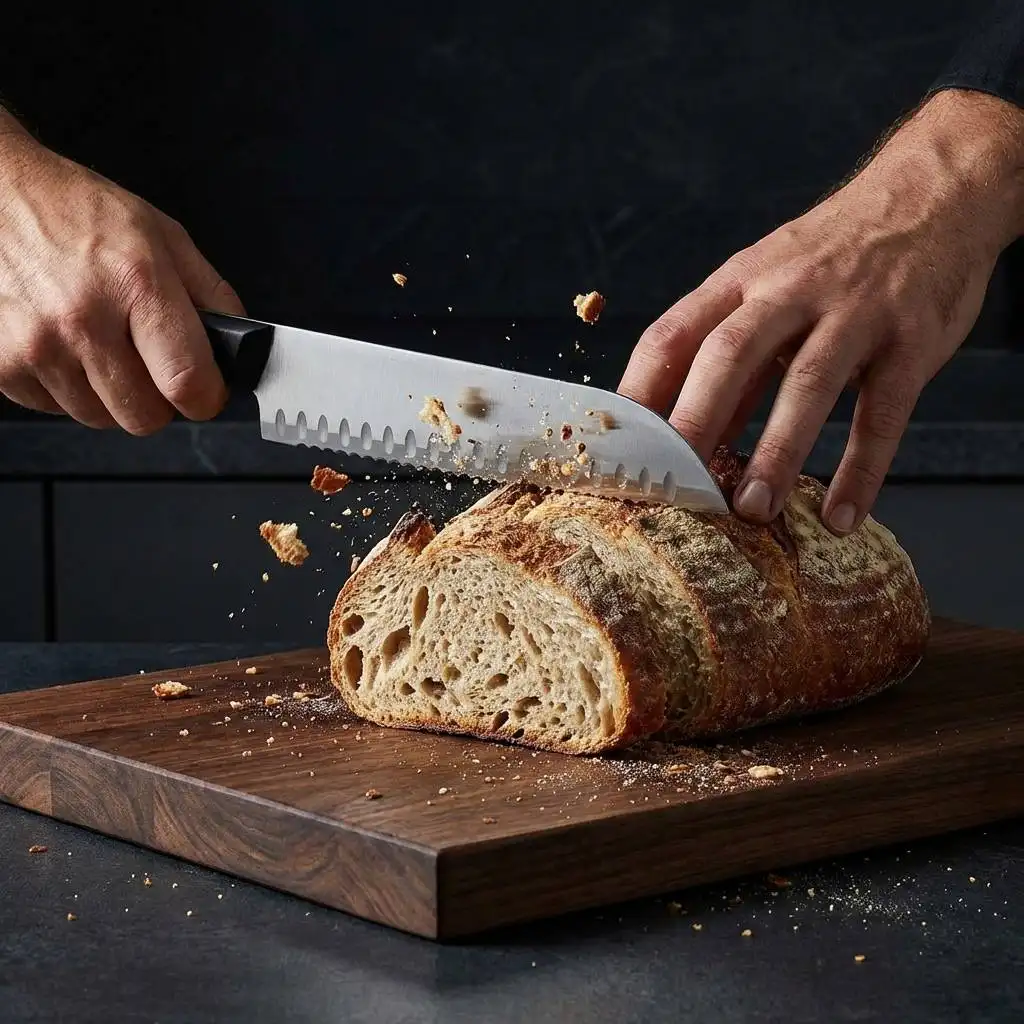
Performance Stress Tests (The Board Test)
I put the 8-inch Chef’s knife through the standard gauntlet to see how the geometry holds up.
The Rough Prep: Chicken Breakdown
This is where the German steel shines. I drove the heel through chicken joints and cartilage. No chipping. The softer steel absorbs the shock. If you tried this with a Shun or a Miyabi, you’d be crying over a chipped blade. The 4 Star is a tank.
The Finesse Test: The Onion
Here, the weakness shows. The spine is thick, and the grind isn’t particularly thin behind the edge. When making horizontal cuts on an onion, the knife tends to “wedge” or crack the onion rather than gliding through. It lacks the surgical feel of a thinner blade.
Edge Retention
Out of the box, it popped hair off my arm. However, after prepping a banquet for 20 (carrots, onions, celery), the edge lost its bite on tomato skins. It required 4-5 swipes on the honing rod to bring it back. You are trading edge retention for durability.
Who Is This Set For? (The Verdict)
Is the Zwilling 4 Star 7-Piece set worth the money? That depends entirely on your cooking style.
Buy this set if:
- You are a “rock-chopper” who keeps the tip on the board.
- You are rough on your tools or have family members who might throw a knife in the sink.
- Hygiene is a top priority (that seamless handle is a big plus).
- You want a “buy it for life” durability without worrying about chipping delicate edges.
Pass on this set if:
- You use a pinch grip exclusively. The full bolster is uncomfortable and gets in the way of sharpening.
- You hate honing your knife. These require maintenance every few uses.
- You want “laser” performance for precision vegetable work.
Price-to-Value: Generally, buying the 7-piece block is significantly cheaper than buying the Chef, Bread, and Paring knives individually. If you will use at least three of the knives, the math works out.