Zwilling J.A. Henckels 4 Star 7-Piece Review: A Line Cook’s Honest Look at a 1976 Classic
Let’s address the “Knife Block Anxiety” right out of the gate. Most home cooks buy a massive 15-piece block because they think they need an arsenal, only to end up with three useless serrated saws and one dull chef’s knife they use for everything from opening packages to smashing garlic. Then there’s the branding confusion: You see “Henckels” on a box for $60 and “Zwilling” on another for $300. Here is the short version: The “One Guy” logo (Henckels International) is stamped steel, made in China or Spain. It’s acceptable for a dorm room.
The set we are looking at today carries the “Two Guys” logo. That means Zwilling. That means Solingen, Germany. That means forged steel.
I’ve spent over 15 years in professional kitchens, from high-volume French brigades to precise Japanese counters. I often call the Zwilling Four Star line the “Toyota Camry of the commercial kitchen.” It is not sexy. It doesn’t have a Damascus pattern that looks like a mesmerizing flowing river. It doesn’t have a handle made of rare burl wood. But I have seen these knives abused by prep cooks for a decade—thrown in sinks, dropped on tile floors, run through dishwashers against orders—and they just keep cutting. The question isn’t whether they are durable; it’s whether that durability is worth the premium price tag for your home kitchen, or if you’re just paying for the German heritage.
The “Four Star” Legacy: Why It hasn’t Changed Since 1976
The Four Star line dropped in 1976. In the culinary world, a design surviving nearly 50 years without a facelift is unheard of. This was the first time Zwilling introduced a seamless transition from the bolster to a synthetic handle. Why does a chef care about that?
Hygiene.
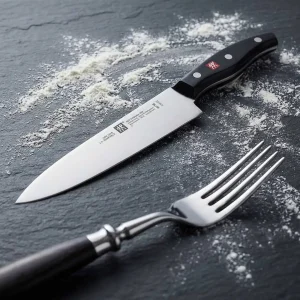
In a frantic kitchen, chicken juice, fish scales, and grease get everywhere. Wooden handles with brass rivets eventually shrink, creating gaps where bacteria setup shop. The Four Star handle is molded directly onto the tang. There are no gaps. It’s sterile. While the design looks undeniably “dated”—it screams late 70s industrial design—it functions perfectly for sanitary standards.
They use a process called SIGMAFORGE. Marketing teams love to make this sound like magic, but effectively, it means the knife is precision-forged from a single piece of steel. This isn’t a stamped blade punched out of a metal sheet like a cookie. It has structural integrity.
The Metallurgy: Decoding “Friodur” and X50CrMoV15
If you ask a department store clerk about the steel, they will say “German Stainless.” That means nothing. The actual alloy is X50CrMoV15. Let’s translate that into English:
- 0.5% Carbon: This is decent, but not high. It creates a hardness of around 57 HRC.
- 15% Chromium: High stain resistance. You can leave a lemon on this blade for an hour and it won’t rust (though please don’t do that).
- Vanadium/Molybdenum: additives for grain structure and strength.
Zwilling treats this steel with their “Friodur” ice-hardening process. They heat the steel, then shock-freeze it to stabilize the molecular structure.
The Chief’s Take on Softness
A hardness of 57 HRC is considered “soft” compared to my Japanese knives, which sit at 61-63 HRC. A Japanese edge is like glass—incredibly sharp, but brittle. If you hit a bone, it chips. The Zwilling Four Star is different. Because it is softer, the steel is tough. If you whack a chicken joint, the edge might roll (bend slightly), but it won’t chip.
The trade-off? Edge retention. This steel loses its screaming sharpness faster than high-carbon steel. You absolutely must use the honing rod included in this set. If you aren’t willing to hone your knife every couple of uses, this steel will feel dull within a month.
The Specs (Data Block)
Here is the breakdown for the primary tool in this set, the 8-inch Chef’s Knife.
| Specification | Data |
|---|---|
| Steel Type | X50CrMoV15 (German High-Carbon Stainless) |
| Rockwell Hardness | 57 ±1 HRC (Friodur Ice-Hardened) |
| Edge Angle | ~15 degrees per side (Laser controlled) |
| Handle Material | Polypropylene (Molded, Seamless) |
| Construction | Forged, Full Tang (Encased), Full Bolster |
| Weight (8″ Knife) | Approx. 230g (Mid-weight) |
The 8-Inch Chef’s Knife: The Workhorse Review
The 8-inch chef’s knife is the reason you buy this set. Everything else is just accessories. The geometry here is distinctly German. It has a significant “belly” (curve) toward the tip. This is designed for rock-chopping—the motion where the tip stays on the board while you lift the handle to mince herbs or garlic. If you are a “push-cutter” (up and down motion) like many who prefer Santokus, this profile might feel clumsy to you.

The Bolster Controversy
Here is where I get critical. The Four Star features a full bolster. This is the thick band of metal where the handle meets the blade, running all the way down to the heel of the cutting edge.
Safety advocates love it because it acts as a finger guard. I hate it.
Why? Because steel wears away as you sharpen it. The bolster does not. Over years of sharpening, the blade edge recedes, but the thick bolster stays the same height. Eventually, the bolster prevents the heel of the blade from touching the cutting board. You end up with an “accordion” cut where your vegetables are still connected by a thread of skin at the bottom. This is the “full bolster headache.” It requires a professional grinder to fix. If you want a knife that is easier to maintain long-term, look at the Zwilling Pro line, which uses a curved half-bolster.
The Supporting Cast: Are the Other 6 Pieces Useful?
Most 7-piece sets are filler. This one is surprisingly disciplined.
- 4″ Paring Knife: This is excellent. The handle is large enough to grip securely, but the blade is nimble. Essential for coring strawberries, peeling apples, or mincing garlic in-hand.
- 5.5″ Prep Knife: Often serrated in these sets (check your specific SKU). If it’s serrated, it’s a bagel and tomato killer. If it’s a fine edge, it’s a glorified pettry knife. It’s useful for quick jobs where you don’t want to dirty the 8-inch chef.
- The Shears: Zwilling makes some of the best kitchen shears on the planet. These aren’t the flimsy scissors you use for paper. These can break down a chicken, snip through lobster shells, and crack nuts. They are a legitimate tool in your mise en place.
- Honing Steel: As mentioned, this is mandatory equipment for X50CrMoV15 steel. It realigns the microscopic “teeth” of the blade.
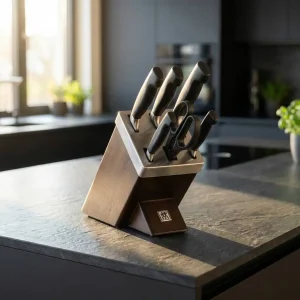
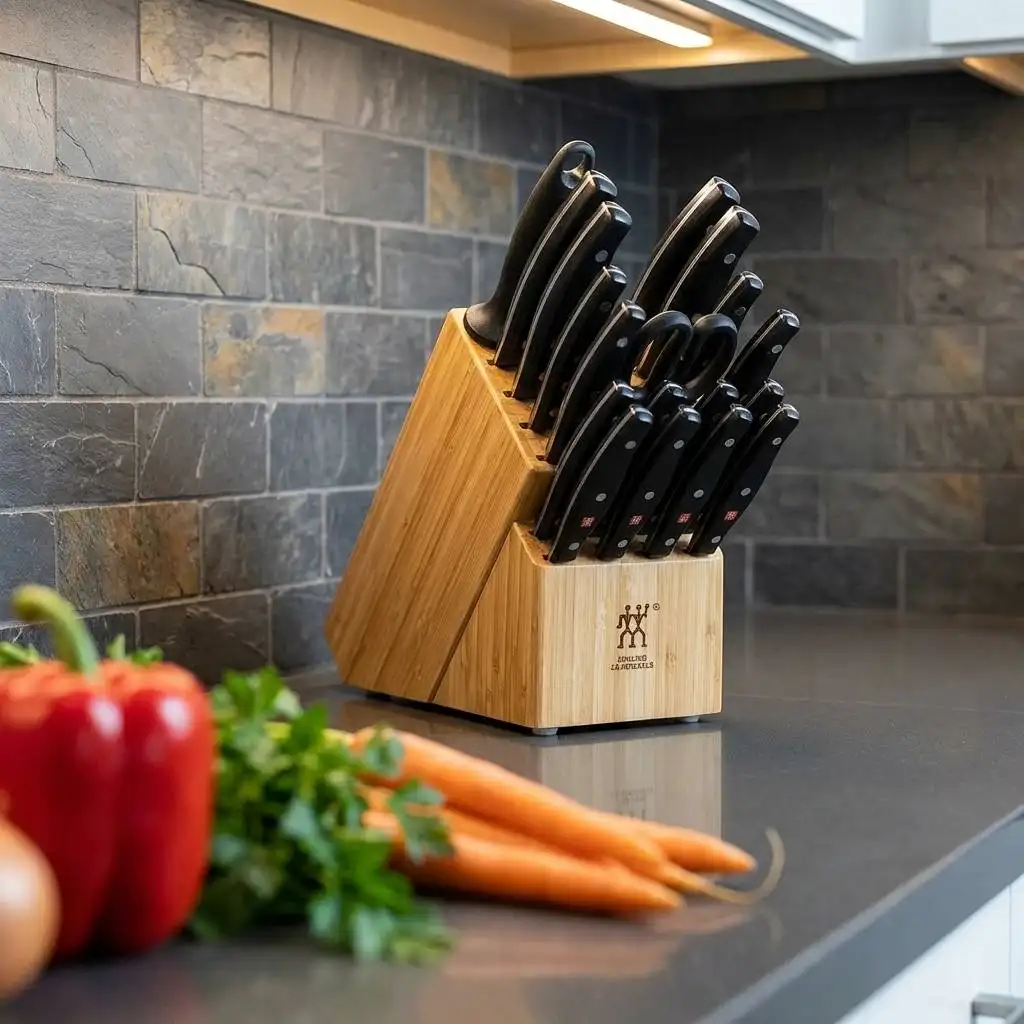
- The Block: It’s solid wood (usually beech or bamboo). It’s functional. Ensure you place it where it doesn’t get wet, as wood absorbs moisture.
Ergonomics: The Feel of the Molded Handle
When you pick up the Four Star, it feels lighter than it looks. The balance point is right at the bolster, which is correct for a pinch grip. However, the handle material is polypropylene. Let’s be real: it feels like plastic because it is plastic.
It lacks the warmth and soul of a wooden handle, and it doesn’t have the “tacky” grip of a rubberized commercial handle. However, the texture is practically indestructible. I have used these with hands covered in duck fat, and the grip remains surprisingly secure. It’s a utilitarian handle designed for a dishwasher environment (though, again, don’t do that).
Performance Tests (The Board Exam)
I ran the 8-inch chef’s knife through my standard gauntlet. Here is how the German steel behaves.
The Onion Test
German knives are generally thicker behind the edge than Japanese knives. When dicing an onion, you will feel a little resistance—a phenomenon we call “wedging.” The knife wants to split the onion rather than glide through it. It’s noticeable, but not a dealbreaker.
The Butternut Squash Test
This is where the Four Star shines. Because the steel is softer and the spine is thicker, you can power through a dense squash or sweet potato without fear. I would never take my $400 Takamura to a squash for fear of chipping the edge. The Zwilling Four Star acts like a tank here.
The Chicken Test
Breaking down a whole bird involves hitting cartilage and occasionally grazing bone. The Friodur steel absorbs this impact brilliantly. It’s a forgiving steel. If you have bad technique, this knife forgives you. A harder knife would punish you with a chipped edge.
The Verdict: Who Should Buy the Four Star 7-Piece Set?
People rave about “German Engineering,” but the full bolster on the Four Star line is a design flaw that should have been retired in the 90s. It makes sharpening the heel impossible without a grinder. If you want perfection, buy the Zwilling Pro; if you want nostalgia and durability, buy this.
Pros
- Indestructible: You will likely pass these down to your kids.
- Hygienic: Seamless handle design prevents bacteria buildup.
- Forgiving Steel: Won’t chip easily; great for heavy-duty prep.
- Shears: The included scissors are top-tier.
Cons
- The Full Bolster: A pain to sharpen long-term.
- Edge Retention: Requires frequent honing compared to Japanese steel.
- Aesthetics: Looks a bit like a cafeteria tool.
Price-to-Performance Ratio: If you catch this set on sale (often around the holidays), it is a high-value purchase. At full MSRP, it faces stiff competition from modern competitors.
Final Recommendation: This set is perfect for the home cook who wants a “buy it for life” tool set, doesn’t want to baby high-carbon steel, and understands that a knife needs to be honed to stay sharp. It’s a solid, reliable workhorse that will get dinner on the table for decades.
FAQ: Common Questions About Zwilling Four Star
- What is the difference between Zwilling Pro and Four Star?
- The main difference is the bolster design. The Four Star has a “full bolster” which runs to the heel of the blade, making sharpening difficult. The Zwilling Pro features a curved “half-bolster” which allows for easier sharpening and a more comfortable pinch grip. The Pro is the more modern design, and honestly, the better knife.
- Can you put Zwilling Four Star knives in the dishwasher?
- Technically, Zwilling marketing says yes. They are dishwasher safe because of the synthetic handle and stainless steel. However, as a professional, I say absolutely not unless you hate your knives. The detergent is abrasive and will dull the edge, the knives will bang against other cutlery causing nicks, and the high heat can damage the handle integrity over time. Hand wash only.
- Are these knives forged or stamped?
- These are forged using their SIGMAFORGE process. This means they are made from a single piece of steel, offering better balance and durability compared to stamped knives (like the cheaper Henckels International lines).