Zwilling Four Star II 7-Piece Review: A Chef’s Unfiltered Take on the “Upgrade”
Let’s address the elephant in the kitchen immediately: Why does the Four Star II cost more than the classic Four Star I used in culinary school back in the day? We are looking at a price hike for what essentially amounts to a stainless steel end-cap. Is this a functional counterweight that improves agility, or is it just jewelry for your knife block?
I’ve spent thousands of hours gripping the original Four Star handles in high-volume banquet halls. I respect the lineage. That molded handle is legendary for a reason—it doesn’t blister your hand during a four-hour prep session. But I’m naturally skeptical of “sequels” that claim to improve on a 40-year classic just by adding weight. I’m not here to read the marketing brochure; I’m here to check the grind, the balance point, and the steel grain. Let’s see if the “II” deserves a spot in your mise en place or if you should stick to the original.
The Genealogy: Why “Four Star II” Exists
To understand this set, you have to understand the original. The Zwilling Four Star was revolutionary because of its seamless, molded polypropylene handle. No rivets to collect bacteria, no gaps for chicken juice to seep into. It was, and is, a sanitary workhorse.
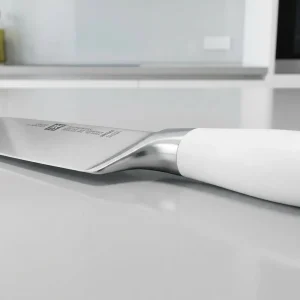
The Four Star II is exactly the same knife—same SIGMAFORGE process, same Friodur ice-hardened blade—except for one thing: the logo-stamped stainless steel cap on the butt of the handle. Zwilling marketing claims this provides “better balance.” In the industry, we call this a facelift. While the aesthetic is admittedly sharper and less “institutional” than the all-black plastic of the original, the core question remains: does that extra metal change how the knife moves, or just how it looks on the counter?

The Specs: Drilling Down on the Steel (X50CrMoV15)
If you’re looking for exotic powder steels like SG2 or ZDP-189, you are in the wrong place. This is standard German formula: X50CrMoV15.
- Carbon (0.5%): Enough for hardness, but not enough for extreme edge retention.
- Chromium (15%): High stain resistance. You can leave this wet on the board for ten minutes without it rusting (though please don’t).
- Hardness (57 HRC): This is the polarizing part.
At 57 HRC, this steel is significantly softer than the Japanese blades I usually obsess over (which run 60-64 HRC). However, soft doesn’t mean bad. It means tough. Zwilling uses their “Friodur” process—a cryogenic treatment where they freeze the blade to align the grain structure. It’s not magic, but it works. It creates a blade that acts like a tank. It will roll its edge rather than chip. If you accidentally hit a bone while breaking down a chicken, a Shun might chip; the Four Star II will just suffer a minor dent you can fix on a steel.
Ergonomics & The Balance Point Shift
This is where the “II” designation actually matters. The stainless steel cap adds mass to the rear of the knife. On the 8-inch Chef’s knife, this shifts the center of gravity slightly back toward the handle.
When you use a professional pinch grip (thumb and index finger on the blade spine), the handle weight acts as a counter-balance. I found that this makes the tip feel slightly lighter and more nimble than the original Four Star, which was arguably a bit blade-heavy. The handle texture is still that same polypropylene—it’s ugly, let’s be honest—but functionally, it’s brilliant. When your hands are covered in grease or animal fat during a breakdown, this material grips. It doesn’t get slick like polished Micarta or stabilized wood.
The Grind and Geometry: Does It Wedge?
The grind is Zwilling’s “Special Formula,” usually honed to about 15 degrees per side. Out of the box, it will shave hair off your arm. But we need to talk about the geometry behind the edge.
German knives are thick. The spine thickness at the heel gives the knife authority, but it also leads to “wedging.” If you cut a tall, dense vegetable like a sweet potato, the thickness of the blade can crack the vegetable open before the edge finishes the cut. It’s not a laser.
The Bolster Problem
Here is my biggest gripe, and I will die on this hill: The Full Bolster.
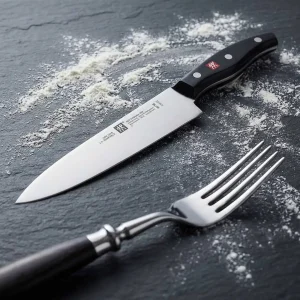
The Four Star II features a thick finger guard that runs all the way down to the heel of the edge. Marketing calls it a “safety feature.” I call it a planned obsolescence feature. Because steel is thick at the heel, you cannot sharpen the entire length of the blade on a whetstone. Over time, as you sharpen the rest of the edge, the blade recedes, but the bolster stays the same height. Eventually, you create a “recurve” where the edge doesn’t even touch the cutting board anymore. It is a dated design choice that makes long-term maintenance a nightmare unless you own a belt grinder.
The Board Test: Performance Breakdown
I put the primary 8-inch chef’s knife through the standard gauntlet.
The Tomato Test (Horizontal Slicing)
The factory edge is polished well. It bites into tomato skin immediately without sliding. The “Friodur” treatment allows for a decent initial edge, though because of the lower carbide count, that biting aggression fades after a few heavy prep sessions.
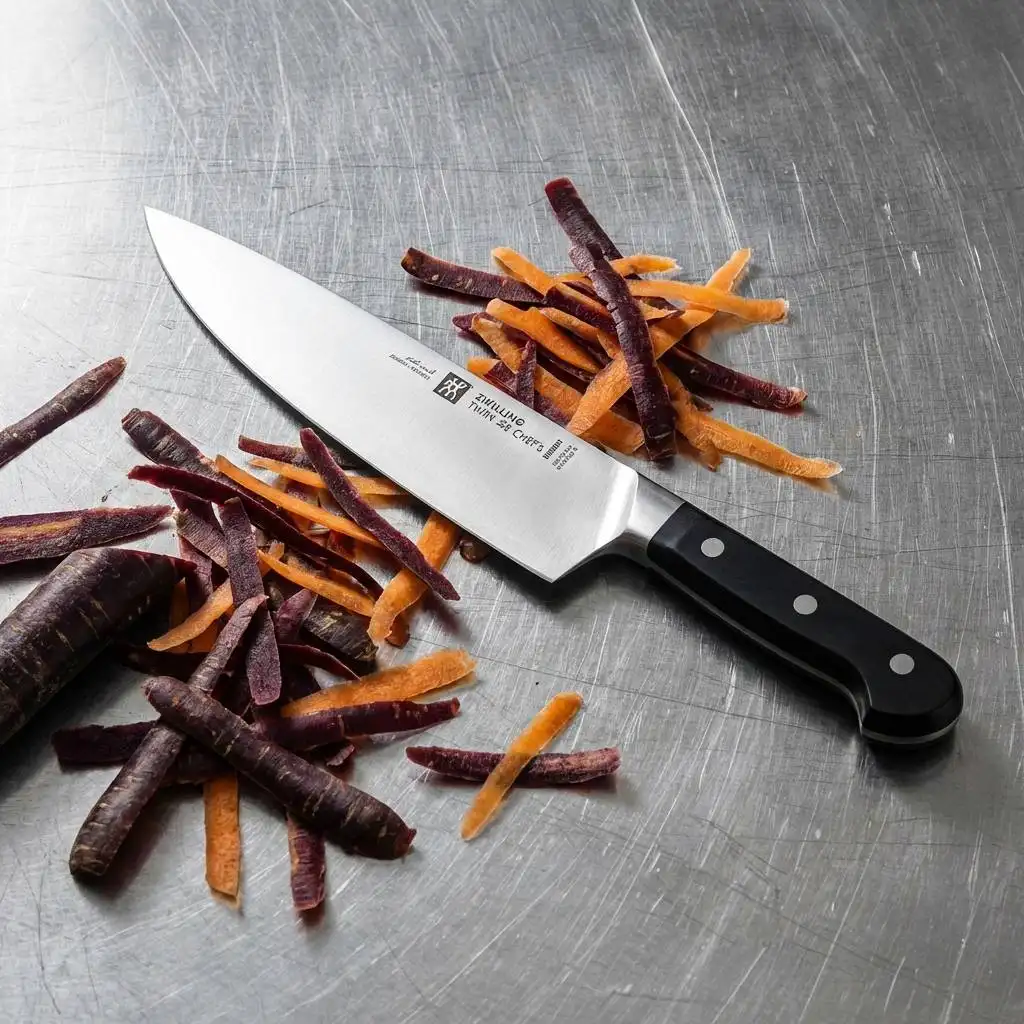
The Carrot Test (Vertical Chopping)
As expected, there is resistance. You can feel the geometry pushing the carrot apart. It doesn’t glide; it splits. If you want transparently thin slices of radish, you’ll have to fight the knife a bit. This is a splitter, not a slicer.
The Protein Test
This is where the German steel shines. Breaking down a whole chicken feels great. You can pop joints and slice through cartilage without wincing. The knife feels solid, heavy, and practically indestructible. It has the mass to go through silver skin and sinew without deflection.
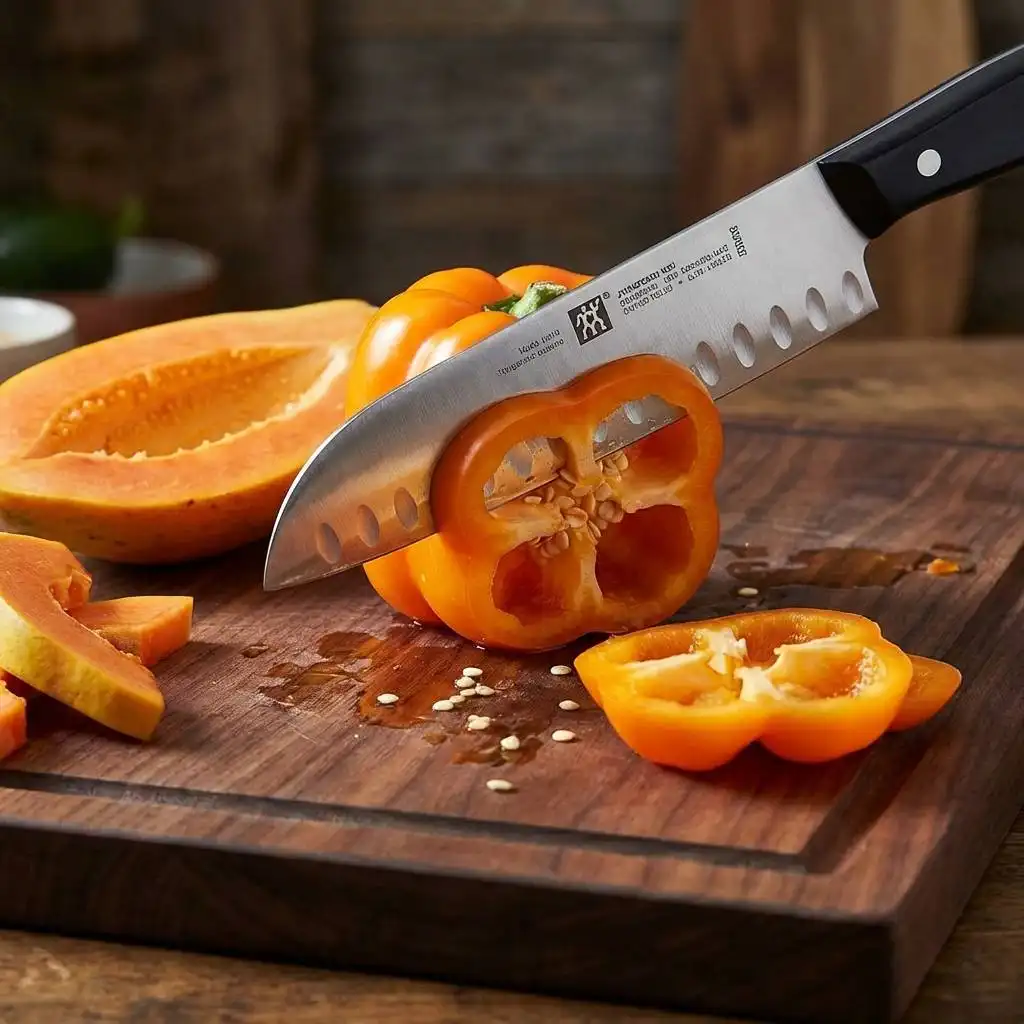
Analyzing the 7-Piece Loadout: Filler vs. Killer
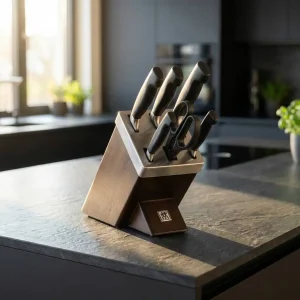
Most sets are filled with fluff to get the piece count up. Here is the breakdown of the Four Star II 7-Piece configuration:
- 8″ Chef’s Knife: The MVP. Solid, heavy, reliable.
- 5″ Serrated Utility: The “Sandwich Knife.” It cuts tomatoes and hard-crusted rolls well. It’s useful, even if it’s not a “chef” grade tool.
- 3″ Paring Knife: Standard. Good for coring strawberries or peeling garlic. The handle is a bit bulky for such a small blade, but it works.
- Kitchen Shears: Zwilling usually includes solid shears. If they are the take-apart kind, they are excellent for sanitation. If they are fixed, they are trash. Check the specific SKU, as this varies by retailer.
- 9″ Sharpening Steel: Crucial. Because this steel is 57 HRC, the edge rolls easily. You will need to use this rod every 2-3 times you cook to realign the microscopic teeth of the edge.
- The Block: It holds knives. It looks decent. Not much else to say.
Maintenance: The Reality of Ownership
Sharpening X50CrMoV15 on whetstones can be frustrating if you are used to Japanese steel. It tends to form a “gummy” burr that flops back and forth and is hard to deburr cleanly. You have to be light with your finishing strokes.
A Warning: Do not put these in the dishwasher. I don’t care what the box says. The high heat and harsh detergents will eventually cause the polymer handle to degrade and separate from the steel cap. If you respect your tools, wash them by hand.
The Verdict: Is the “II” Better than the Original?
The Zwilling Four Star II is a tank in a tuxedo. It offers the legendary durability of the original Four Star with improved balance thanks to the end cap. If you have large hands or prefer a knife with some “heft” in the rear, the II is a legitimate upgrade.
However, the full bolster prevents this from being a true enthusiast’s knife. It limits the lifespan of the geometry. This set is perfect for a home cook who wants a “buy it for life” durability and doesn’t want to baby their tools. It is a workhorse, a beater, and a reliable partner. But if you are looking for laser precision, look elsewhere.
Price-to-Performance Ratio: B+
Solid, reliable, but slightly overpriced for the steel type unless you catch it on sale.