Review: Is the Zwilling Four Star Starter Set Still the King of Commercial Kitchens or Just a Relic?
Let’s be real for a second. You’re staring at a $150–$200 price tag for three knives, wondering if you’re paying for German engineering or just a logo that was famous twenty years ago. It’s a fair question. Marketing teams love to throw around terms like “precision-forged” and “Friodur ice-hardened” until your eyes glaze over. But as someone who has spent over 15 years on the line, listening to the ticket machine print non-stop during a Friday night dinner rush, I don’t care about the buzzwords. I care about whether the tool works.
I remember my first day in a high-volume French brigade. Half the line cooks were wielding these exact knives—the Zwilling Four Star series. They looked beat up, the logos were faded, but they were still cutting. I don’t look at these knives with nostalgia; I look at them with the critical eye of a steel nerd who knows exactly how X50CrMoV15 steel behaves after 500 covers. Is this set a “buy it for life” investment, or are you just buying a headache that feels like a crowbar in your hand?
The Context: Why This Set Exists
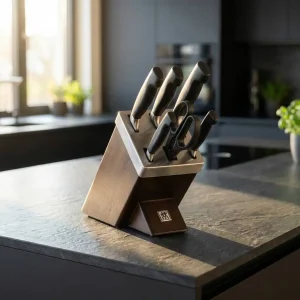
The “Starter Set” is the holy trinity of kitchen prep: usually an 8″ Chef’s Knife, a 5″ Serrated Utility, and a 4″ Paring Knife. If you can’t cook a five-course meal with these three tools, more knives won’t help you.
The Four Star line hasn’t changed its design since 1976. In the culinary world, that is ancient. Professionals have tolerated it for decades for one reason: durability. These aren’t your delicate Japanese lasers that chip if you look at them wrong. These are tanks. This is the set you pull out when you need to break down a chicken and you don’t want to risk chipping the edge of your $400 Aogami Super Gyuto. It’s the “beater” set—reliable, tough, but frankly, a bit boring.
The Specs: Breaking Down the Metallurgy
Let’s cut through the “surgical steel” nonsense. Here is the data block on what you are actually holding.
- Steel Type: X50CrMoV15 (German High Carbon Stainless)
- Hardness: 57 ±1 HRC
- Handle Material: Polypropylene (molded)
- Construction: Precision Forged
The steel is the standard German formula: X50CrMoV15. In plain English, this means it is highly stain-resistant and very tough, but relatively soft compared to modern super steels. Zwilling uses their “Friodur” process, which is a fancy name for cryogenic tempering (ice hardening). They freeze the blade to align the grain structure, which squeezes a bit more potential out of the steel.
However, the hardness is only 57 HRC. To put that in perspective, a decent Japanese VG10 blade sits around 60–61 HRC. Why does this matter? Lower HRC means the steel is softer. It won’t hold a razor edge for weeks if you’re doing heavy prep. Instead of chipping, the edge will “roll” over. This is great for beginners because you won’t destroy the knife, but for a pro, it means you are honing that edge constantly.

The Ergonomics: The “Seamless” Polypropylene Debate
The handle is where the age of this design really shows. It features a molded polypropylene handle that is seamless. From a health inspector’s perspective (HACCP), this is gold. There are no gaps for chicken juice or bacteria to hide in. It’s sanitary and practically indestructible.
But how does it feel? In a pinch grip, the balance point is decent, usually right at the bolster. However, the handle material feels… plasticky. It lacks the warmth of wood or the grippy texture of a Micarta composite. It gets slick if your hands are greasy. Furthermore, the distal taper (how the blade thins out from the handle to the tip) is adequate but not impressive. The spine stays relatively thick for most of the length, which adds weight but kills the feeling of agility.
The “Full Bolster” Problem (My Personal Rant)
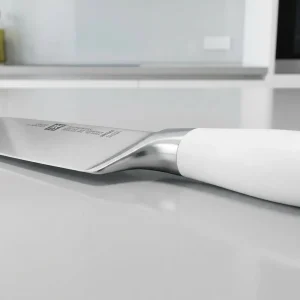
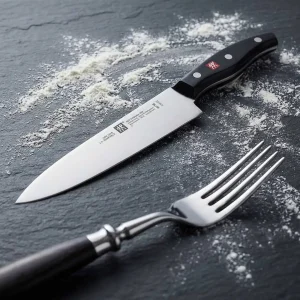
We need to talk about the bolster. This is the thick metal finger guard that runs from the handle down to the heel of the blade. The Four Star features a “full bolster.”
I honestly hate the full bolster on this series. It’s a design flaw masquerading as a safety feature. Sure, it stops your finger from slipping onto the edge, but it creates a massive maintenance nightmare.
Here is the physics of the problem: As you sharpen a knife over the years, you remove metal from the edge, causing the blade to recede slightly. However, the thick steel bolster does not get ground down on a whetstone. Eventually, the bolster becomes longer than the blade edge. This creates a “dead heel.” When you try to chop, the bolster hits the cutting board before the sharp edge does, leaving your green onions held together by a thread of uncut fiber—the dreaded “accordion cut.”
To fix this, you have to grind down the bolster itself, which is a miserable task. It forces you to maintain the knife in a way that fights against the geometry of the tool.
Performance: The Board Test
I took these knives through a standard prep list to see how they perform beyond the specs.
The 8″ Chef’s Knife
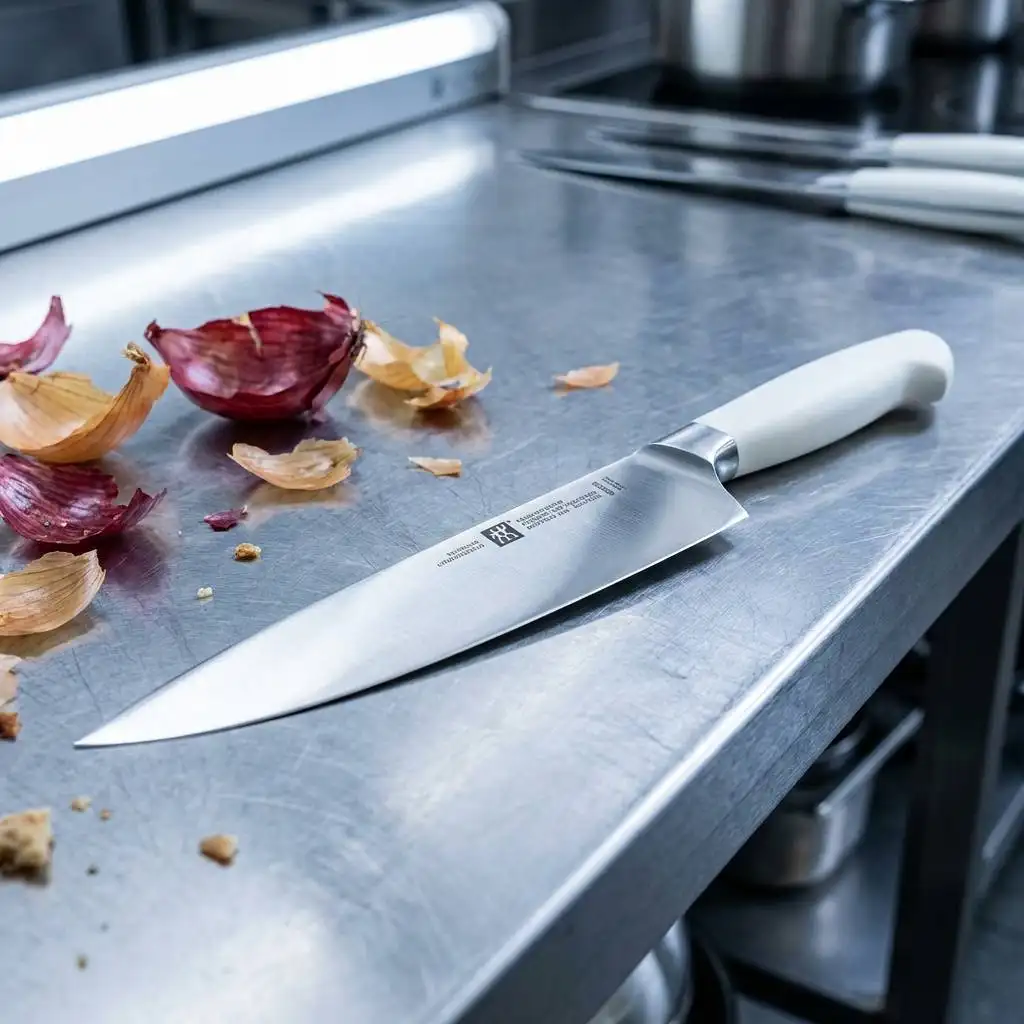
The Carrot Test: I pushed the blade through large, dense carrots. Because of the thicker spine and the wedge-like geometry, I felt significant resistance. It didn’t “glide” through; it “wedged,” cracking the carrot open near the bottom of the cut rather than slicing it clean.
The Rock Chop: This is where the knife shines. The belly has a dramatic curve, making it excellent for rock-chopping herbs or garlic. It has a rhythmic, rolling motion that feels natural.
The 5″ Serrated Utility
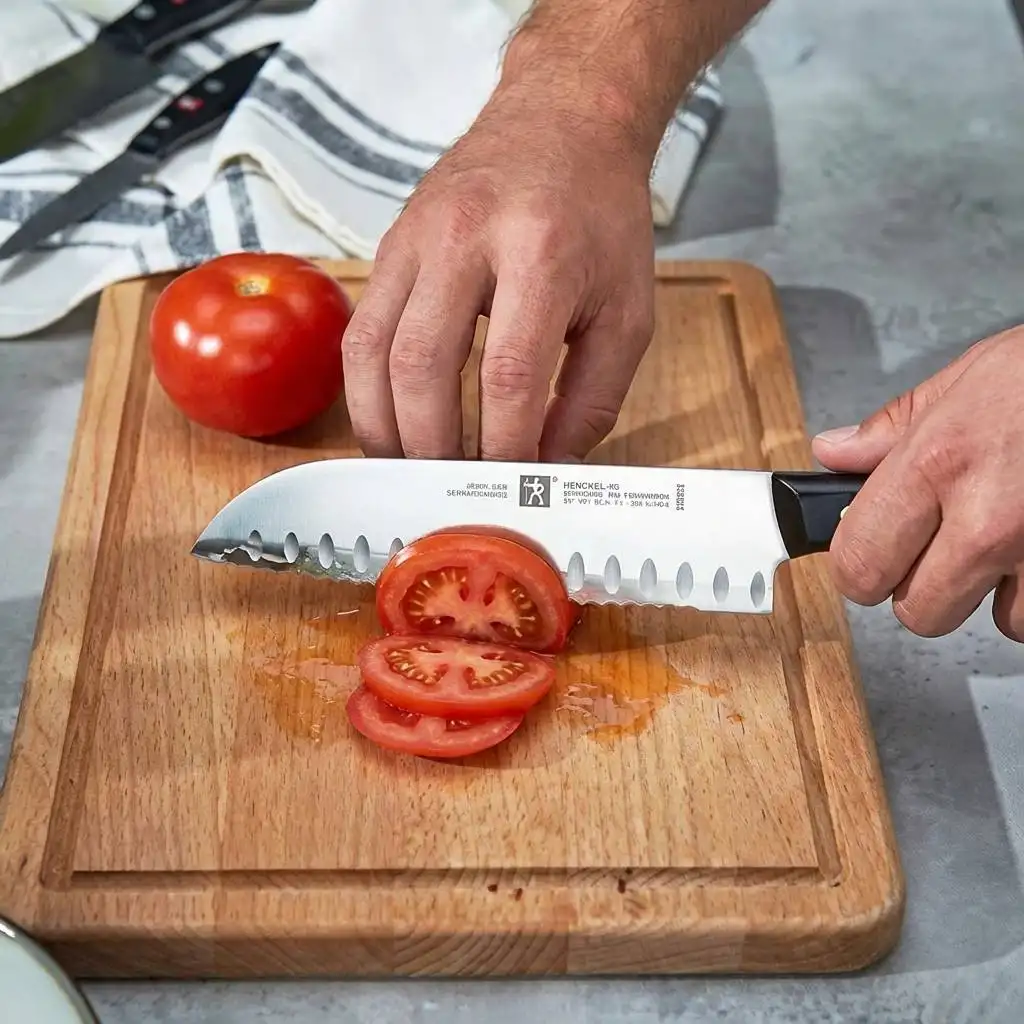
The Tomato & Baguette: This is arguably the most useful knife in the set for the average home cook. The serrations are aggressive. It bites through the tough skin of a tomato without crushing the pulp. On a crusty baguette, it saws cleanly without tearing the soft interior. It’s a workhorse.
The 4″ Paring Knife
In-Hand Work: Peeling an apple or coring strawberries. The handle feels a bit bulky for such a small blade, limiting dexterity. However, the tip is robust, so you don’t have to worry about snapping it off if you pry at a stubborn potato eye.
Edge Retention & Maintenance Reality
Out of the box, these knives are ground to roughly 15 degrees per side. They are sharp enough to shave hair on your arm. But don’t get used to it.
Because the steel is 57 HRC, that razor edge will roll after a few heavy prep sessions. You are not going to get the six-month edge retention you might see on a Powdered Metallurgy steel. To keep these cutting well, you must own a honing rod (steel or ceramic) and you must use it. Every time you pull this knife out of the block, give it four swipes on each side. If you aren’t willing to do that, this knife will be dull in two weeks.
Pros & Cons (The No-Nonsense List)
| Pros | Cons |
|---|---|
| Indestructible: You can drop these, abuse them, and throw them in a drawer. They won’t chip. | The Full Bolster: A nightmare for whetstone sharpening. It eventually prevents the heel from contacting the board. |
| Hygiene: Seamless handle transition means no gunk buildup. | Soft Steel: Requires constant honing to maintain performance. Edge retention is mediocre. |
| Warranty: Zwilling stands behind their product. | Dated Ergonomics: The handle feels cheap compared to modern G10 or Pakkawood options. |
| Forgiving: The steel rolls rather than chips, saving you from catastrophic blade failure. | Price: Often overpriced unless you find it on sale. |
Verdict: Who Should Actually Buy This?
After putting the Zwilling Four Star Starter Set through the wringer, the conclusion is mixed.
Buy this set if: You are a home cook who wants a “buy it for life” durability without having to baby your tools. If you are the type of person who throws knives in the sink or might accidentally cut into a bone, this steel will forgive you. It’s a solid, reliable workhorse for the average kitchen.
Hard Pass if: You are a knife enthusiast who enjoys sharpening on whetstones. That full bolster will drive you insane. Also, pass if you want the tactile sensation of a “laser” cut—this knife wedges in hard produce. If you want a Zwilling but hate the bolster, look at the Zwilling Pro line instead. It features a curved half-bolster that solves the sharpening issue entirely.
Price-to-Performance: Is it worth $150+? Only if you catch it on sale. At full retail, you are paying a premium for a 40-year-old design.
FAQ: Questions From the Line
Can I put Zwilling Four Star knives in the dishwasher?
Technically, Zwilling says yes. But if you do, you’re an idiot who hates sharp edges. The dishwasher detergent is abrasive and will blast the edge dull in a few cycles. Plus, the clanking around will ding the blade. Wash them by hand, dry them immediately.
What is the difference between Zwilling Four Star and Zwilling Pro?
The steel is exactly the same. The difference is geometry. The “Pro” line has a curved half-bolster. This allows you to pinch the blade comfortably and, more importantly, sharpen the entire length of the edge. The Four Star has the old-school full bolster. Spend the extra money for the Pro if you care about sharpening.
How often do I need to sharpen them?
Because the steel is soft (57 HRC), it loses its bite quickly. You need to hone it on a steel rod before every heavy prep session. If you do that, you’ll only need to actually sharpen (remove metal) every 6 to 12 months depending on volume.