J.A. Henckels vs. Chicago Cutlery: A Chef’s Brutally Honest Steel Comparison
The Hook: Analysis Paralysis in the Cutlery Aisle
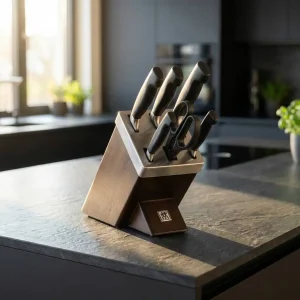
There is a specific kind of headache reserved for home cooks standing in the cutlery aisle of a big-box store—or worse, doom-scrolling through Amazon at 11 PM. You are staring at two knife blocks. One is a J.A. Henckels set, priced just high enough to make you hesitate. The other is a Chicago Cutlery set that looks almost identical, claims to be “Professional Grade,” and costs half as much.
You’re flying blind. You see terms like “High Carbon,” “Surgical Steel,” and “Precision Taper” thrown around like confetti. You’re afraid of being the sucker who overpays for a logo, but you’re equally terrified of buying a budget set that turns into a rusting, dull pile of useless metal within six months.
I’ve been there. I remember my first year as a commis chef. I was broke, arrogant, and trying to prep 50 pounds of onions with a “house knife”—a cheap, stamped blade that had the geometry of a crowbar. My hand cramped, the blade wedged in the onions instead of slicing them, and by the end of the shift, I had blisters on my pinch-grip finger from the sharp, unfinished spine. The moment I finally saved up enough for my first proper forged German blade, the difference wasn’t just “nice.” It was physical relief.
I’m not a brand snob. I’ve used $10 knives that cut like lasers and $300 knives that were absolute garbage. But I am a performance snob. Today, we are going to cut through the marketing fluff and look at the metallurgy, the grind, and the brutal reality of Henckels vs. Chicago Cutlery.
The “Identity Crisis”: Clarifying What We Are Actually Comparing
Before we put these knives on the chopping block, we have to address the elephant in the room. Most people don’t realize they are looking at completely different tiers of manufacturing when they see the name “Henckels.”
The Two Faces of Henckels
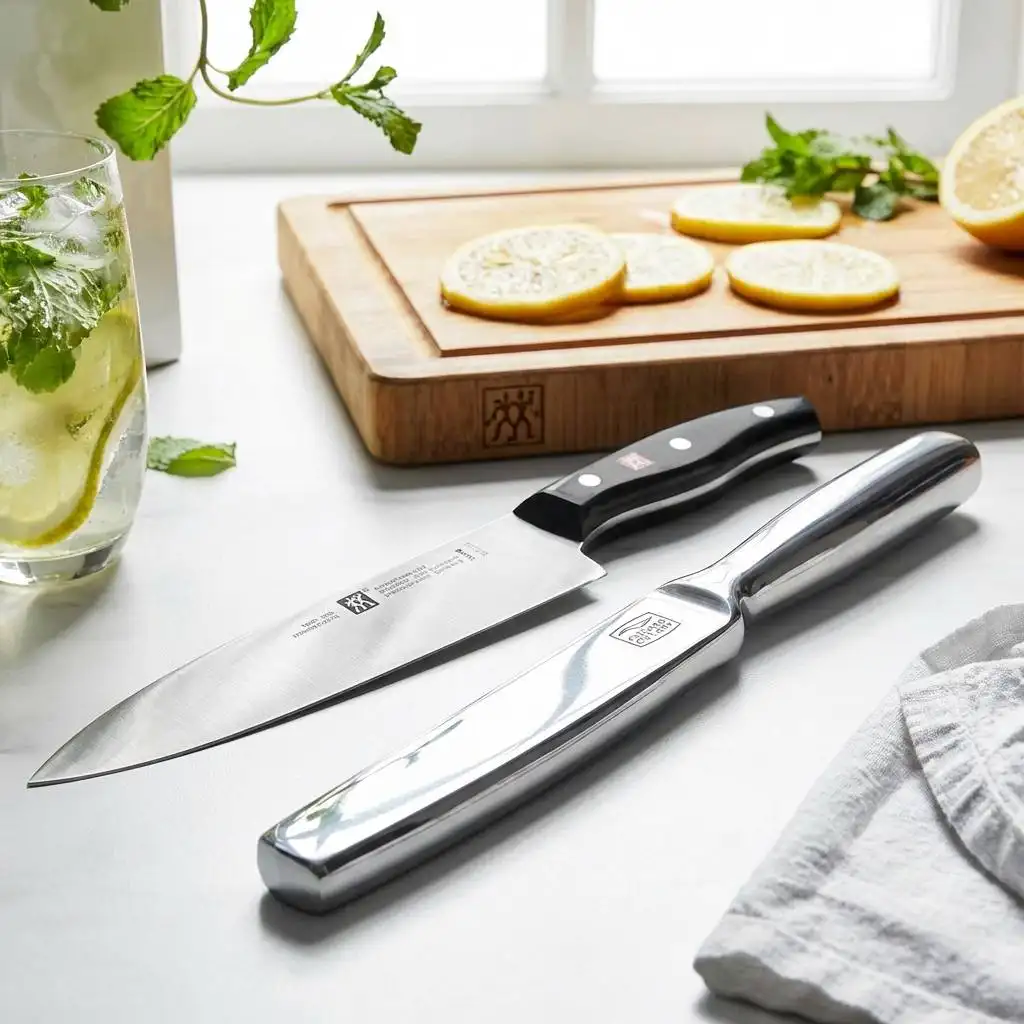
You have Zwilling J.A. Henckels, represented by the “Twins” logo. These are premium, forged knives made in Germany or Japan. Then you have Henckels International, represented by the “Single Guy” with a halberd logo. These are generally stamped knives made in China, Spain, or Thailand to hit a lower price point.
The Fair Fight
If we compare a $150 Chicago Cutlery set to a $700 Zwilling Pro set, it’s not a comparison; it’s a slaughter. That’s unfair to the Chicago brand.
For this article, we are focusing on the battle you are likely researching: Henckels International (specifically lines like Definition, Statement, or Classic) vs. Chicago Cutlery (specifically lines like Insignia or Walnut Tradition). This is the battle for the sub-$200 block set. This is where price usually reflects manufacturing tolerances and Quality Control (QC).
The Metallurgy: Hardness, Grain, and “Mystery Metal”
As a steel nerd, this is where I get frustrated with marketing. If a brand tells you their knife is made of “Surgical Stainless Steel,” they are treating you like an idiot. Surgical steel basically means “soft metal that won’t rust, but won’t hold an edge.” I’d rather have a rusting carbon blade that cuts than a shiny stainless bar that mashes my tomatoes.
Henckels Steel Analysis: The German Standard
Even in their International lines, Henckels typically utilizes X50CrMoV15 steel. Let’s break down that alphabet soup because it actually matters:
- 0.5% Carbon: This is the bare minimum for “high carbon.” It provides decent edge retention without being brittle.
- 15% Chromium: This is high. It makes the knife incredibly stain-resistant. You can leave a lemon on this blade for an hour, and it likely won’t pit.
- Vanadium/Molybdenum: These trace elements refine the grain structure, making the steel tougher.
The Rockwell Hardness (HRC) usually sits around 55-57 HRC. It’s not Japanese hard (60+), but it’s tough enough to hit a bone without chipping.
Chicago Cutlery Analysis: The “Mystery” Alloy
Chicago Cutlery rarely discloses their exact steel composition, usually labeling it generic “High Carbon Stainless Steel.” In the industry, this often points to 420HC or similar budget alloys. While 420HC is tough and resists rust beautifully, it lacks the carbide volume to hold a screaming edge for long.
The hard truth is that the HRC on these knives often dips below 55. When steel is this soft, it behaves differently on a whetstone. It feels “gummy.” Instead of abrasion removing metal cleanly, the steel just smears. You form a “wire edge”—a microscopic foil of metal that feels sharp to the touch but folds over the second it hits a cutting board.
Construction & Grind: Do They Wedge or Glide?
Geometry cuts. Steel just determines how long it cuts for. You can have the best steel in the world, but if the grind is thick, the knife will perform like a doorstop.
Stamped vs. Forged
Most Chicago Cutlery knives and the budget Henckels (Statement/Definition) are stamped. Imagine a cookie cutter punching a blade shape out of a large sheet of steel. It is cost-effective but usually results in a lighter blade without a bolster.
However, the Henckels Classic line offers a forged bolster (that thick band of metal where the handle meets the blade). This adds weight and protects your fingers. Chicago Cutlery attempts this with their Insignia line, but the “bolster” is often just a cast piece of metal welded on, not an integral part of the forging process.
Distal Taper Analysis
This is where the pros separate the tools from the toys. Distal taper refers to the blade getting thinner as you move from the handle to the tip. A good distal taper allows you to do fine work—like dicing a shallot—with the tip, while using the heel for heavy chopping.
Henckels usually features a consistent, gradual taper. Chicago Cutlery blades often remain uniform in thickness until the very end. They act more like a wedge. When you try to cut a hard vegetable, the thickness of the spine cracks the produce open before the edge actually slices it.

The Grind Geometry
Chicago Cutlery frequently employs what I call an “axe grind.” The angle is obtuse (wider), likely over 20 degrees per side. Why? Because soft steel rolls easily. By keeping the edge thick, they prevent the customer from damaging it, but they sacrifice cutting performance. Henckels generally grinds to a steeper 15 degrees per side, relying on the slightly harder X50 steel to support that finer edge.
Ergonomics & The “Pinch Grip” Test
You don’t hold a knife like a tennis racket. You use a pinch grip—thumb and index finger pinching the blade itself. This is why handle ergonomics are secondary to the *bolster* and *spine* comfort.
The Handle Material
Chicago Cutlery (Walnut Tradition): I get it. The wood looks nostalgic. It looks like Grandma’s kitchen. But unless you are oiling those handles with mineral oil once a month (and let’s be real, you aren’t), that wood will shrink. I’ve seen countless Chicago knives where the wood scales have pulled away from the metal tang, creating a gap that fills with chicken juice and bacteria. It’s gross.
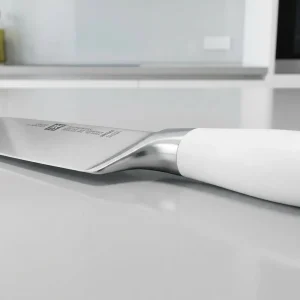
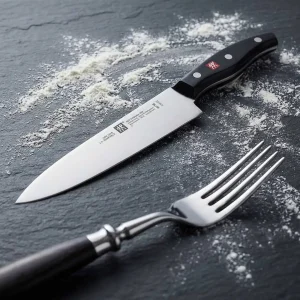
Henckels (POM/Polypropylene): They use synthetic black handles. Are they sexy? No. Are they sterile, durable, and impervious to shrinking? Yes. The triple-rivet design on the Henckels Classic or Statement is iconic because it works.
Balance and The “Corner” Issue
A huge pet peeve of mine with budget stamped knives (common in Chicago Cutlery sets) is the spine finish. The manufacturers punch the blade out and don’t bother to round off the 90-degree angles on the spine. After twenty minutes of prep, those sharp corners dig into your index finger. Henckels usually—though not always on the cheapest lines—tumbles their blades to soften these edges slightly.
Balance is another factor. Chicago Cutlery knives, especially the ones with heavy synthetic handles, tend to be handle-heavy. This makes the tip feel floaty and hard to control. Henckels aims for a balance point right at the bolster, giving you more control over the tip.
The Board Test: Performance in the Kitchen
Let’s stop looking at specs and start cutting.
The Tomato Test
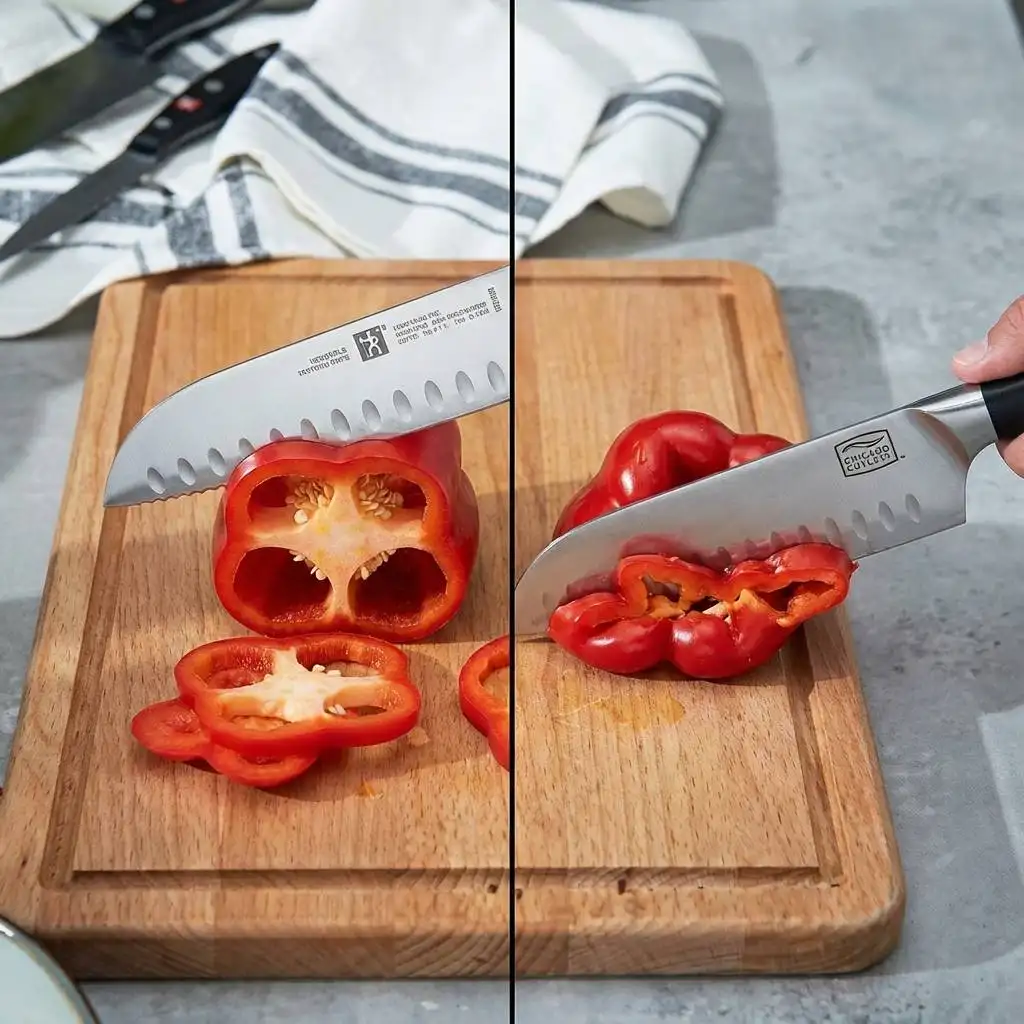
A tomato skin is the ultimate test of “tooth.” A polished, soft steel knife (Chicago) will often slide right over the skin unless you use significant pressure to puncture it. A Henckels, with its slightly better grind and carbide distribution, usually bites immediately. If you have to saw at a tomato to get the cut started, your knife is failing.
The Carrot Test (The Wedging Check)
This is where the thickness creates problems. When cutting a carrot into rounds, listen to the sound. Does it make a quiet swish? Or a loud CRACK? The crack is the sound of the carrot breaking apart because the knife is too thick behind the edge. In my testing, Chicago Cutlery knives are notorious “wedgers.” Henckels, while not as thin as a Japanese laser, generally glides through with less resistance.
The Chicken Test
Raw chicken is slippery and fibrous. You need a knife that holds an edge when it inevitably scrapes against the cutting board or hits a bone. The softer steel of the Chicago Cutlery tends to roll (bend) after de-boning a few thighs. Once that edge rolls, it becomes unsafe because you have to use more force to cut. The X50 steel in the Henckels is resilient; it might dull, but it rarely rolls catastrophically under normal kitchen use.
Edge Retention & Maintenance (The Long Game)
Every knife goes dull. The difference is how fast, and how hard it is to fix.
The “Steeling” Frequency
With a Chicago Cutlery set, you need to be honing that blade on the steel rod before every single use. The steel is soft enough that the edge aligns easily, but it misaligns just as fast. With a Henckels, you can usually get away with honing every 2-4 preps, depending on the volume.
Sharpening: The Whetstone Experience
This is where the “Steel Nerd” in me comes out. Sharpening Henckels is predictable. You rub it on a 1000 grit stone, raise a burr, flip it, and remove the burr. It deburrs cleanly.
Sharpening cheap, soft stainless (like the Chicago) is frustrating. The burr is stubborn. It just flops back and forth like a loose tooth that won’t fall out. You end up with a “wire edge” that cuts great for five minutes and then folds. If you plan on learning to sharpen, Henckels provides a much better learning platform.
The Verdict: Price-to-Performance Ratio
So, is the Henckels worth the extra $50 to $100 over the Chicago Cutlery?
The “Beater” Category: When to Buy Chicago Cutlery
If you are outfitting an Airbnb, a cabin rental, or sending a kid off to a college dorm with roommates who will open beer bottles with the chef’s knife—buy the Chicago Cutlery. It is cheap, replaceable, and sturdy enough to handle abuse. It is a tool for people who view cooking as a chore.
The Culinary Investment: When to Buy Henckels
If you actually enjoy cooking, or if you want to improve your knife skills, the Henckels International (specifically the Classic or Statement lines) is the mandatory upgrade. The geometry is better, the steel is chemically superior, and the handles won’t rot off. It is the entry-level drug into the world of high-performance cutlery.
Chief’s Recommendation
Skip the Chicago Cutlery Insignia. It’s a costume of a professional knife. Buy the Henckels Classic 3-piece starter set if you can’t afford the big block. Build your kit slowly with better tools, rather than buying a massive block of mediocre metal.
Frequently Asked Questions (FAQ)
Are Chicago Cutlery knives made in the USA?
Historically, yes. But don’t let the name fool you. Today, the vast majority of Chicago Cutlery products are manufactured in China. They trade heavily on their American heritage, but the factory has moved.
Can I put Henckels knives in the dishwasher?
Absolutely not. I don’t care if the box says “Dishwasher Safe.” That is marketing nonsense. The dishwasher uses high heat and abrasive detergents that will degrade the handle material and, more importantly, bang the delicate edge of your knife against ceramic plates and plastic racks. Putting a knife in the dishwasher is a crime against cutlery.
Do Henckels knives stay sharp longer?
Yes. Due to the higher Chromium and Carbon content in the X50CrMoV15 steel, combined with a better heat treatment (usually 55-57 HRC), a Henckels blade will hold a working edge significantly longer than the softer steel found in Chicago Cutlery sets.
What is the difference between Zwilling and Henckels?
Zwilling (The Twins) is the premium brand, typically manufactured in Germany with forged blades and Friodur ice-hardening technology. Henckels (The Single Guy) is the value-oriented brand, often manufactured in Spain or Asia with stamped blades (though some are forged). Think of it as Toyota vs. Lexus. Both are reliable, but one is built for performance luxury.