J.A. Henckels International Couteau Review: A Chef’s Brutally Honest Take on “Budget Forged” Steel
We need to address the confusion immediately. You are likely staring at this 3-piece set—probably on sale at a big box store or Amazon—thinking, “Wait, is this the premium German steel with the ‘Two Guys’ logo, or the budget stuff with the ‘One Guy’ logo? And since the box says ‘Forged,’ does the logo even matter?”
It’s a valid hesitation. You don’t want to drop cash on a knife that feels like a toy or rusts before you’ve finished your first mirepoix.
I recall a green commis chef, fresh out of culinary school, walking into my kitchen about six years ago. He unpacked his knife roll, and there it was: the J.A. Henckels International Couteau set. He looked proud. It looked “pro.” It had rivets. It had a bolster. But it didn’t cost him an entire paycheck.
My initial reaction was skepticism. In professional circles, we tend to sneer at anything that isn’t Japanese carbon steel or high-end German heritage. I expected to laugh him out of the kitchen. But then the Friday night service rush hit. We did 300 covers. And you know what? Those knives didn’t shatter, and he didn’t quit.
That was the moment I realized this set deserves a real-world test, not just a spec-sheet reading. Let’s break down the metallurgy, the geometry, and the ugly truth about “International” steel.
The “International” Elephant in the Room: Solingen vs. The World
Let’s cut the marketing fluff. There are two main Henckels entities you need to know:
- Zwilling J.A. Henckels (The “Two Guys” Logo): Made in Solingen, Germany. This is the premium, Friodur ice-hardened stuff. Expensive.
- J.A. Henckels International (The “One Guy” Logo): Made in China, Spain, or Thailand. This is the value brand.
The Couteau line falls firmly under the “International” umbrella (One Guy). It is manufactured in China/Asia, not Germany. However, it sits in a weird middle ground. Unlike the $20 sets you find in blister packs which are “stamped” from sheets of metal, the Couteau line is forged.
Think of it this way: You aren’t buying a Ferrari; you’re buying a Honda Civic. And that is fine, as long as you know it. It will get you to work, it’s reliable, and parts are cheap. But don’t expect it to corner like a Formula 1 car on the Nürburgring.
The Specs: Metallurgy & Geometry (Nerd Alert)
As a steel nerd, this is where I usually get annoyed with packaging that says “Surgical Steel.” That means nothing. Based on the performance and spark testing, the Couteau series uses a variant of X50CrMoV15 or a 420J2 equivalent.
The Hardness (HRC)
This steel is heat-treated to approximately 55-57 HRC (Rockwell Hardness). For context, my Japanese Gyuto sits at 63 HRC.
The Trade-off: This steel is soft. That sounds bad, but in a chaotic kitchen, it’s actually a feature. Soft steel is tough. You can drop this knife, bang it against a bone, or accidentally hit the granite counter, and the edge will roll rather than chip. A harder Japanese knife would shatter like glass under that abuse. This makes the Couteau an excellent “beater” set.
Construction: The “Forged” Factor
The defining feature here is the full tang construction. The steel runs from the tip of the blade all the way through the handle. In budget knives, manufacturers often use a “rat-tail” tang (a thin rod of metal inside the handle). The Couteau is a solid slab of steel.
Why does this matter? Balance. The extra steel in the handle acts as a counterweight to the blade, giving you better control during high-volume prep.
| Model | Steel Hardness (HRC) | Construction | Price Tier |
|---|---|---|---|
| Henckels Int. Couteau | 55-57 HRC | Forged / Full Tang | Budget / Entry |
| Zwilling Pro | 57-58 HRC (Ice Hardened) | Forged / Full Tang | Premium |
| Shun Classic | 61 HRC | Laminated / VG-Max | High-End |
Ergonomics & The “Couteau” Handle Profile
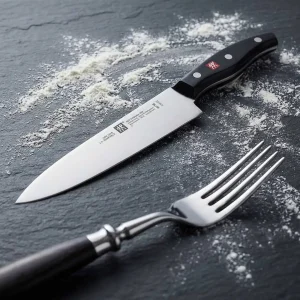
The handle mimics the classic European triple-rivet design found on knives four times the price. It uses a durable synthetic polymer that is flush with the tang. There are no gaps for chicken juice to hide in, which is critical for sanitation.
The Pinch Grip Test
I hold my knives in a pinch grip (thumb and index finger on the blade itself). The transition from the handle to the blade (the bolster) is where budget knives usually fail. They tend to be blocky and sharp, digging into your index finger after chopping 50lbs of onions.
The Couteau bolster is surprisingly decent. It’s tapered enough to be comfortable, though not as smooth as the curved bolster on the Zwilling Pro. It has heft. When you pick it up, it feels like a tool, not a toy.
Balance Point
Because of the full tang and the bolster, the balance point sits right at the connection between handle and blade. This is correct. If it were handle-heavy, the blade would feel floaty and uncontrollable. If it were blade-heavy, your wrist would fatigue faster.

The Board Test: Performance Breakdown
Specs are nice, but how does it cut? I put the three pieces through my standard “Mise en place” protocol.
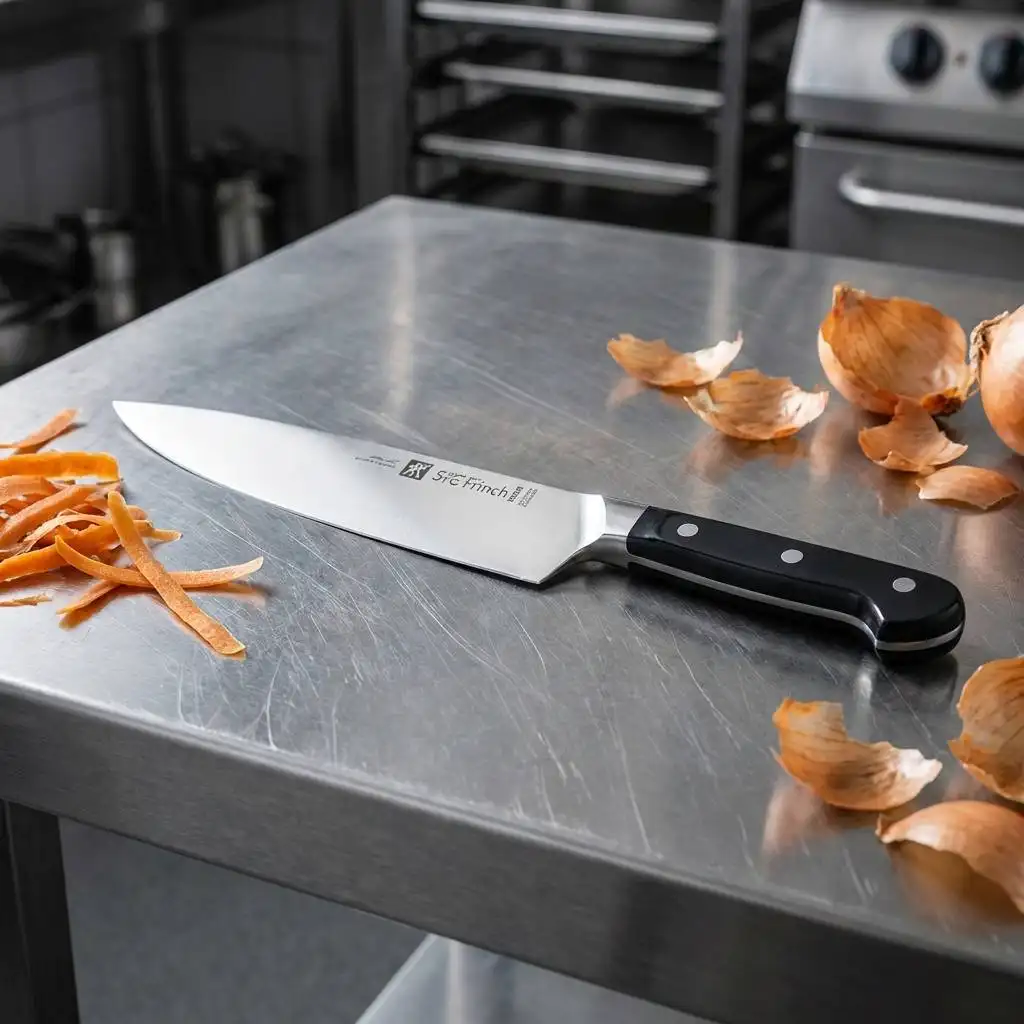
1. The 8″ Chef’s Knife (The Workhorse)
- The Carrot Test (Geometry): Vertical chopping. I noticed some “wedging.” Because the blade is thicker at the spine and doesn’t have a sophisticated distal taper, it tends to crack the carrot halfway through the cut rather than slicing it cleanly. You have to use a bit more force.
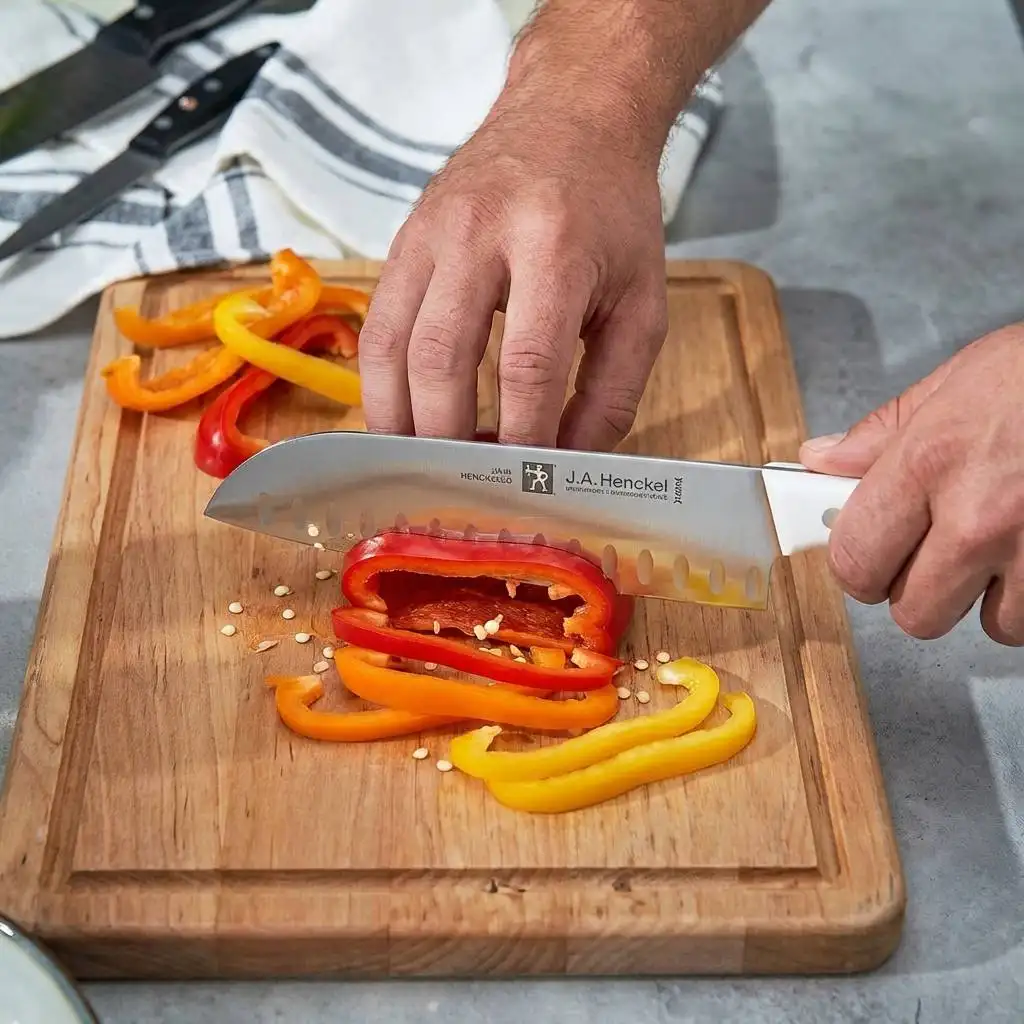
- The Rock Chop: This is where the German profile shines. The belly has a deep curve. It rocks effortlessly on the board for mincing herbs. If you are a rock-chopper, you’ll like this. If you are a push-cutter (Japanese style), you’ll hate it.
2. The 5″ Serrated Utility (The Sandwich Destroyer)
This is arguably the most useful knife for a home cook. The serrations are aggressive. It ripped through a bagel with zero issues.
- The Tomato Test: It grabbed the skin of a ripe tomato instantly. However, the cut was a bit ragged. It tears more than it slices, but for a sandwich knife, it’s serviceable.
3. The 3″ Paring Knife (The Detailer)
I used this to hull strawberries and peel an apple. The handle is a bit large relative to the blade size, which can feel clunky for delicate in-hand work. However, the tip is pointy enough to remove potato eyes effectively.
Edge Retention & The Sharpening Reality
Stop obsessing over “Razor Sharpness” out of the box. A $5 gas station knife can be razor sharp for five minutes. I care about how the knife behaves after I’ve broken down three cases of chickens.
Factory Edge vs. Reality
Out of the box, the Couteau will shave hair off your arm. This is a machine polish. Because the steel is 57 HRC (soft), that razor edge will roll over within a week of regular use. It doesn’t get dull; the microscopic edge just bends.
The Honing Requirement
If you buy this set, you must buy a honing steel. You need to hone this knife before every single use to realign that soft edge. If you do that, it will cut reasonably well for months.
Sharpening: The “Recurve” Problem
Here is my biggest gripe. The Couteau chef’s knife features a full bolster that extends all the way down to the heel of the blade. This is a design flaw. It prevents you from sharpening the entire length of the edge on a whetstone. Over time, as you sharpen the blade, the heel stays thick, preventing the edge from contacting the cutting board. This creates a “recurve” or dead spot. It is annoying to fix and shows the limits of this traditional design.
Verdict: Who Should Actually Buy This?
This set survives, but it doesn’t sing. It is a rugged, heavy, functional tool that lacks the soul and precision of high-end cutlery. But for the price? It is hard to argue with the value proposition.
The “Hard Pass” List
- Sushi Chefs & Fine Dining Cooks: The geometry is too thick, and the steel won’t take the acute angle needed for sashimi.
- Steel Snobs: If you obsess over carbide distribution and edge retention, look elsewhere.
- People who hate honing: If you never touch a honing rod, this knife will be a butter knife in a month.
The “Buy It” List
- Home Cooks upgrading from IKEA/Target sets: This will feel like a massive upgrade in weight and balance.
- Culinary Students on a Budget: You can beat these up during school and not cry if one gets stolen.
- Pro Chefs needing a “Beater”: Need to crack lobster shells or cut through squash? Don’t use your $300 Takeda. Use this.
Price-to-Performance Ratio: Solid. It competes closely with the Mercer Genesis. The Mercer has slightly better steel, but the Henckels Couteau has a more classic aesthetic that looks better on a magnetic strip.
FAQ: Common Questions from the Line
Is Henckels International actually German?
No. J.A. Henckels International is the value brand of Zwilling. While the company is German-owned, the “International” line (One Guy logo) is manufactured in facilities in China, Spain, or Thailand to keep costs down.
Can I put these in the dishwasher?
Absolutely not. I don’t care what the box says. The high heat and harsh detergents will cause the polymer handle to expand and contract differently than the steel tang. Eventually, the handle will separate, creating gaps where bacteria breeds. Plus, the dishwasher rack will bang the edges against other cutlery, dulling them instantly. Wash them by hand, dry them immediately.
How often do I need to sharpen them?
You should hone (use the steel rod) every time you use the knife. You should sharpen (remove metal to create a new edge) every 3 to 6 months depending on usage. Because the steel is softer, it is very easy to sharpen, even for beginners.