J.A. Henckels Four Star 8-Pc Set Review: A Pro Chef’s Autopsy of a 40-Year-Old Classic
Let’s get the elephant out of the room first. If you’ve walked through a department store or scrolled through a wedding registry in the last 40 years, you’ve seen this block. The J.A. Henckels Four Star series is the Toyota Camry of the cutlery world. It’s everywhere.
But here is the problem: You see that “Zwilling” logo and the German heritage, and you assume you’re buying a lightsaber. You’re terrified of dropping $300+ on “surgical steel” that might go dull in a week. You want to know if this design, untouched since 1976, is actually timeless or if it’s a dinosaur compared to modern Japanese blades.
I’ve spent 15 years in professional kitchens, from high-volume French brigades to precision Japanese counters. I’ve seen these specific black-handled knives abused by line cooks, thrown into commercial dishwashers (a cardinal sin), and dropped on quarry tile floors. I know exactly how much punishment they can take. But today, I’m not testing them for survival. I’m testing them for performance.
The Specs: What You’re Actually Buying (Beyond the Marketing)
Forget the fluffy marketing copy on the box. As a steel nerd, I only care about the metallurgy and the geometry. If the foundation is bad, no amount of polishing will fix it. Here is the breakdown of the chassis.
| Steel Type | X50CrMoV15 (High Carbon Stainless) |
| Hardness (HRC) | 57 ±1 HRC |
| Blade Construction | SIGMAFORGE (One-piece precision forging) |
| Edge Angle | 15° per side (Laser Controlled) |
| Handle Material | Molded Polypropylene (Seamless) |
The Steel Analysis: X50CrMoV15
This is the standard German formula. The “50” stands for 0.5% Carbon. In the world of high-performance cutlery, that is adequate, not exciting. Compare that to a Japanese VG10 core which hits 1.0% Carbon. The Henckels steel is softer. It won’t hold an edge as long as a Shun or a Miyabi, but it has high toughness. It resists chipping when you inevitably hit a bone or twist the blade.
The Heat Treat: Friodur
Henckels uses a cryo-hardening process they call “Friodur.” They freeze the steel to alter the molecular structure. This isn’t magic; it’s physics. It maximizes corrosion resistance. I’ve seen these knives sit in a sink full of water overnight (don’t do this) and come out rust-free. The heat treat is solid, ensuring the grain structure is stable, but don’t expect it to turn soft steel into a diamond.
Hardness Stats: 57 HRC
At 57 Rockwell Hardness, this steel is relatively soft. The implications for you? The edge will roll over rather than chip. You will need to use the honing steel constantly to realign that rolled edge. If you are lazy about maintenance, this knife will feel dull within three weeks of heavy use.
The “Big Three” Breakdown: Analyzing the Core Knives
A set is only as good as the tools you actually touch. The rest is just expensive clutter. Let’s look at the workhorses.
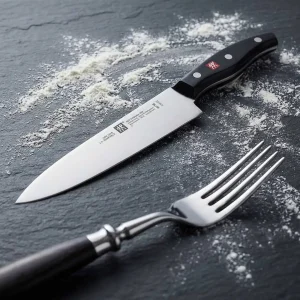
The 8-Inch Chef’s Knife: The Line Cook’s Workhorse
This is the primary tool. The profile is a classic German belly—a deep curve designed for “rock chopping” herbs and mirepoix. If you are a “push cutter” (up and down motion), you might find the curve excessive.
The Grind: Out of the box, the edge is grinded to roughly 15 degrees per side. It’s sharp enough to shave arm hair, but the thickness behind the edge is substantial. It doesn’t fall through food; you have to drive it.
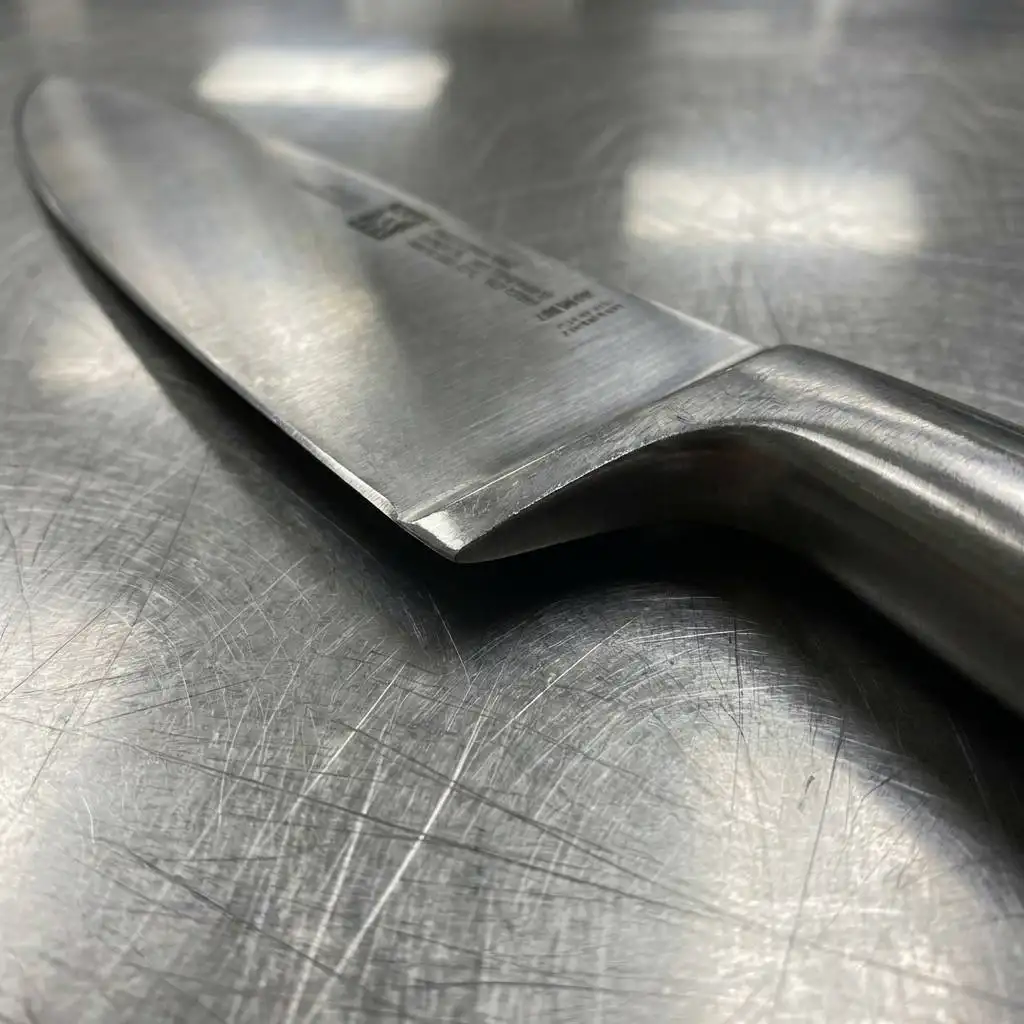
The Bolster Issue (CRITICAL): This is where I have beef with Henckels. The Four Star features a “Full Bolster”—that thick metal finger guard that runs all the way to the heel of the blade. Henckels calls it a safety feature; I call it a design flaw. It prevents you from sharpening the entire length of the blade. Over time, as you sharpen the edge, the bolster doesn’t wear down. You end up with a recurve profile where the heel hits the cutting board before the edge does, leaving your onions like an accordion—connected at the bottom.

The Serrated Utility & Paring Knife
The 5-inch Serrated Utility: This is actually the sleeper hit of the set. The serrations are aggressive. It handles tomatoes and bagels without crushing them. It tears more than it slices, but for tough skins, it works.
The 4-inch Paring: The handle on the paring knife is almost the same size as the chef’s knife. For me, it feels bulky. When I’m trying to flute a mushroom or core a strawberry, I want dexterity. The large handle forces your hand back, reducing control.
Ergonomics & The “Four Star” Handle
Why has this design survived since 1976? Because it works for the average human hand.
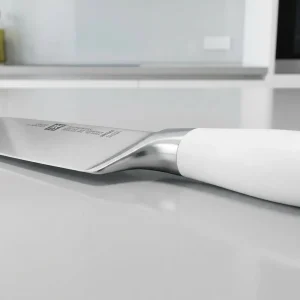
Material: The handle is molded polypropylene. Unlike the “Pro S” line which has scales and rivets, this is a seamless piece of plastic fused to the tang. In a professional kitchen, we love this because there are no cracks for bacteria or chicken juice to hide in. It is sanitary and easy to scrub.
The Pinch Grip Test: I did a two-hour prep session (dicing 10lbs of onions). The spine of the knife is rounded enough that it doesn’t dig into my index finger. However, the balance point is right at the bolster, making it feel slightly handle-heavy. It doesn’t disappear in the hand; you are always aware you are holding it.
Performance: The Board Test
I put the 8-inch chef’s knife through the standard gauntlet to see how the geometry holds up.
- The Tomato Test: Passed. The factory edge sliced the skin without pressure. However, after the 10th tomato, I could feel the edge starting to slide. The soft steel loses that “bite” quickly.
- The Carrot Test (Wedging): Failed. Because the spine is thick and the grind is not fully flat, the knife “wedges” in dense vegetables. You can hear a loud crack as the carrot splits apart before the cut is finished. It’s splitting the food, not laser-slicing it.
- The Protein Test: Trimming silver skin off a tenderloin requires finesse. The tip of the Four Star is slightly bulbous, lacking the needle-point precision of a Japanese Gyuto. It gets the job done, but it feels clumsy.
- The Feel: The steel feels “dead” on the board. It absorbs impact well, which is good for fatigue, but you don’t get that tactile “glassy” feedback you get from harder steel.
The Filler vs. The Killer (Evaluating the Rest of the Set)
Is the 8-piece count legitimate value or just marketing padding?
The Shears: These are decent, heavy-duty shears. However, if they are the non-take-apart version (which many sets include), I deduct points. If you can’t separate the blades, you can’t clean them properly after cutting raw poultry. Check the specific SKU before you buy.
The Honing Steel: With 57 HRC steel, this rod is not an accessory; it is a life support system. You will need to use this every single time you cook to keep the edge true.
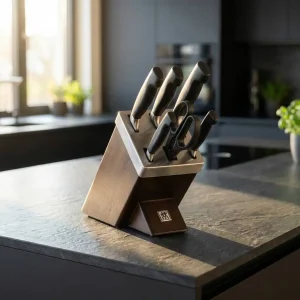
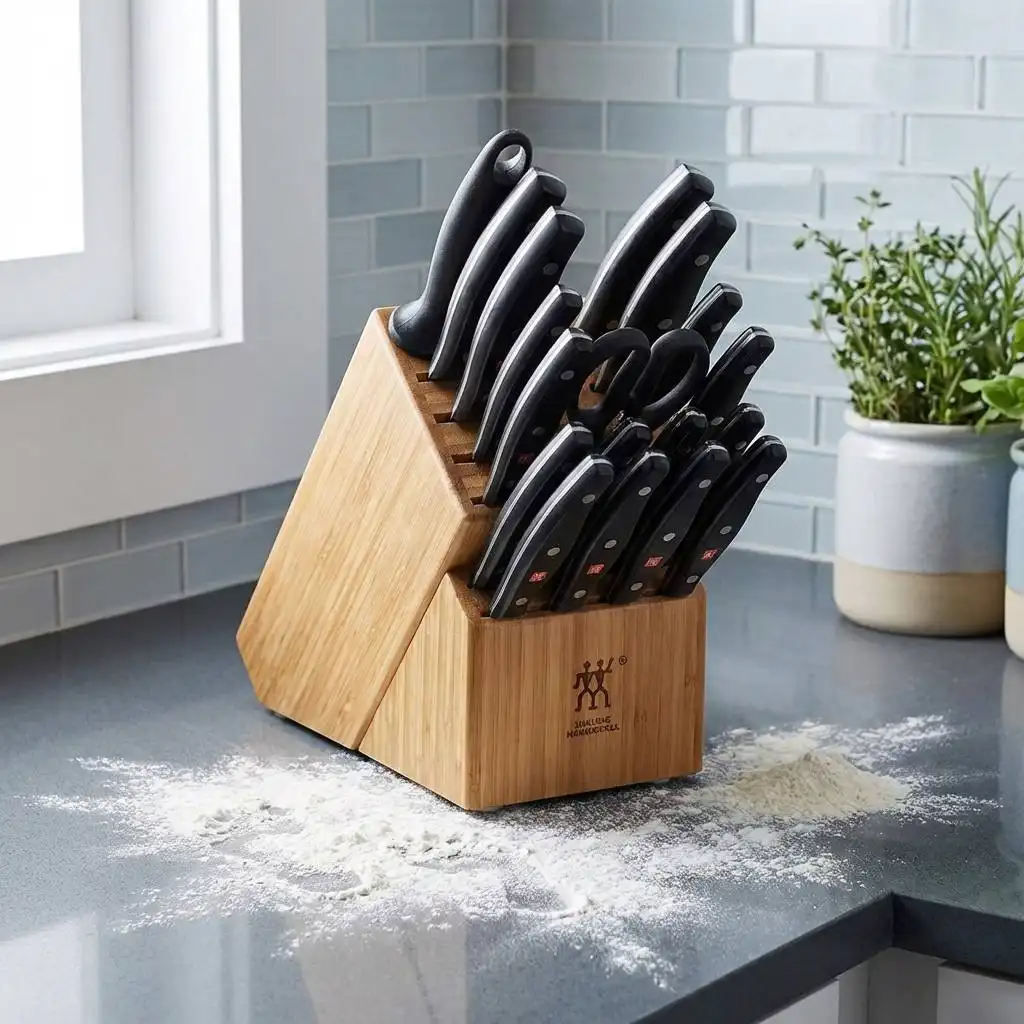
The Block: It’s wood. It holds knives. It takes up counter space. Nothing revolutionary here, though the angled slots do help protect the edges.
Maintenance: The Reality of German Steel
Here is the trade-off. You give up edge retention, but you gain ease of sharpening. When I put the Four Star on a 1000 grit whetstone, it feels “gummy.” It raises a burr almost instantly. This is great for beginners learning to sharpen because you get immediate feedback.
However, for a pro, it’s annoying. The steel abrades so fast that if you aren’t careful, you’ll grind away years of life in one session. And again, that full bolster will eventually become a headache, preventing the heel from touching the stone.
Durability: I will give it this—the thing is a tank. You can drop it, bang it, and abuse it, and it will not snap. It is bombproof.
Verdict: Who Should Buy This?
The J.A. Henckels Four Star is not a precision instrument; it is a blunt force tool built to last a lifetime of abuse. It is the knife for the cook who throws things in the sink and forgets about them.
Buy This If:
- You want a “beater” set that family members can’t destroy.
- You prioritize a comfortable, molded handle that is easy to clean.
- You hate chipped blades and prefer a tougher, softer steel.
- You prefer a rocking motion when chopping herbs.
Pass If:
- You want “scary sharp” edges that last for months.
- You sharpen your own knives on stones (that bolster will drive you crazy).
- You do a lot of precise vegetable work and hate wedging.
- You prefer the aesthetic and balance of Japanese cutlery.
Price-to-Performance: At the full retail price of nearly $350, it is overpriced compared to modern competitors. If you find it on sale for around $200, it’s a solid value for a German-made workhorse set.
FAQ: Common Kitchen Questions
Is the Henckels Four Star dishwasher safe?
Technically, Henckels says yes. In reality? No. High heat expands the metal, and the harsh detergents will corrode the edge and dull the blade rapidly. If you put these in the dishwasher, you are ruining them.
What is the difference between Zwilling Pro and Four Star?
The main difference is the handle and the tang. The Pro series features a curved bolster (better for pinch grip) and a traditional 3-rivet handle design. The Four Star has the fully enclosed, molded polypropylene handle and a straight, intrusive full bolster.
Does this set need a sharpener?
Yes. The steel is soft (57 HRC). You will need to use the included honing rod before every use, and you will likely need to perform a true sharpening (whetstone or pull-through) every 3 to 6 months depending on usage.