J.A. Henckels Cutlery Sets: Professional Steel or Overpriced Department Store Metal? (A Chef’s Guide)
I’ve spent over 15 years in professional kitchens, from the high-volume grind of French brigades to the quiet, obsessive precision of Japanese sushi bars. I’ve abused steel in ways that would make a home cook cry. I’ve seen $300 knives chip on a chicken bone, and I’ve seen $20 beaters survive a drop into a deep fryer.
Here is the reality of J.A. Henckels: It is the most confusing brand on the market. You walk into a department store and see a “15-piece block set” for $150. Then you see another Henckels block that looks exactly the same, but it costs $800. What gives?
Most people buy the cheaper one, thinking they scored a deal on a premium German brand. They didn’t. They bought soft, stamped metal that can’t hold an edge through a single holiday dinner. They bought the brand name, not the performance.
I have a soft spot for the old-school Zwilling Pro “S”—it was the workhorse of the 90s. But the brand has diluted its reputation with cheap “International” sets found in every big-box store in America. Today, we are going to cut through the marketing fluff. We’re going to talk about grain structure, HRC hardness, and whether that “surgical steel” on the box is actually worth your money.

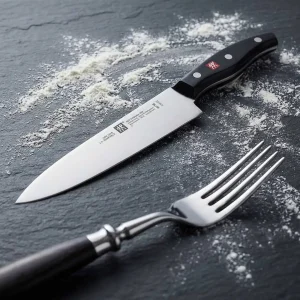
The “Twin” vs. The “Single Man”: Do Not Miss This Logo Detail
If you take nothing else away from this article, remember this: Count the stick figures on the blade. The entire Henckels hierarchy comes down to a simple binary distinction.
- The “Zwilling” (Twin) Logo: Two little stick figures. This is the real deal. German engineering, often forged in Solingen, using their proprietary steel formula. This is professional-grade equipment.
- The “International” (Single Man) Logo: One stick figure holding a halberd. This is the budget line. These are manufactured in China, Spain, or Thailand. They are not the same steel.
The Metallurgy Rant
Why does the number of stick figures matter? Because of the metallurgy. The Twin lines use a proprietary formula roughly equivalent to X50CrMoV15. It’s high-carbon, stain-resistant, and heat-treated to balance toughness with edge retention.
The Single Man lines? That’s usually a lower-grade stainless, something akin to 3Cr13 or 5Cr15MoV. In the kitchen, we call this “mystery metal.” It’s soft. It rolls over if you look at it wrong. You will be honing these knives every 15 minutes during prep.
And please, ignore the term “Surgical Steel.” To a chef, that is a red flag. Surgical steel just means it has enough chromium to not rust. That’s great for a scalpel that gets used once and thrown away, but for a chef’s knife? It usually means the steel is too soft to hold a refined edge. It’s marketing nonsense designed to make you feel safe buying a mediocre product.
The Metallurgy Deep Dive: HRC, Friodur, and Grain Structure
Let’s look at the specs. If you are going to drop serious cash, you need to know what you are buying.
| Spec | Zwilling (German) | Henckels Int. (Budget) |
|---|---|---|
| Hardness (HRC) | 57 ±1 | 53 – 55 |
| Construction | Forged (Usually) | Stamped (Sheet metal) |
| Edge Angle | 15° per side (Newer lines) | 20°+ per side |
Friodur: Ice-Hardening Explained
You’ll see “Friodur” stamped on the good blades. Is it just a fancy trademark? Actually, no. It refers to a cryogenic tempering process where they freeze the steel to align the molecular structure and carbide distribution. This changes the grain structure, making the steel significantly more corrosion-resistant and slightly tougher. It’s not magic, but it’s solid physics.
The hardness (HRC 57) is softer than Japanese steel (which usually sits at 60-62 HRC). This is intentional. It means the edge will roll rather than chip. But if you buy the budget lines (HRC 53), the steel is gummy. It feels like cutting with a butter knife that you just sharpened on a sidewalk.
The Top Tier: Reviewing the Zwilling (German) Lines
If you want a knife that will last 20 years, these are the lines you look at. The fit and finish here are typically excellent, with flush rivets and smooth handle transitions.
The Zwilling Pro
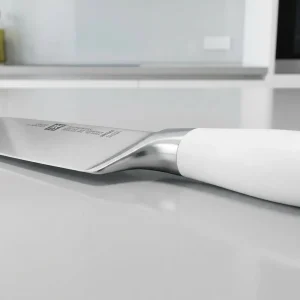
This is currently the best design they make, purely because of the bolster. They utilize a “curved bolster” that encourages a proper pinch grip. The face of your thumb and index finger slide naturally onto the blade. Crucially, it’s a half-bolster design, meaning the heel of the edge is exposed. You can sharpen the entire length of the blade. This is an ergonomic win.
The Zwilling Pro “S”
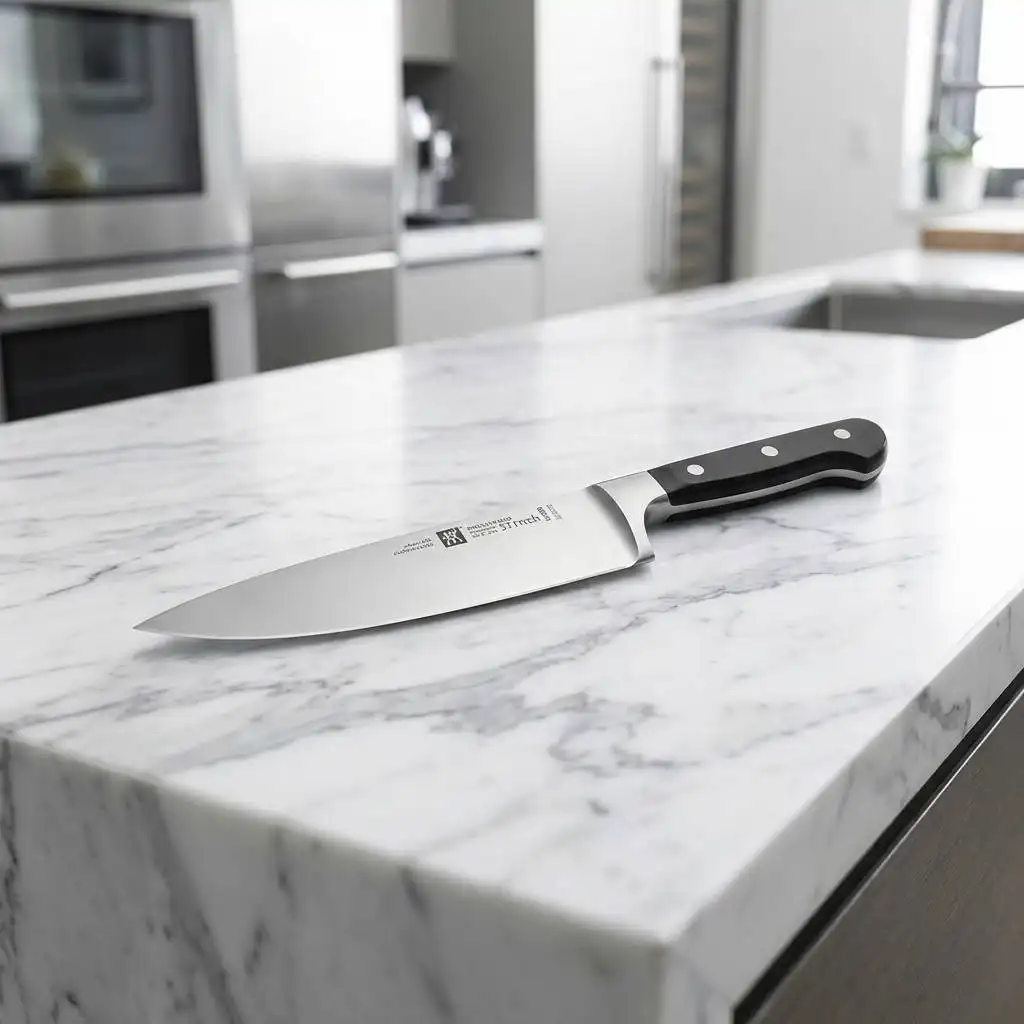
The “S” stands for Standard (or Sturdy, depending on who you ask). This is the classic 1990s tank. It has a full bolster that runs all the way down to the heel. I hate this. That thick chunk of steel at the heel prevents you from sharpening the last half-inch of the blade. Over time, as you sharpen the rest of the edge, you develop a “recurve” where the blade doesn’t touch the cutting board anymore because the bolster is in the way.
The Four Star
Same steel as the others, but with a molded polypropylene handle. Some chefs love it because there are no rivets to collect gunk or bacteria—it’s very sanitary. Personally? It feels too light. It throws off the balance point, making the knife feel blade-heavy in a way that tires out my wrist during heavy prep.
The Budget Tier: Henckels International (The “Beater” Sets)
I’m not going to trash these entirely. Every kitchen needs a “beater” knife—something you can hand to your brother-in-law when he wants to open a clam, or something to take to an Airbnb.
Most of these are stamped. That means they are punched out of a sheet of steel like a cookie cutter, rather than pounded into shape from a hot bar of steel (forged). Stamped knives lack a bolster and distal taper. They feel weightless in the hand—and not in a good, agile way. They feel cheap.
The “Definition” and “Solution” lines are the bottom of the barrel. They use softer stainless steel. If you buy these, buy a honing rod, because you will be using it every time you cook. The edge retention is non-existent.
The Board Test: Performance & Geometry
How does the steel actually behave on the board? I put these knives through the standard gauntlet.
The Tomato Test (Edge Bite)
Out of the box, even the cheap Henckels usually slice a tomato skin cleanly. They polish the edges well at the factory. However, the budget lines lose this “bite” rapidly. After three days of mise en place, the International blade started sliding off the tomato skin rather than piercing it.
The Carrot Test (Wedging)
This is where German knives struggle compared to Japanese lasers. The spines on the Henckels sets are thick. When you cut a dense carrot, you often hear a crack before you finish the cut. That’s “wedging”—the thickness of the blade is splitting the vegetable apart rather than slicing it. The Zwilling Pro has a decent grind that minimizes this, but the Pro “S” is a wedge monster.
The Chicken Bone Test
This is where Henckels shines. I took the Zwilling Pro and hacked through chicken joints and rib cages. No chipping. The edge rolled slightly (which is fixed in 10 seconds with a steel), but it didn’t shatter. This is why we use German steel in high-volume kitchens. It is tough. It takes abuse.
Handle Ergonomics: The “Two-Hour Onion Soup” Factor
You don’t know if a handle is good until you’ve cut 50 pounds of onions for soup. Ergonomics are everything.
The higher-end lines use POM (Polyoxymethylene) handles. This stuff is bomb-proof. It won’t shrink, crack, or fade. The three-rivet design is classic for a reason—it secures the full tang (the metal running through the handle) firmly.
The budget lines often use generic resin or plastic. My gripe with the cheap sets is that the plastic gets slick when wet. In a professional kitchen, your hands are always wet or greasy. A slick handle is a dangerous handle.
Balance points matter, too. Ideally, you want the knife to balance right at the pinch grip (where the handle meets the blade). The forged Zwilling lines usually nail this. The stamped International lines are blade-heavy because the handles are hollow or lightweight plastic, making the knife feel clumsy.
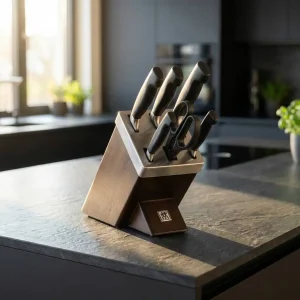
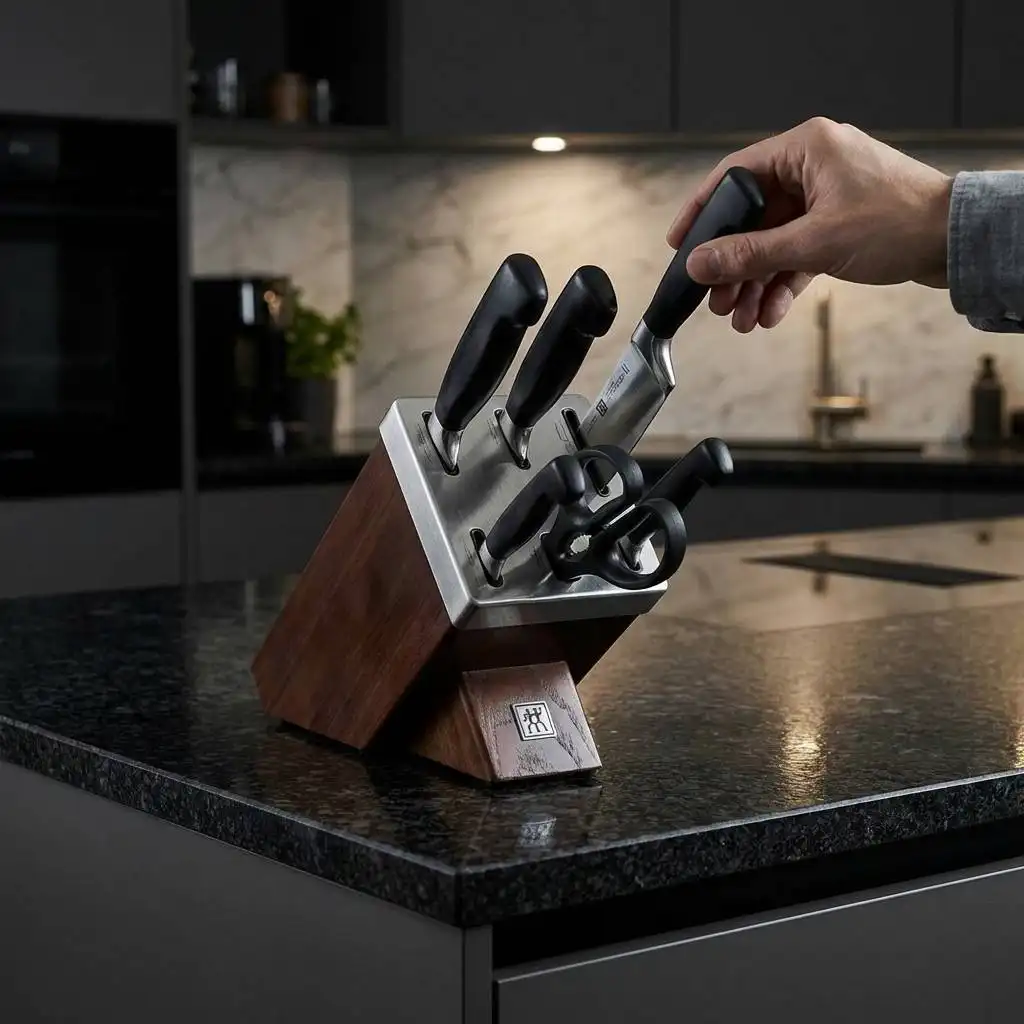
The “Self-Sharpening Block” Gimmick: A Chef’s Warning
I see these “Self-Sharpening Blocks” everywhere now. The slots have little ceramic or carbide V-notches built in. Every time you pull the knife out, it scrapes the edge.
Do not buy these.
I cannot stress this enough. These blocks are edge-killers. They act as carbide scrapers, aggressively stripping metal off your blade every single time you use it. They don’t align the edge; they tear it. Furthermore, they encourage a recurve profile over time because they grind the belly of the blade more than the heel or tip. Within two years, your knife profile will be ruined, and it won’t contact the cutting board properly. Learn to use a honing rod. It takes five seconds.
Final Verdict: Which Set is Worth Your Money?
German steel is designed to be abused. It’s softer than Japanese steel on purpose. If you want a knife that stays razor-sharp for six months, buy a Japanese blade. If you want a knife you can drop in the sink and not cry about, buy the Henckels.
Here is the breakdown of where your money should go:
| Category | Recommended Set | Why? |
|---|---|---|
| Best for Enthusiasts | Zwilling Pro | The curved half-bolster is the best ergonomic design in the German game. Period. |
| Best for Traditionalists | Zwilling Pro “S” | Heavy, tank-like, indestructible. Just annoying to sharpen the heel. |
| Best Budget Pick | Henckels Classic | It carries the “International” logo, but it is forged steel made in Spain. It’s the only budget line worth owning. |
| Avoid | Statement / Solution | Stamped, soft metal. You are paying for the name on a generic product. |
Frequently Asked Questions
Are Henckels knives dishwasher safe?
Technically? Yes, the marketing materials say they are. In reality? If you put a forged knife in the dishwasher, you are dead to me. The high heat ruins the temper of the steel, the harsh detergents eat the edge, and the water pressure bangs the blade against the rack. Hand wash only. It takes 20 seconds.
What is the difference between the one man and two men logos?
Two men (Zwilling) signifies premium German steel, usually forged. One man (International) signifies the budget line, usually stamped and manufactured in Asia or Spain with softer steel.
How often should I sharpen my Henckels set?
Distinguish between honing and sharpening. You should hone (use the ribbed steel rod) every time you use the knife to realign the microscopic teeth of the edge. You should sharpen (remove metal on a whetstone) every 6 to 12 months, depending on usage.