JA Henckels Cutlery Set Review: German Workhorses or Overpriced Soft Steel? A Chef’s Brutal Analysis.
Let’s address the elephant in the kitchen immediately. You are looking at a knife block set that costs $150, and right next to it, another one with the same name that costs $800. Why? It’s the “Logo Trap,” and it catches home cooks every single day. There is a massive fear—rightfully so—of dropping rent money on a “premium” block only to find out you bought stamped sheet metal that goes dull after dicing three onions.
I’ve spent 15 years in high-volume French and Japanese kitchens. My personal knife roll is filled with high-carbon Japanese steel that rusts if you look at it wrong and chips if you hit a bone. But I’ve also worked in plenty of kitchens where the “house knives”—the beaters we abuse during prep for a 300-cover service—are Henckels. I know exactly which lines survive the dish pit and which ones snap. I’m not here to sell you a lifestyle; I’m here to tell you if the steel can actually cut.
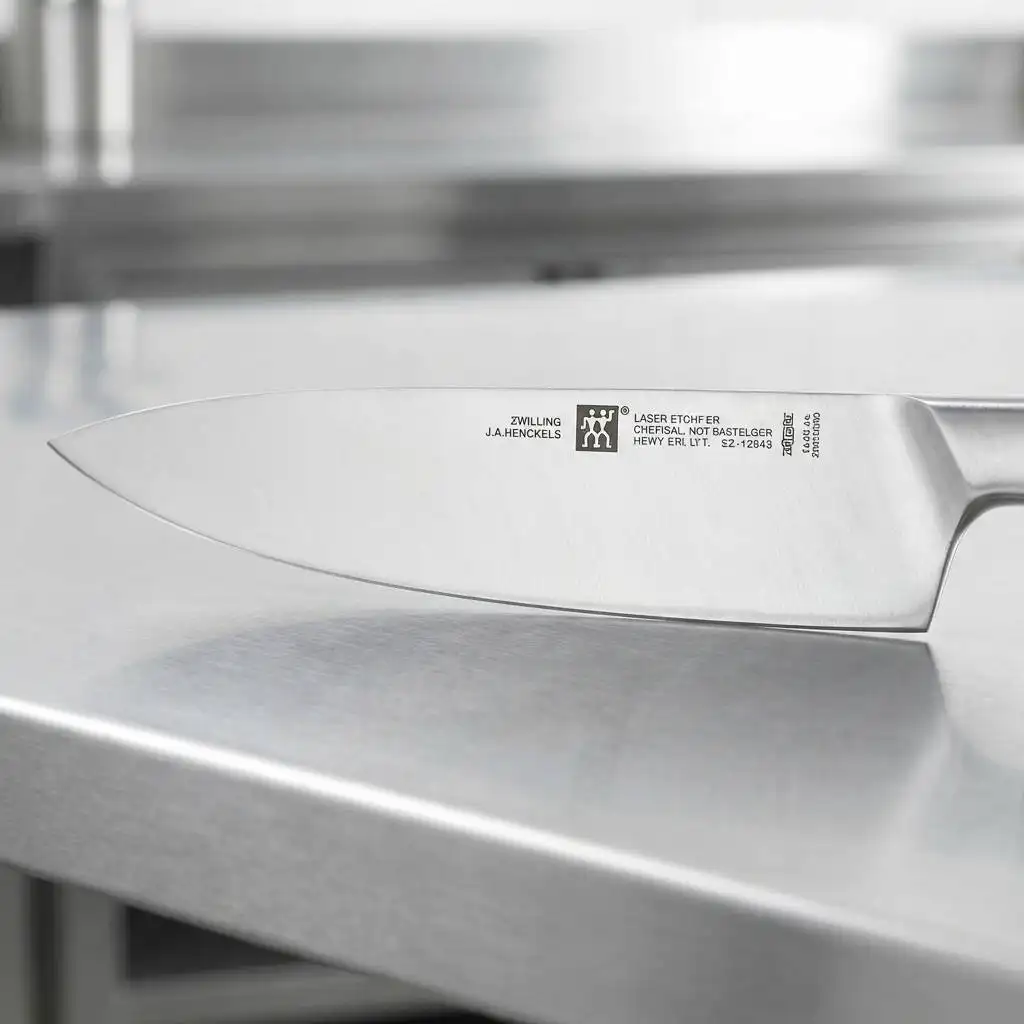
The “Zwilling” vs. “International” Trap: Read the Logo
If you take nothing else away from this breakdown, understand this: Henckels is not just one brand. It is a confusing hierarchy of metallurgy. You have to look at the logo on the blade.
- Zwilling JA Henckels (The “Twins”): If you see two little stick figures, you are looking at the premium line. These are typically manufactured in Germany (Solingen) or Spain. They use the company’s proprietary Friodur ice-hardened steel.
- Henckels International (The Single Man): If you see one stick figure holding a halberd, you are looking at the budget line. These are made in China, Thailand, or Spain. The steel quality drops significantly here.
The manufacturing difference is usually “Forged” vs. “Stamped.” The International lines are often stamped—literally punched out of a sheet of steel like a cookie. This results in a lighter blade with poor balance and a grain structure that hasn’t been aligned by heat and hammer. The Zwilling lines are forged from a single piece of steel, giving them a bolster (the thick junction between handle and blade) and significant weight.
The Steel Nerd Minute: X50CrMoV15
The standard German formula used in the premium Zwilling lines is X50CrMoV15. Let’s decode that. It contains 0.5% Carbon, 15% Chromium, and traces of Molybdenum and Vanadium. In the world of modern metallurgy, this is not a super steel. It is archaic compared to powder metallurgy steels like SG2 or R2. However, its low carbon content is a feature, not a bug. It is designed to be stainless and tough, not necessarily to hold a razor edge for six months.

The Metallurgy: Why “Surgical Steel” is Marketing Garbage
Marketing departments love the term “Surgical Steel.” It sounds precise. In reality, it just means the metal has enough chromium to resist rust. It tells you nothing about performance.
The critical metric here is Rockwell Hardness (HRC). Most premium Henckels sets clock in at 57 HRC. For context, a decent Japanese Gyuto sits around 61-64 HRC.
Here is the trade-off: The Henckels steel is soft. If you drag it across a stone, it feels “gummy” or chalky compared to the glassy feel of hard steel. Because it is soft, the edge retention is mediocre. You will lose that “out of the box” sharpness within a week of heavy prep.
However, because it is soft, it is incredibly tough. If you drop a Henckels knife on a tile floor, the tip might bend, but it won’t snap. If you whack a chicken bone, the edge will roll (bend over microscopically) rather than chip out. This is why these are the workhorses of the industry. They survive abuse that would destroy a $400 Japanese laser.
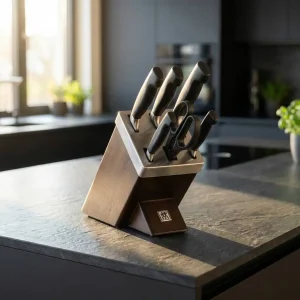
The Protocol: If you buy a Henckels set, the honing rod included in the block is not a decoration. You must use it every time you cook. The soft steel aligns easily, but it deforms just as fast. No honing = dull knife in three uses.
The Top Contenders: Breaking Down the Popular Sets
Not all “Twins” are created equal. The handle construction and bolster design drastically change how the tool performs in a pinch grip.
Zwilling Pro (The Modern Standard)
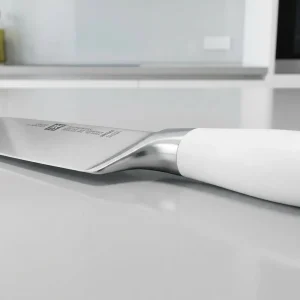
This is the line designed by Matteo Thun. The key feature here is the curved bolster. Instead of a blocky chunk of steel separating your hand from the blade, it tapers smoothly. This encourages a proper “pinch grip” (thumb and index finger on the blade). It’s the most ergonomic option they have.
Zwilling Pro “S” (The Traditional Flaw)
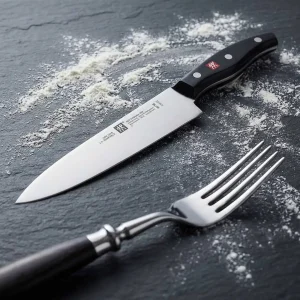
This is the “classic” look. It features a full, heavy bolster that runs all the way down to the heel of the edge. I hate this design. While it looks sturdy, that thick bolster prevents you from sharpening the entire length of the blade. Over time, as you sharpen the metal away, the bolster stays high, creating a gap between the blade and the cutting board. It’s bad engineering sold as tradition.
Zwilling Four Star (The Ugly Duckling)
These have molded polypropylene handles. They look cheap and dated. But, if you close your eyes, the balance is arguably the best in the lineup. Because there are no heavy rivets or tang exposure in the handle, the weight is forward, where it should be. This is the ultimate line cook’s beater.
The Geometry & Grind: Do They Cut or Do They Wedge?
European knives are generally thicker behind the edge than their Japanese counterparts. We measure this in spine thickness and distal taper.
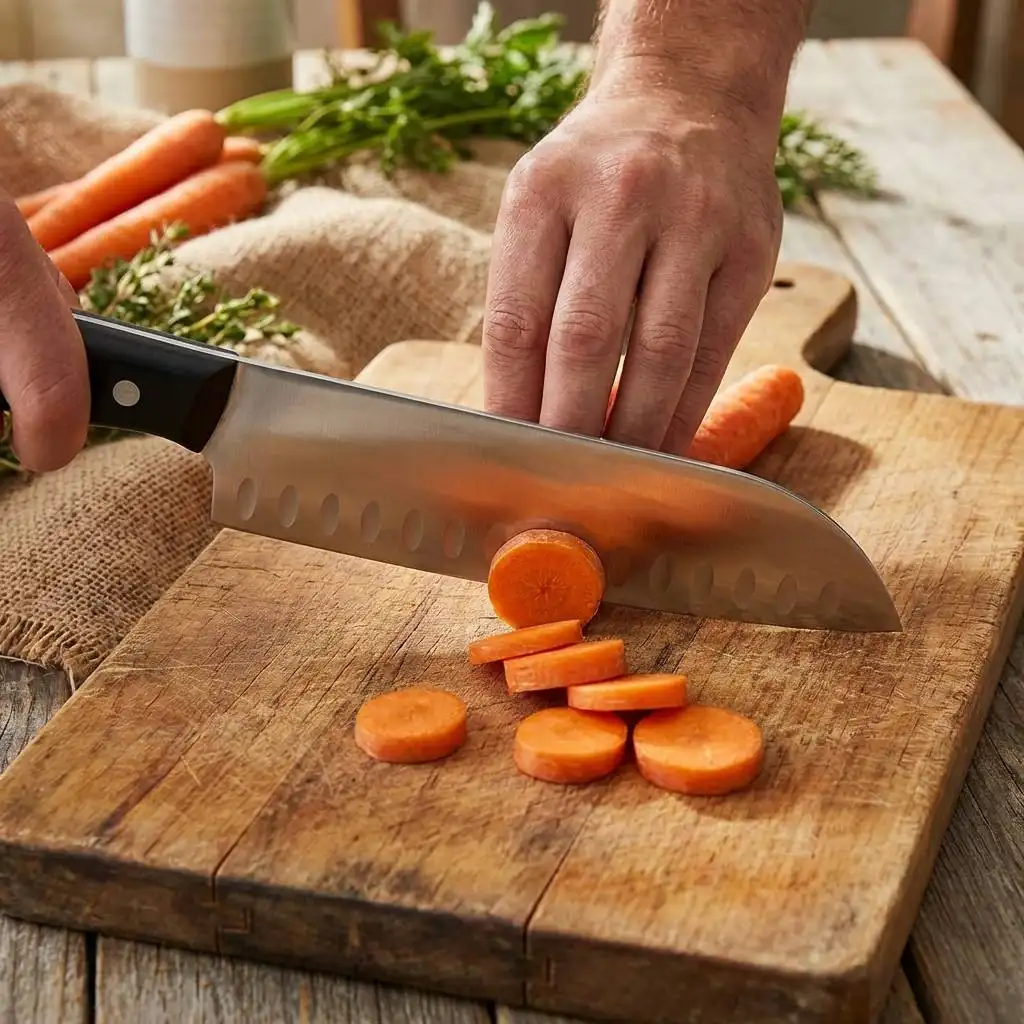
The Carrot Test: When you chop a thick carrot with a standard Henckels Chef knife, you will often hear a loud “CRACK” halfway through. This is wedging. The blade is so thick it acts like a splitting maul rather than a knife, breaking the vegetable apart before the edge cuts it. If you are looking for effortless, silent slicing, this isn’t it.
The Tomato Test: Out of the factory, Henckels edges are ground to roughly 15 degrees per side. They usually pass the tomato test (slicing without crushing the skin) right out of the box. But because the steel is soft, this ability fades fast without maintenance.
| Spec | Henckels (German) | Average Japanese Knife |
|---|---|---|
| Steel Type | X50CrMoV15 (Standard) | VG10 / SG2 / Blue Paper |
| Hardness (HRC) | 57 ±1 | 60 – 64 |
| Edge Retention | Low (requires honing) | High (brittle) |
| Grind Style | Convex / Robust | Flat / Thin |
Ergonomics & Handle Design: The “Handshake” of the Knife
A knife is the only tool you hold for hours at a time during intense mise en place. If the handshake is bad, your wrist will know about it.
Most Henckels sets use POM (polyoxymethylene) scales on the handles. It’s a dense, durable plastic. It doesn’t shrink or swell like wood, making it hygienic. However, it gets incredibly slippery when your hands are covered in chicken fat or oil. The finish is usually smooth and polished, which provides zero traction.
Regarding balance: These knives are typically handle-heavy due to the full tang and heavy steel end-caps on some models. This shifts the balance point back toward your wrist. Some cooks like this feeling of “heft,” but in a professional setting, a blade-heavy balance does more of the work for you.
The Verdict: Price-to-Performance Ratio
Are JA Henckels sets worth the money? That depends entirely on how you treat your tools.
The Pros
- Durability: You can practically run these over with a truck. They will not chip.
- Maintenance: Very easy to sharpen. The soft steel responds immediately to a honing rod or a standard pull-through sharpener.
- Warranty: Zwilling has legitimate customer service.
The Cons
- Edge Retention: Poor. You are paying for the brand name, not high-performance steel.
- Geometry: Thick and heavy. It wedges in dense produce.
- The Bolster: On the classic lines, the full bolster is a sharpening nightmare.
Who is this for? The home cook who wants a “buy it for life” set that can handle frozen food, bones, and being tossed into a sink full of other dishes. If you want tools you don’t have to baby, get the Zwilling Pro.
Who is this NOT for? The enthusiast. If you care about grain structure, distal taper, and “scary sharp” edges that last through 500 covers, look elsewhere. You will find the soft German steel frustratingly dull.
FAQ: Questions from the Pass
Can I put JA Henckels knives in the dishwasher?
Physically? Yes, the POM handles and stainless steel can survive it. Morally? Absolutely not. The high heat expands the metal, damaging the temper, and the detergent is abrasive enough to dull the edge immediately. If you respect your tools, hand wash them.
What is the difference between Zwilling and Henckels?
It comes down to the logo. Zwilling (The Twins) is the premium line, usually made in Germany or Spain with forged steel. Henckels International (The Single Man) is the budget line, often made in Asia using stamped sheet metal.
How often should I sharpen my Henckels set?
You should hone (align the edge with the steel rod) every single time you use the knife. You should sharpen (remove metal to create a new edge) about once every 6 months, depending on usage.