Is the Henckels Definition 20-Piece Self-Sharpening Set a Gimmick? A Pro Chef’s Honest Audit
Let’s address the elephant in the kitchen immediately. To a professional chef, the concept of a “self-sharpening” knife block is usually borderline sacrilege. In the kitchens I came up in—from high-volume French brigades to precise Japanese counters—you touched your blade to a whetstone or you got off the line. We controlled the angle, the grit, and the polish. Handing that responsibility over to a wooden box with hidden ceramic wheels feels like letting a robot cut your hair.
But I also live in the real world. I have friends who cook five nights a week and treat their knives like pry bars. They throw them in the sink, dull them on glass cutting boards (a capital offense), and haven’t seen a sharp edge since the unboxing. For them, a dull knife is a dangerous knife. A dull knife slips. A dull knife cuts fingers instead of onions.
So, I am putting aside my Japanese steel snobbery to audit the Henckels International Definition 20-Piece Self-Sharpening Set. Is it a marketing gimmick designed to eat your steel, or is it a necessary piece of engineering for the home cook who simply refuses to learn whetstone maintenance?
The “International” Distinction: What You’re Actually Buying
First, we need to clear up the branding confusion that catches 90% of buyers. There are two Henckels.
- ZWILLING J.A. Henckels: The premium line. The logo is two stick figures (the “Twins”). These are usually forged in Germany using Friodur ice-hardened steel.
- Henckels International: The value line. The logo is a “Single Man” holding a spear. These are manufactured in places like China, India, or Thailand.
The “Definition” set falls firmly into the International category. This matters because it dictates the construction. These knives are stamped, not forged. A sheet of stainless steel is stamped out like a cookie cutter, then ground and heat-treated.
What does this mean for your hand? Stamped knives are significantly lighter. They lack a heavy steel bolster (the thick junction between handle and blade). The steel is likely a standard X50CrMoV15 or a similar high-carbon stainless variant. It’s decent, utilitarian steel, but don’t let the marketing confuse you—this isn’t the same tool a Michelin chef is using. It’s a budget-friendly workhorse.
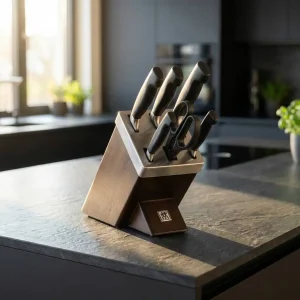
The Self-Sharpening Block: Innovation or Knife Coffin?
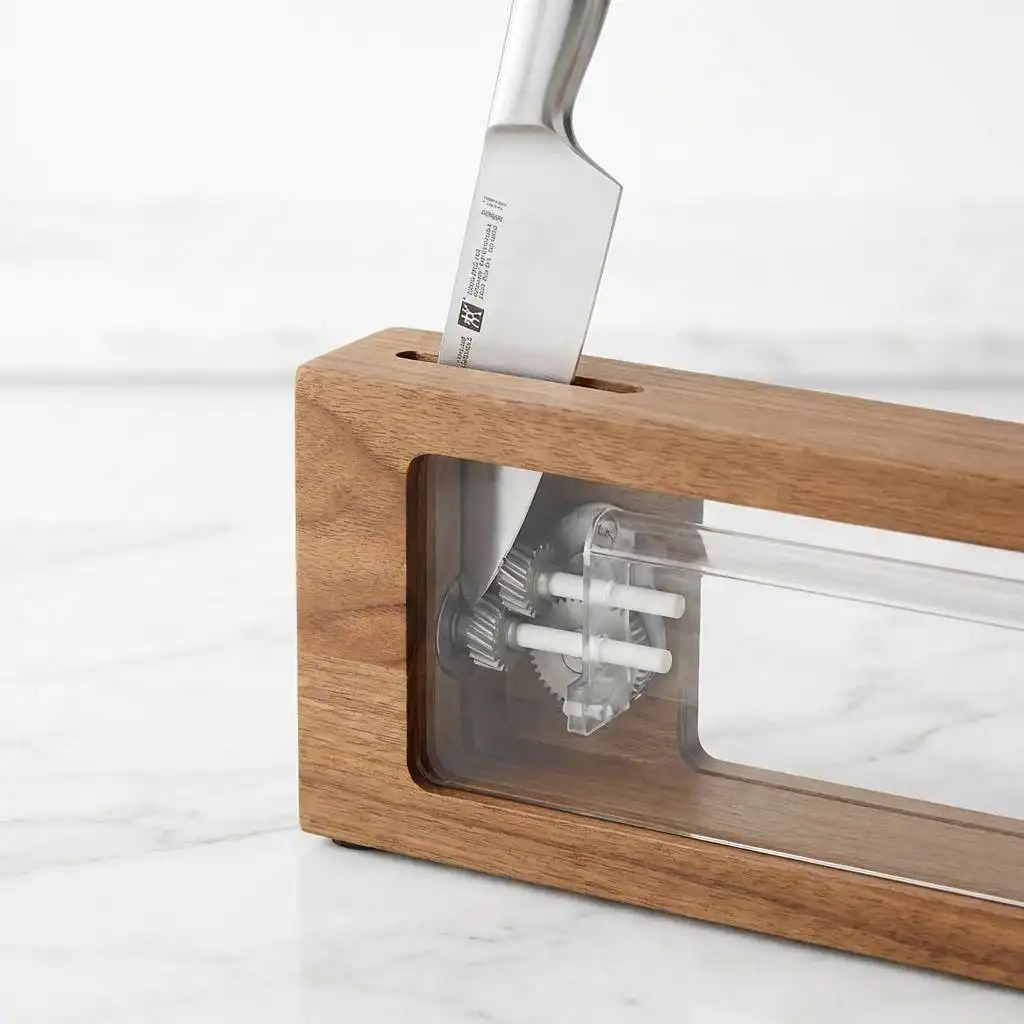
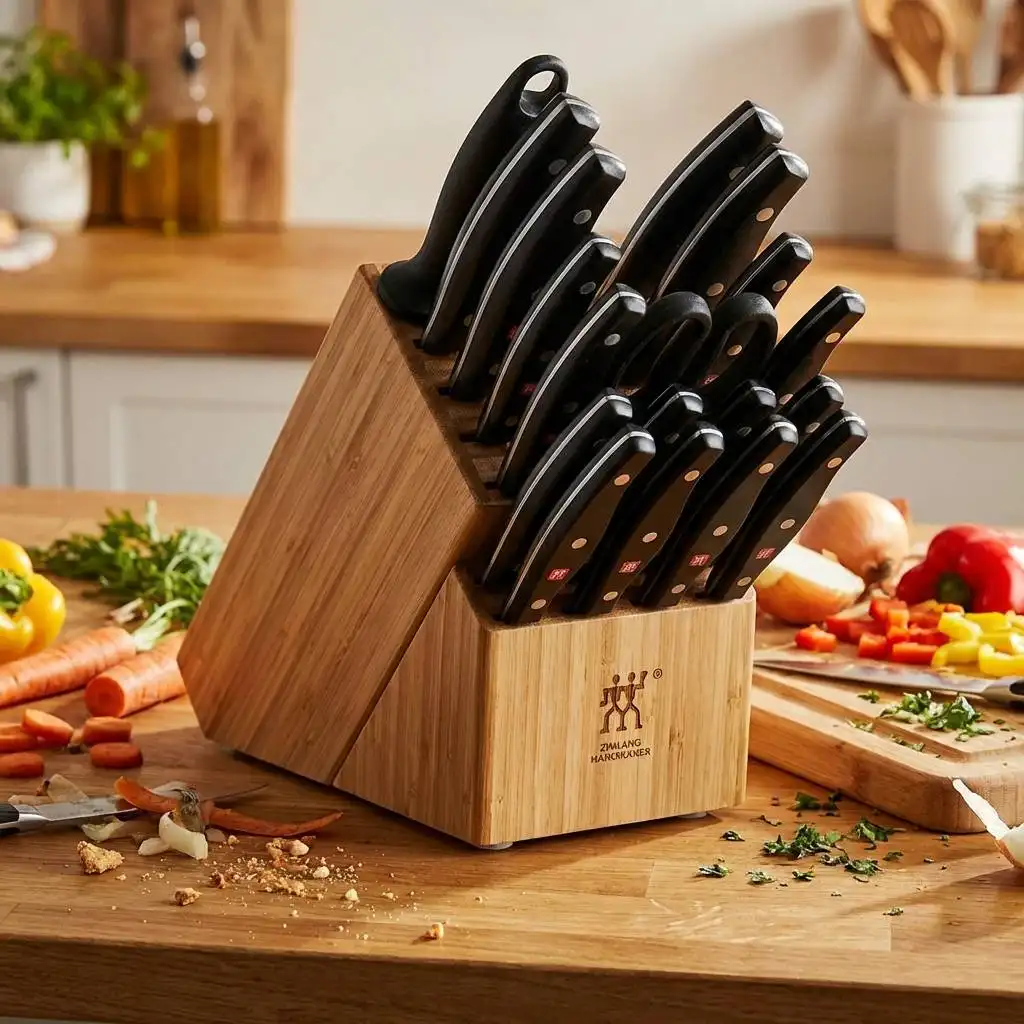
Here is the physics of the “Self-Sharpening” claim. The slots for the fine-edge knives (Chef, Santoku, Paring) contain built-in ceramic honing wheels set at a specific V-angle. Every time you pull the knife out or push it back in, the edge drags against these ceramic rods.
We need to distinguish between honing and sharpening. Honing realigns the microscopic “teeth” of the edge that get bent during use. Sharpening actually removes metal to create a new bevel. This block is aggressive—it does a bit of both.
The Risk: If you are the type of person who aggressively slams your knife back into the block, you are grinding away steel unnecessarily. You are essentially putting your knife on a diet every time you store it. Over three years of heavy use, you will notice the profile of the blade changing—the “belly” of the chef’s knife will flatten out as the steel is eaten away.
However, the Angle Enforcement is the redeeming factor here. Most home cooks can’t hold a steady 15-degree angle on a stone to save their lives. This block forces the angle. If the factory edge was 15 degrees and the block is set to 15 degrees, it maintains the edge. If the factory grind was sloppy (which happens with mass-market knives), the block will eventually correct it to its own angle. It’s a brute-force solution, but it works for maintenance.

Geometry & Grind: The “Definition” on the Cutting Board
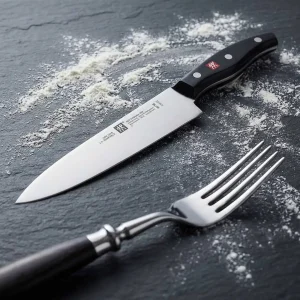
Let’s talk geometry. The “Definition” Chef’s knife features a traditional Western profile with a curved belly. This is designed for the “rock chop”—the motion where the tip stays on the board and the heel rocks up and down over herbs or garlic.
Because these are stamped knives, the spine thickness is relatively thin. In my testing, this actually gives the Definition an advantage over cheap forged knives in one specific area: The Carrot Test.
Thick, clunky knives “wedge” in dense vegetables—they crack the carrot open rather than slicing it. The Definition is thin enough to pass through with minimal resistance. However, the lack of distal taper (thinning toward the tip) means it feels largely the same thickness the whole length of the spine. It feels like a tool made in a factory, not shaped by a smith.
Ergonomics: The Handle and The Pinch Grip
The handles are a matte black polymer with a classic three-rivet look. It’s a full-tang construction, meaning the steel runs all the way to the butt of the handle. This is non-negotiable for durability. If a knife isn’t full tang, don’t buy it.
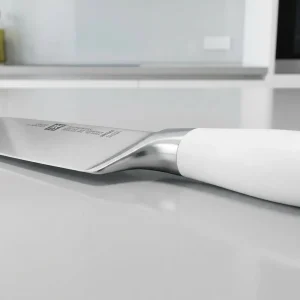
The Balance Point: This is where the stamped nature hurts the performance. Because the blade is light and thin, but the handle is full of steel tang and dense plastic, the balance point shifts back toward the handle.
When you use a “pinch grip” (thumb and index finger gripping the blade spine), the handle feels heavy. It wants to fall backward into your palm. It doesn’t feel like an extension of your arm; it feels like a tool you are holding. The lack of a smooth, rounded bolster also means the spine of the blade can dig into your index finger during a long prep session. It’s not comfortable for 50 pounds of onions, but for chopping one onion for spaghetti? It’s serviceable.
The 20-Piece Bloat: Do You Need This Much Steel?
Let’s do the math on the “20-Piece” claim. Whenever you see a set this large, check the inventory. Here is what you usually get:
- 1 Chef’s Knife (The Captain)
- 1 Santoku (The redundancy—basically a second Chef’s knife)
- 1 Paring Knife (Essential)
- 1 Utility Knife (The sandwich cutter)
- 1 Bread Knife (Essential)
- 1 Boning Knife (Rarely used by most home cooks)
- 1 Kitchen Shears
- 8 Steak Knives
- 1 Block
nearly half the “pieces” are steak knives. If you are buying this set for $200 (prices vary), and you subtract the value of the block and the steak knives, you are paying very little for the actual Chef’s knife. You are buying volume, not precision.
That said, the steak knives are usually serrated. This is smart for general dining use because serrations don’t dull instantly when hitting ceramic dinner plates. It’s a practical inclusion for a family, but don’t trick yourself into thinking you are getting 20 high-performance cooking tools.
Performance Stress Tests (The Board Exam)
I ran the typical battery of kitchen tests to see if the “Definition” could hang.
The Tomato Test (Sharpness)
Out of the box, the factory edge was decent. It sliced the skin of a ripe tomato without crushing it. However, the edge felt “toothy.” It didn’t glide like a polished Japanese edge; it sawed slightly. This is typical for mass-market finishing grits.
The Chicken Test (Slippage)
Breaking down a raw chicken requires grip. The polymer handles are smooth but have just enough contouring to prevent total slippage when your hands are greasy. However, compared to a textured material like Micarta or even rough G10, it feels a bit slick. You need to maintain a firm grip.
The Block Fit Test
This was the most annoying part. Sliding the knives into the sharpening slots creates a distinct grinding sound—metal on ceramic. It’s the sound of friction. If you have sensory issues with grinding noises, this block will drive you insane. Furthermore, there is significant resistance. You can’t just drop the knife in; you have to push it.
Durability & Edge Retention
The steel hardness (HRC) on these is likely in the 55-57 range. In the metallurgy world, this is “soft.” Soft steel rolls over easily, meaning the edge bends microscopically when it hits the cutting board.
This is exactly why the self-sharpening block is paired with these knives. If you didn’t hone/sharpen these soft blades constantly, they would be useless within two weeks of heavy use. The system is designed to compensate for the softer steel.
Longevity Prediction: The handles will last forever. The block is solid wood (usually stained rubberwood or ash) and will hold up. The blades, however, are on a timer. The self-sharpening mechanism removes material. Expect about 3 to 5 years of optimal geometry before the knives start looking significantly worn down or “re-curved” from the sharpener.
Verdict: Who Should Buy This?
Let’s be real: Self-sharpening blocks are basically training wheels for adults. If you buy this, you are admitting you will never learn to use a whetstone. And honestly? For 90% of home cooks, that’s probably a smart admission. Better a sharp cheap knife than a dull expensive one.
Pros
- Zero Maintenance: You literally don’t have to think about sharpening.
- Complete Ecosystem: You get every knife you could possibly need, plus steak knives.
- Price-to-Volume: A lot of steel for the money.
- Carrot Friendly: Thin, stamped blades don’t wedge in hard veg.
Cons
- Metal Removal: The block eats your knives over time.
- Ergonomics: Handle-heavy and lacks a comfortable bolster.
- Steak Knife Bloat: You are paying for 8 knives you might not need.
- Noise: The grinding sound of the block is unpleasant.
Buy this if: You are a busy parent, you cook frequently but quickly, and you know deep down you are never going to buy a ceramic honing rod or a whetstone. It ensures you always have a usable edge.
Skip this if: You care about the craft of cooking. If you enjoy the feeling of a perfectly balanced tool or want to learn how to maintain an edge yourself, buy one high-quality forged Chef’s knife (Zwilling Pro or Wusthof) instead of this entire bucket of stamped steel.