Henckels Modernist 14-Piece Review: Legit Forged Steel or Just “Department Store” Shiny?
The “Pain Point”: Confusion in the Aisle
You’re standing in the cutlery aisle—or scrolling through Amazon—and you see the “Henckels” name. You see the sleek, all-steel handle design that looks like it belongs in a minimalist architectural magazine. Then you see the price tag for the Henckels Modernist cutlery set 14 pc block. It seems too good to be true.
Here is the fear: Is this set going to rust the first time it sees a drop of water? Are those metal handles going to turn into slippery projectiles the second you touch a raw chicken breast? It’s a valid concern. Most budget-friendly “modern” knife sets are stamped sheets of metal welded to hollow tubes that rattle like cheap toys.
Let’s clear the air. I’m looking at the “Single Guy” logo—Henckels International—not the “Twins” (Zwilling). That means we aren’t dealing with hand-finished blades from Solingen, Germany. We are dealing with high-volume production, likely from China or Spain. Usually, an all-metal handle is a red flag for me. It screams “design over function” and typically results in a knife that is handle-heavy and fatiguing during a long prep session. But, specs are specs. I’m taking this set to the whetstone and the cutting board to see if the “Modernist” line earns its keep in a real mise en place or if it’s just shiny countertop jewelry.
The “Single Man” Logo: Understanding What You’re Buying
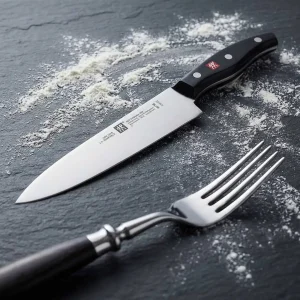
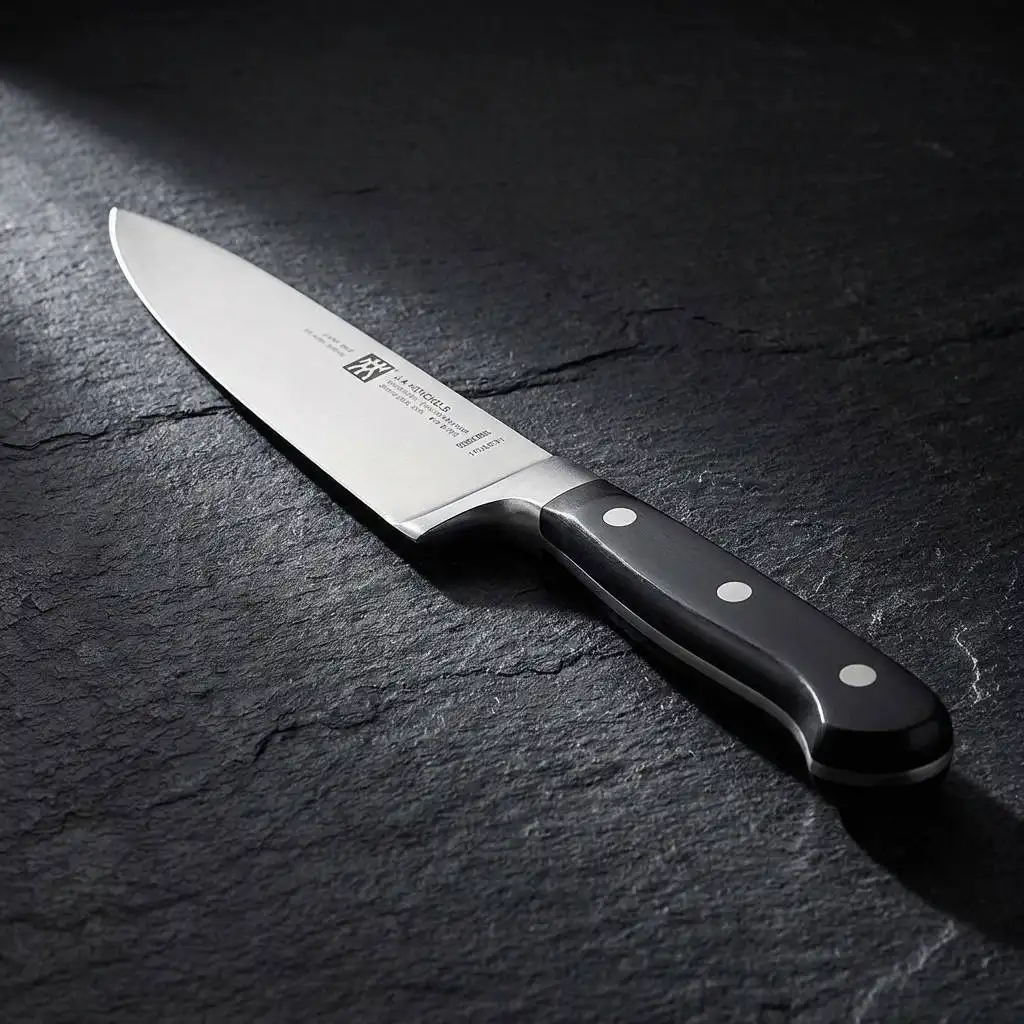
First, look at the logo on the blade. If you see one stick figure holding a halberd, you have Henckels International. If you see two figures, that’s Zwilling. The Modernist set is the former. This distinction matters for the price point, but purely from a metallurgical standpoint, origin matters less than the chemical composition of the steel.
We are looking at high-quality German Stainless Steel here, almost certainly X50CrMoV15. In the kitchen, we call this “The German Standard.” It is not a powder metallurgy “super steel” like SG2 or R2 that I’d use for precision sashimi slicing. It won’t hold an edge for six months of commercial abuse. However, X50 is practically indestructible. It bends before it breaks. It resists rust aggressively. For a home kitchen where the knife might accidentally get left wet on the board for an hour, this steel is a smarter choice than high-carbon options.
The Specs (Data Block)
Before we cut anything, let’s look at the numbers. This is what you are actually paying for:
- Steel Type: German Stainless (X50CrMoV15).
- Hardness (HRC): ~53-55 HRC. (Soft enough to resist chipping, hard enough for home use, but requires frequent maintenance).
- Construction: Fully Forged bolster.
- Handle: Stainless steel with a sandblasted texture.
- Tang: Fully integrated/welded into the handle construction.
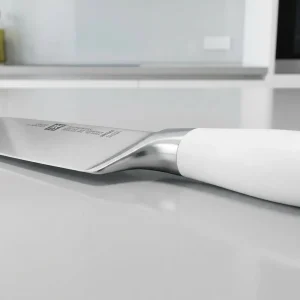
The standout spec here is the forged bolster. At this price point, 90% of competitors are selling stamped knives—flat sheets of metal cut out like cookies. A forged bolster provides a thick transition point between the blade and handle. It adds critical weight to the center of the knife, moving the balance point forward where you need it for control. Finding a true forged bolster in a budget 14-piece set is rare.

Ergonomics & The “Wet Hand” Test
I have a love-hate relationship with metal handles. They look clean, but in a professional kitchen, sweat and animal fat are realities. If a handle doesn’t have traction, it’s dangerous.
The Modernist series addresses this with a sandblasted texture on the grip. It’s not aggressive—it won’t tear up your hand like G10 fiberglass might—but it provides a matte friction that polished steel lacks. I ran the “Wet Hand” test: soaked my hand in water and simulated a pinch grip chop. The verdict? It’s acceptable. The ergonomic curve of the handle swells into the palm, which helps lock the hand in place. However, if your hands are covered in oil or chicken fat, you will lose some traction. You have to keep a towel on your hip.
Regarding balance: Because of the forged bolster and the likely hollow construction of the handle (standard for this design), the balance point sits right at the bolster. This is correct. It encourages a pinch grip, where your thumb and index finger grip the blade face, rather than a hammer grip on the handle. It feels nimble, not clunky.
Blade Geometry: The Carrot and Tomato Test
Out of the box, the “factory edge” was serviceable. It sliced copy paper cleanly but snagged a bit on the push cut. It’s sharpened to roughly 15 degrees per side, which is standard for Western knives.
The Carrot Test (Wedging): I took the 8-inch chef’s knife to a thick carrot. This is where we test the grind thickness. If the blade is too thick behind the edge, it will “wedge”—cracking the carrot open with a loud snap before actually cutting it. The Modernist performed decently. There was some resistance halfway through due to the spine thickness, but it didn’t wedge aggressively. It’s a workhorse grind, not a laser.
The Tomato Test (Bite): This tests the “tooth” of the edge. The knife bit into the tomato skin with minimal pressure. This tells me the factory finish is slightly coarse, which is actually good for kitchen utility work as it grabs onto slippery vegetable skins.
The 14-Piece Loadout: Filler vs. Killer
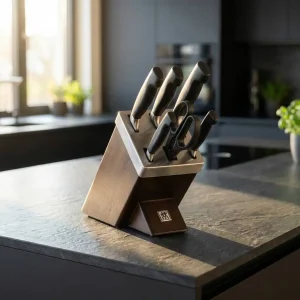
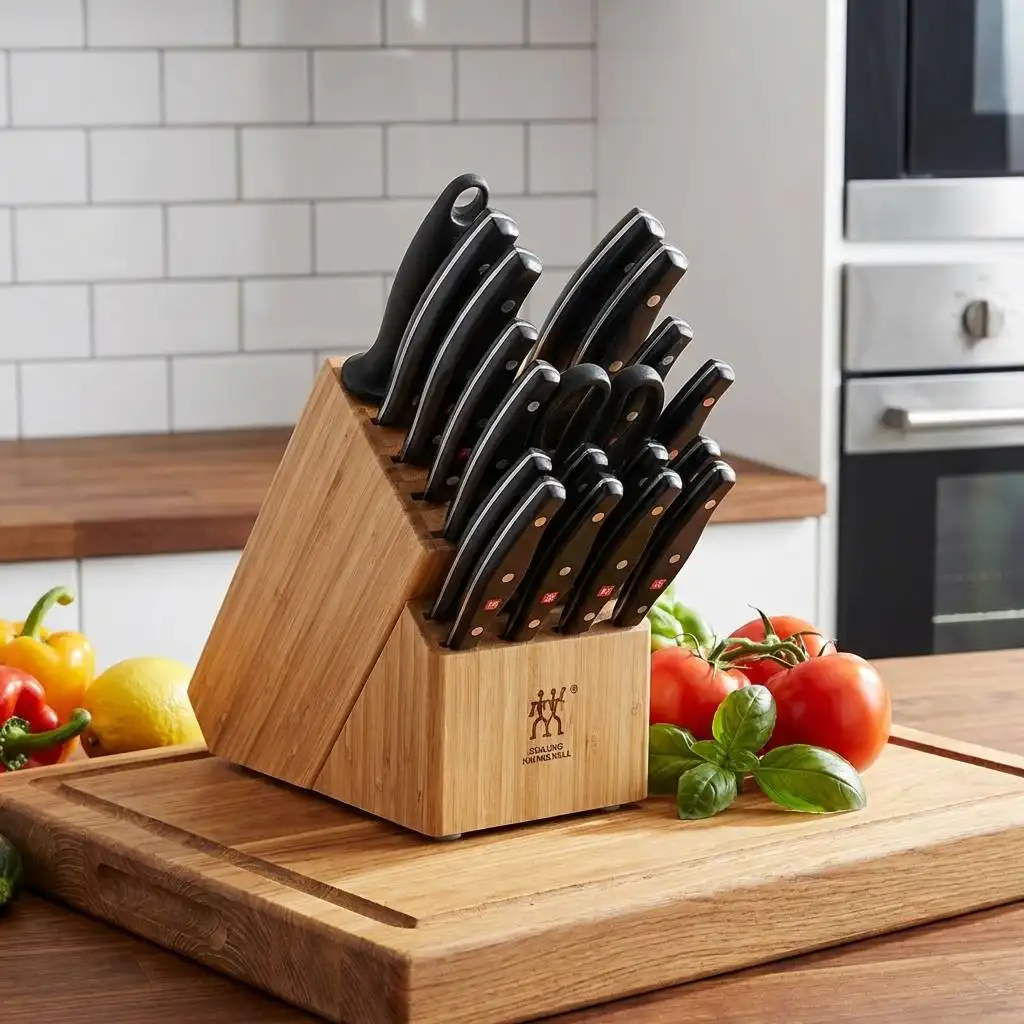
A 14-piece block is usually full of “filler”—tools you don’t need just to pump up the piece count. Here is the breakdown of the Modernist loadout:
The Stars
- 8″ Chef’s Knife: The primary tool. Good rocker belly for mincing herbs.
- Hollow Edge Santoku: The grantons (dimples) actually help. Because the finish on these knives is satin-smooth, starchy foods like potatoes stick like glue. The hollow edge creates air pockets to help release the food.
The “Meh”
- The Serrated Utility Knife: Let’s get one thing straight: A serrated utility knife is usually a manufacturer’s admission that they don’t trust you to keep a straight edge sharp. It tears through fiber rather than slicing it. But in this set, for cutting bagel sandwiches or tomatoes when your chef’s knife is dull, I’ll give it a pass.
The Steak Knives
There are six of them. They are serrated. For the average home, this is fine—they will stay “sharp” forever because the teeth protect the edge from the ceramic plates. But be aware, they tear meat fibers; they don’t slice them cleanly like a fine-edge steak knife would.
The Shears
They cut well, but I have to dock points if they don’t come apart. Take-apart shears are essential for sanitation. If raw chicken juice gets in the pivot screw and you can’t separate the blades to clean it, that’s a bacteria trap.
Edge Retention & Maintenance Reality
This is where the rubber meets the road. With a hardness of 53-55 HRC, this steel is soft compared to Japanese VG10 (60+ HRC). What does that mean for you?
It means the edge will “roll” rather than chip. When you hit a bone or a glass cutting board (don’t do that), the microscopic edge bends over. The good news: You can fix this in 10 seconds with the included honing steel. You must use the honing rod every 2-3 times you cook. If you do, these knives will perform well.
When it comes to actual sharpening on a stone, X50 steel feels “gummy.” It raises a large burr that flops back and forth. It can be frustrating to deburr perfectly if you are used to hard carbon steel, but it takes an edge very quickly. You don’t need expensive diamond plates for this; a standard 1000 grit combo stone is plenty.
The Dishwasher Myth
Henckels might print “Dishwasher Safe” on the box. I say: Over my dead body.
Just because the handle is metal doesn’t mean it’s invincible. Dishwasher detergents are abrasive; they will sandblast that nice satin finish into a dull gray over time. Worse, the high heat cycles cause expansion and contraction. Even on a welded metal knife, micro-gaps can form, or water can get trapped in the block if you put them away damp. And “Stainless” is not “Stain-proof.” If a carbon steel pan touches these in the wash, you will get rust spots transfer. Wash them by hand, dry them immediately.
Verdict: The Price-to-Performance Ratio
So, is the Henckels Modernist 14-piece set worth the cash?
Pros: You get a fully forged bolster, which provides a professional balance rarely seen at this price. The steel is durable and forgiving. The aesthetic is undeniable.
Cons: The steel is soft and requires honing. The metal handles, while textured, will never be as grippy as a synthetic composite. The block is bulky.
The Final Cut: If you are an aspiring pro looking for high-performance laser cutters, look elsewhere. But if you are a home cook who wants a set that looks incredible on the counter, feels substantial in the hand, and can survive the abuse of daily family meal prep without chipping, this is a solid buy. It outperforms the stamped “Gourmet” lines significantly due to that forged bolster.