Henckels International Statement 20-Pc Review: A Chef’s Honest Take on “Self-Sharpening” Blocks
Let’s talk about the elephant in the room: Fear. Most home cooks are terrified of their knives. They’re afraid of cutting themselves, sure, but they’re mostly afraid of ruining the knife. Or, they’re just exhausted by the maintenance. The result? A drawer full of dull, dangerous metal that mashes tomatoes rather than slicing them.
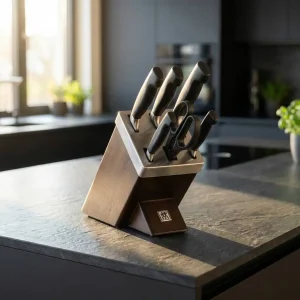
Enter the Henckels International Statement 20-Piece Self-Sharpening Block Set. The marketing pitch is seductive: “A knife set that takes care of itself.” It promises to eliminate the drudgery of honing and the skill curve of whetstone sharpening.
Look, in my kitchens, we sharpen on whetstones at the end of every shift. It’s a ritual. It’s part of our mise en place for the next day. So, when I see a block that promises to do my job for me, my instinct is skepticism. But I also know you aren’t trying to prep 400 covers of Beef Bourguignon on a Tuesday night while yelling at a sous chef. I’m judging this set not against my $400 Takamura laser, but against the reality of a busy home kitchen that just needs dinner on the table.
First Things First: The “International” vs. “Zwilling” Confusion
Before we look at grain structure or edge geometry, we need to clear up the branding confusion that tricks 90% of buyers. You see “Henckels” and you think “German Engineering, Solingen, Centuries of tradition.”
Stop right there.
There are two main lines under the Zwilling J.A. Henckels umbrella:
- Zwilling (The Twins): The logo has two little stick figures. These are usually made in Germany, forged, and expensive.
- Henckels International (The Single Man): The logo has one stick figure holding a halberd. These are the value line.
The Statement set falls under the “Single Man” logo. These knives are not forged in Germany. They are manufactured in China (sometimes Spain or Thailand depending on the production lot). Why does this matter? Because you need to manage your expectations regarding fit and finish. You are buying a budget-friendly entry-level set designed for mass production, not an heirloom piece of cutlery you’ll pass down to your grandkids. This is a workhorse for the here and now.
The Specs: What Exactly Are You Buying?
As a steel nerd, I don’t care about the box art. I care about the metallurgy. Here is what is actually under the hood of the Statement line.
The Steel
Henckels uses a proprietary “special formula” stainless steel here. In industry terms, this is almost certainly an equivalent to X50CrMoV15 or a similar Chinese DIN standard alloy. It is a high-carbon, stain-resistant steel.
Hardness (HRC)
If I had to bet my station on it, these clock in around 53-54 HRC on the Rockwell scale. For reference, premium Japanese steel hits 60-64 HRC.
What does this mean for you? The steel is softer.
The Good: It is incredibly tough. You can drop it, bang it against a bone, or abuse it, and it will likely dent or roll rather than chip.
The Bad: It cannot hold a steep, razor-sharp edge for very long. It will “roll” (bend over at the microscopic level) after just a few heavy prep sessions.
Construction
These are stamped knives, not forged. They are punched out of a large sheet of steel like a cookie cutter. However, Henckels has added a metal end-cap on the handle. This is a clever design trick to mimic the weight and balance of a forged knife, giving it a more substantial feel in the hand than a flimsy dollar-store blade.

The “Self-Sharpening” Block: Gimmick or Genius?
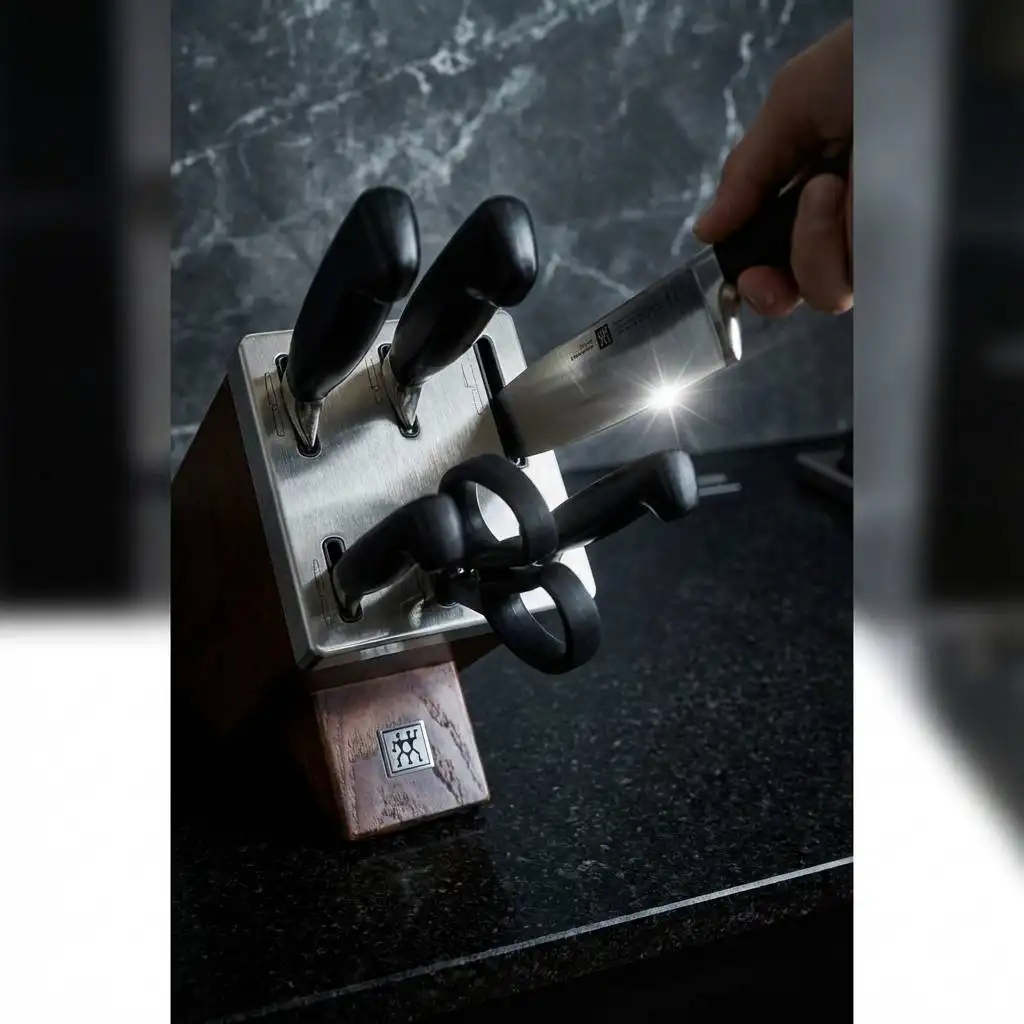
This is the main selling point, right? The block features slots labeled for specific knives (Chef, Santoku, Paring, etc.). Inside these slots are built-in ceramic honing wheels set at a specific angle (approx. 15 degrees).
The Mechanics
Every time you pull the knife out or put it back in, the edge drags across these ceramic rods. It’s an aggressive form of honing.
The “Steel Nerd” Analysis
Here is the physics: A normal honing rod realigns the edge. These slots do a bit of honing and a bit of micro-sharpening (removing metal). Because the steel is soft (53 HRC), it responds very well to this. It forces the edge back into alignment instantly.
The Verdict on the Block
Pros: For the average cook, the knife will never feel “dull.” It will always slice paper reasonably well because you are constantly dressing the edge.
Cons: You are grinding away your knife. Honestly, self-sharpening blocks are basically knife coffins. They keep your edge usable by slowly grinding your knife into a toothpick. But if you’re the type of person who hasn’t sharpened a knife since 2015, this slow death is better than cutting with a dull spoon.
Pro Tip: The sound will make your teeth hurt—that dry “zip” of metal dragging on ceramic. To minimize the damage, don’t saw the knife in and out. One smooth pull is enough.
Ergonomics & Handle Design: The “Statement” Feel
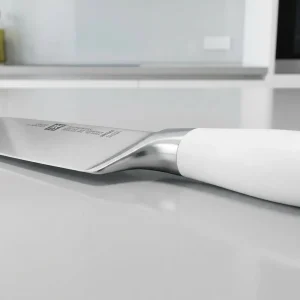
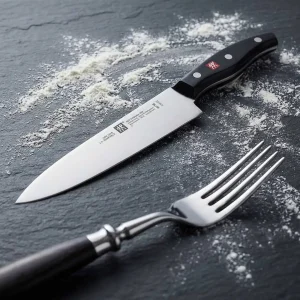
The handle utilizes a traditional triple-rivet design with a black polymer (plastic) scale. It looks professional on the counter, mimicking the aesthetic of the high-end Zwilling Pro line.
Balance Point: Because these are stamped blades (which are lighter) but they have that heavy metal end-cap, the balance point shifts backward toward the handle. It feels “butt-heavy.” For a pinch grip user like me, this feels slightly unnatural, as I want the weight forward to help the knife fall through the food. For a handle-gripper (which most home cooks are), it feels secure and solid.
The Pinch Grip Test: This is where budget knives usually fail. The spine of the Statement knife has not been rounded or polished. It has sharp 90-degree corners. If you use a professional pinch grip for an hour of prep, you are going to feel a callus forming on your index finger. It’s not a dealbreaker, but it’s a reminder of the price point.
The Board Test: Performance Evaluation
I took the 8-inch Chef’s Knife and the Santoku through a standard prep list to see if they could hang.
The Tomato Test
Out of the box, the factory edge was decent. It bit into the tomato skin without sliding off. This is “toothiness,” and softer stainless steel is good at this. However, the blade geometry is a bit thick behind the edge compared to higher-end knives. It requires a bit more pressure to complete the slice.
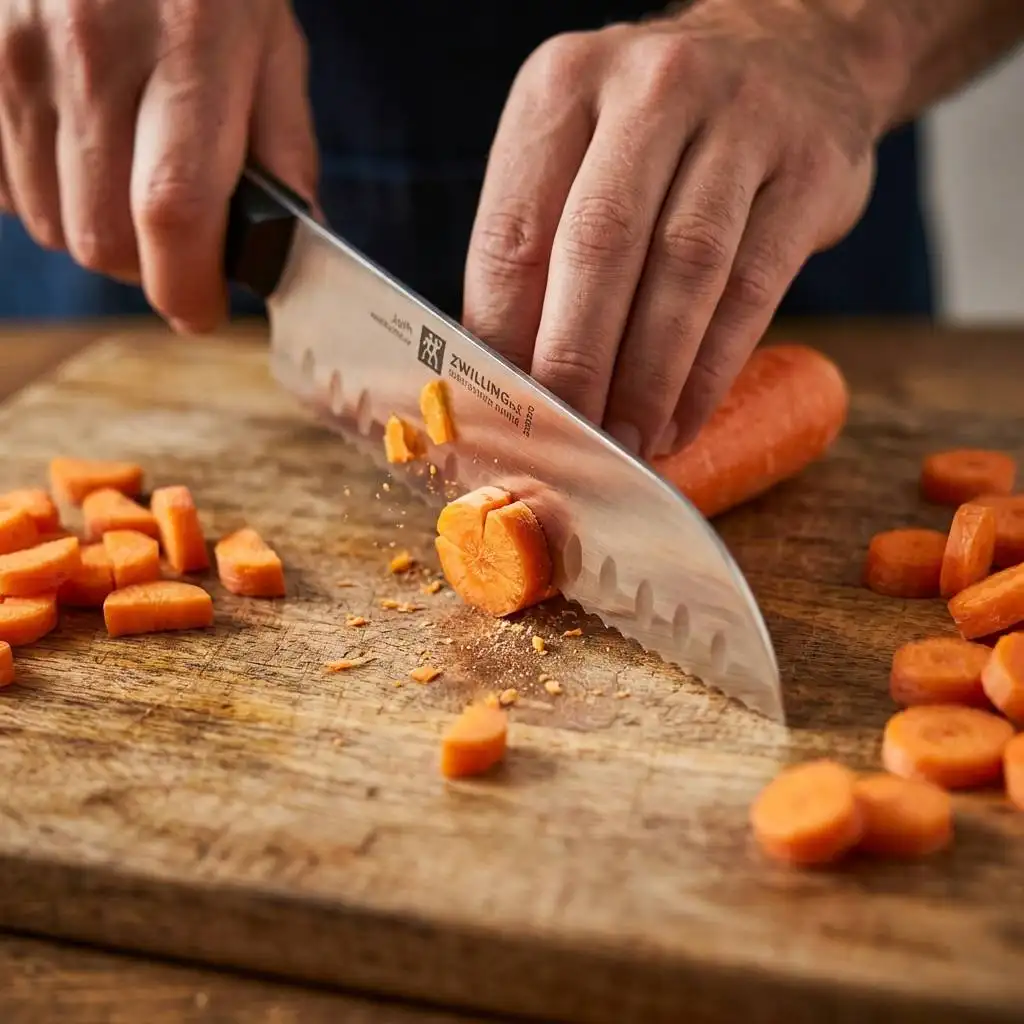
The Carrot Test (Wedging)
When cutting dense carrots, I noticed significant “wedging.” This happens when the knife is too thick near the spine, causing the carrot to crack apart with a loud snap before the cut is finished, rather than slicing silently through. It’s functional, but it lacks finesse.
The 20-Piece Bloat
Let’s be real about the “20-piece” claim. Here is the breakdown:
The Core: Chef, Santoku, Bread, Utility, Paring. (5 useful knives).
The Filler: 8 Steak Knives, Shears, and the Block.
You are essentially buying a steak knife set that happens to come with kitchen tools. The steak knives are non-serrated (straight edge), which I actually prefer because they cut meat cleanly without tearing it like a saw, but they will go dull on ceramic dinner plates very fast.
Maintenance: The Reality of Softer Steel
Since the steel is softer, edge retention is not its strong suit. Without the self-sharpening block, this knife would go dull in about two weeks of regular use.
The Dishwasher Warning: I will type this as loudly as I can: DO NOT PUT THESE IN THE DISHWASHER.
I don’t care what the box says. The dishwasher is a torture chamber for knives. The high heat causes the metal tang to expand at a different rate than the plastic handle, eventually causing the handle to crack or separate. The harsh detergent will eat away at the aluminum rivets. If you want this set to last more than a year, hand wash and dry immediately.
Comparison: Henckels Statement vs. The Competition
Is this the best bang for your buck? Let’s look at the data.
| Feature | Henckels Statement (This Review) | Zwilling Pro | Mercer Genesis |
|---|---|---|---|
| Construction | Stamped (w/ End Cap) | Forged | Forged |
| Steel Hardness | ~54 HRC (Soft) | ~57 HRC (Medium) | ~56 HRC (Medium) |
| Sharpener | Built-in Ceramic Wheels | None (Standard Block) | None (Usually glass/roll) |
| Origin | China/Spain | Germany | Taiwan |
| Ideal For | Low Maintenance / Beginners | Enthusiasts / Pros | Culinary Students |
The Final Cut: Who is this Set For?
After putting the Henckels International Statement through the wringer, here is the verdict.
Pros
- Zero Maintenance: The block keeps them usable without you learning to sharpen.
- Aesthetics: They look more expensive than they are with the steel caps and triple rivets.
- Durability: The soft steel is forgiving of bad technique and abuse.
- Complete Kit: You won’t need to buy another knife for a long time.
Cons
- Steel Consumption: The block eats your knives over time.
- Fit and Finish: Sharp spines and “blocky” handles.
- Steak Knife Heavy: Half the set is for the dining table, not the kitchen.
The Ideal User: This set is perfect for the busy family cook who views cooking as a chore to be completed efficiently. You want a uniform look on your counter, you hate the idea of using a sharpening stone, and you want a knife that cuts when you pull it out. For the current MSRP, the convenience factor is high.
The “Hard Pass” User: If you are interested in culinary arts, enjoy the feeling of a laser-sharp cut, or obsess over grain structure, walk away. You will find the grind too thick and the self-sharpening feature annoying.
Price-to-Performance Ratio: Solid, provided you understand you are paying for the convenience of the block, not the pedigree of the steel.
FAQ: Common Questions About Henckels International
Are Henckels International knives made in Germany?
No. While Henckels is a German company, the “International” (Single Man logo) line is manufactured in factories in China, Spain, or Thailand to keep costs down. Only the “Zwilling” (Twin logo) lines are typically made in Solingen, Germany.
Do the self-sharpening slots ruin the knives?
It’s a nuanced “yes.” They don’t ruin them immediately, but they aggressively remove metal every time you use them. Over 5 to 10 years, you will notice the blade shape changing (recurving) significantly more than if you hand-sharpened them. It shortens the lifespan of the knife in exchange for daily sharpness.
Can I put the Statement set in the dishwasher?
Absolutely not. Dishwasher detergent is abrasive and corrosive to the rivets, and the heat cycles will destroy the bond between the handle and the steel tang. Hand wash only.
What is the angle of the Henckels Statement knives?
These are sharpened to approximately 15 degrees per side. This is sharper than the old-school standard of 20 degrees, making them slice better, but the edge is also more fragile.