Henckels International Solution 12-Piece Review: A Pro Chef’s Honest Take on “Budget” Steel
The Hook: Can a “Beater” Set Actually Cut It?
We need to address the elephant in the kitchen immediately: You are looking at this set because you want German engineering, but you don’t want to take out a second mortgage to pay for it. You see the name “Henckels,” you see a price tag that feels suspiciously reasonable, and the anxiety kicks in. Is this a legitimate culinary tool, or is it supermarket trash that’s going to rust in a week and crush a ripe tomato rather than slice it?
Look, I get it. On the line, my knife roll holds $400 Japanese lasers made of Aogami Super steel that chip if you look at them wrong. But I’m a realist. I don’t use those at home when I’m drunk-cooking a grilled cheese at 2 AM, and I certainly don’t bring them to an Airbnb. Every chef needs a “beater” set. I grabbed the Henckels International Solution 12-Piece Set to answer one specific question: Is this just a brand name stamped on mystery metal, or is it a viable tool for a home cook who just wants to get dinner on the table?
The “One Man” vs. “The Twins”: Clearing Up the Branding Scam
Before we talk about edge geometry, we have to clear up the most common deception in the cutlery industry. Marketing departments love to blur the lines here.
There are two Henckels:
- Zwilling J.A. Henckels (The Twins): The logo has two little stick figures. These are generally forged in Germany, cryo-hardened, and cost a fortune.
- Henckels International (The Halberdier): The logo is a single stick figure holding a spear. These are the value lines, manufactured in China, Thailand, or India.
The “Solution” set falls squarely into the International category. Don’t kid yourself—you aren’t getting Solingen craftsmanship or centuries of German forging tradition here. You are buying a mass-produced, stamped steel product manufactured in Asia. But here is the kicker: that doesn’t necessarily mean it’s useless. It just means we need to adjust our expectations regarding edge retention and physics.

The Specs: What Exactly Are We Cutting With?
Let’s strip away the box art and look at the metallurgy.
- Steel Type: High-quality Stainless Steel (Likely X50CrMoV15 or a close Asian equivalent). It’s stain-resistant, but soft.
- Hardness (HRC): Estimated at 53-55 HRC. To a layman, this means the steel is soft. It won’t chip easily, but it will lose its edge faster than a politician breaks a promise.
- Construction: Stamped. These blades are punched out of a large sheet of steel, tempered, and ground. They lack the thick bolster and heavy weight of a forged knife.
- Tang: Full tang. The metal runs all the way through the handle, which is a rare win at this price point.
The Set List:
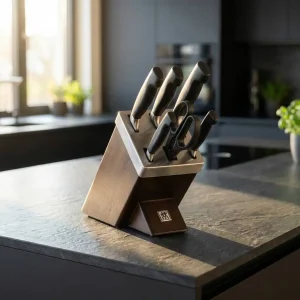
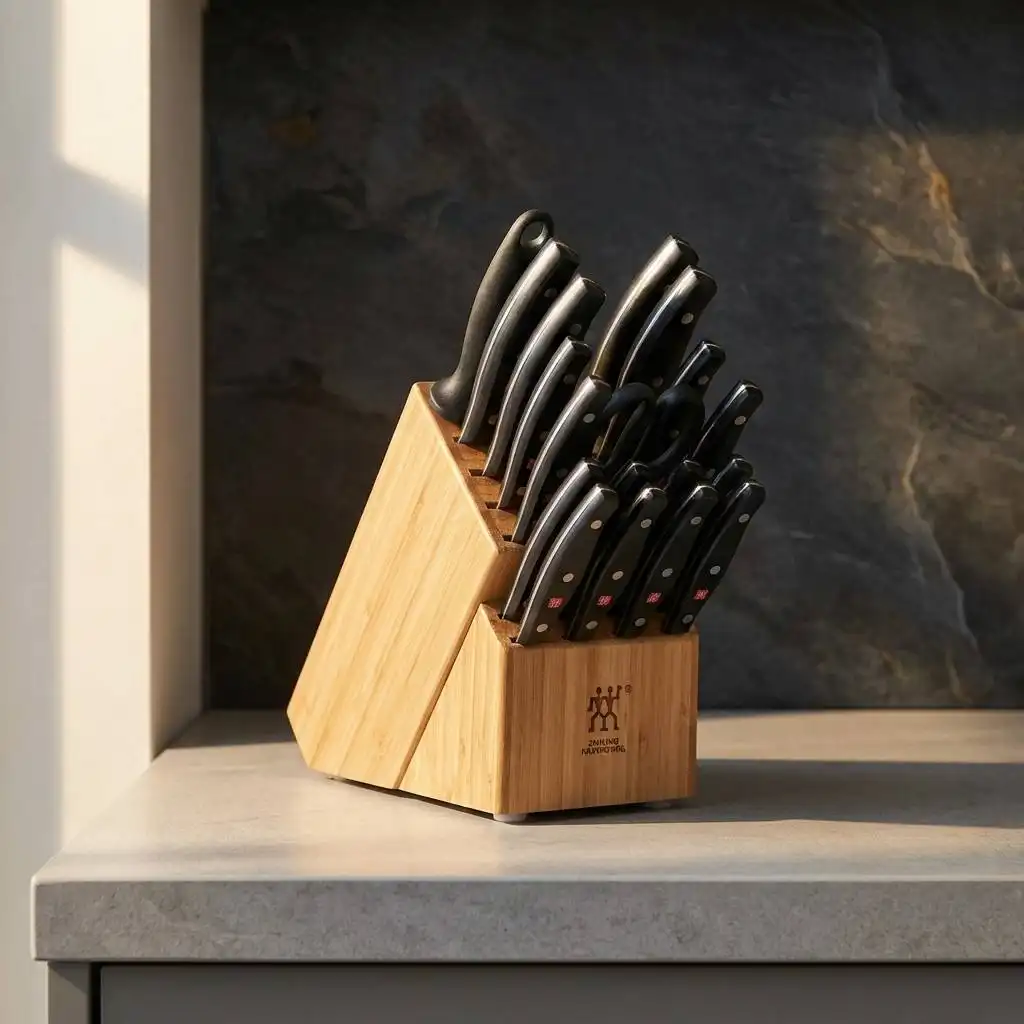
You get an 8″ Chef’s Knife, 5″ Santoku, 5.5″ Utility, 4″ Paring, six steak knives, and a sharpening steel (honing rod).
The 8-Inch Chef’s Knife: The Make or Break Analysis
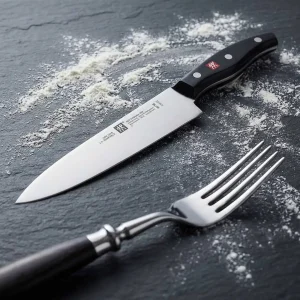
If the Chef’s knife is garbage, the set is garbage. It’s the engine of your mise en place. I put the Solution 8-inch blade through the wringer.
Geometry & Grind
Because this is a stamped knife, the spine is relatively thin. In the culinary world, thin is often better than thick. A thin blade moves through produce with less resistance. The grind is a standard flat grind that tapers decently toward the edge. It’s not a laser, but it’s not a splitting maul either.
The Board Test
I started with the Carrot Test to check for wedging. “Wedging” is when a knife is so thick behind the edge that it cracks the vegetable open rather than slicing it. Surprisingly, the Solution knife performed adequately here. It didn’t crack the carrot, though I felt some resistance halfway through the cut.
Balance
This is where the low cost shows up. Without a heavy steel bolster to act as a counterweight, the knife is extremely handle-heavy. The balance point sits an inch or so behind the pinch-grip area, back into the handle. This makes the tip feel “floaty” and disconnected. If you are used to a weighted German knife, this will feel like a toy.
The Support Crew: Paring, Utility, and Steak Knives
The Paring Knife
The 4-inch parer is actually the highlight of the set. Stamped steel works great for small knives. The tip is fine enough to hull strawberries or devein shrimp without tearing the flesh.
The Santoku
It features “hollow edge” grantons—those little divots on the side of the blade meant to create air pockets so food releases. Honest truth? On a knife this cheap, they are mostly decorative. Potatoes still stuck to the side of the blade like glue. However, the straighter profile is nice for push-cutting vegetables.
The Steak Knives (The Filler)
Here is the hard truth about “12-Piece” sets: Half the set is filler. You are getting six serrated steak knives. I despise serrated steak knives. They don’t slice your ribeye; they tear the fibers apart like a saw. It ruins the mouthfeel of good meat. They are included to inflate the piece count so the marketing team can write “12-Piece Set” on the box.
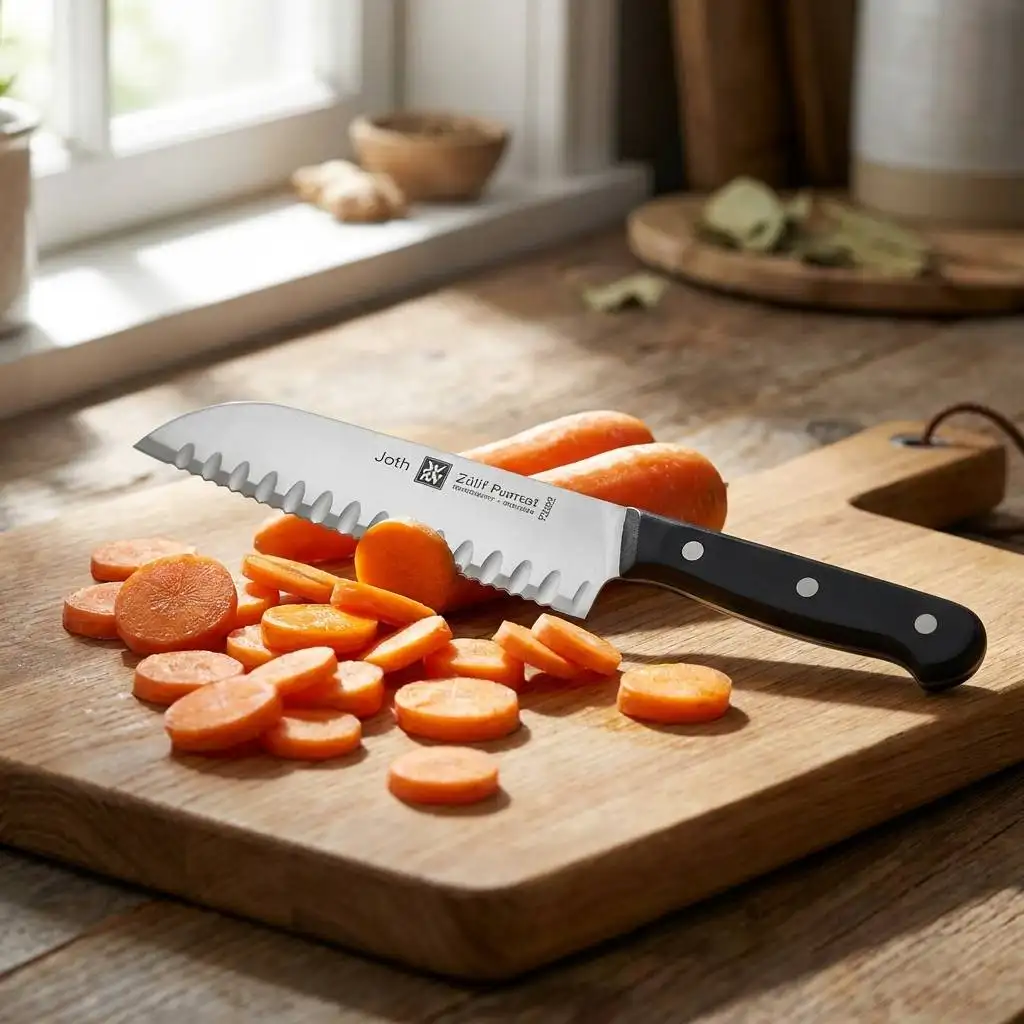
Ergonomics: The “Solution” Handle Design
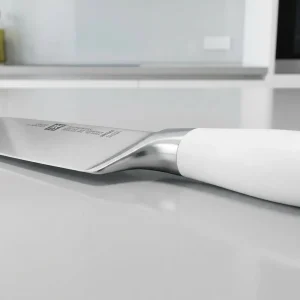
The handles are a sculpted, black polymer with a traditional three-rivet look. They are curved to fit the palm.
The Pinch Grip: As a pro, I use a pinch grip (thumb and index finger on the blade spine). The Solution handle curves forward slightly, which is comfortable, but the spine of the knife is not rounded—it’s squared off and a bit sharp. After an hour of prep, my index finger was feeling the abrasion.
Texture: The plastic is smooth. Too smooth. Once my hands were covered in chicken fat, the handle became slippery. You have to grip tight to keep control, which leads to hand fatigue.
Performance Stress Test: The Kitchen Reality
The Tomato Test
Out of the box, the factory edge was surprisingly toothy. It bit into the skin of a soft tomato without sliding off. Henckels (even the International branch) generally does a good job on the initial sharpen.
Edge Retention
Here is the reality of 53 HRC steel. After prepping a mirepoix (onions, carrots, celery) for a stew and slicing two chicken breasts, the edge was already starting to roll. I could feel it sliding on the bell pepper skins. This is not a “sharpen once a year” knife. This is a “hone every single time” knife.
The Honing Rod
The set includes a steel honing rod. You will need this. It is aggressive enough to realign the soft steel edge quickly. If you don’t learn how to use this rod, these knives will be butter knives within a month.
Maintenance: The Price of Soft Steel
The downside of this set is retention. The upside? Maintenance is incredibly easy.
Because the steel is soft, it doesn’t require diamond stones or a master sharpener to fix. You can run this through a cheap pull-through sharpener (as much as I hate them, they serve a purpose here) and get a working edge back in ten seconds. It’s forgiving. If you drop it, it won’t shatter like a Shun or Miyabi.
Comparison: Henckels Solution vs. The Competition
| Model | Steel Hardness (Est) | Tang Style | Handle Material | My Take |
|---|---|---|---|---|
| Henckels Solution | ~53-55 HRC | Full Tang | Polymer (Slippery) | Best looking, weakest steel. |
| Victorinox Fibrox | ~55-56 HRC | Partial Tang | Fibrox (Grippy) | Ugly as sin, but cuts better. |
| Mercer Culinary | ~54-56 HRC | Full Tang | Santoprene | The culinary student standard. |
FAQ: Questions From the Pass
Is Henckels International the same as Zwilling?
No. Zwilling is the premium German brand. Henckels International is the budget value brand made in Asia. The steel quality, heat treatment, and finish are completely different.
Can I put the Henckels Solution set in the dishwasher?
Physically? Yes, the materials will survive. But if you do, you deserve dull knives. The dishwasher jets knock the blades against other cutlery, destroying the edge, and the high heat can warp the handle rivets over time. Hand wash only.
Are these knives made in Germany?
No. The Henckels Solution line is manufactured in places like China, India, or Thailand to keep costs down.
The Final Cut: Who is This Set For?
Let’s be real: Half of this “12-piece set” is just filler. You’re paying for a block and six steak knives that function like mini-saws. You’re really buying three actual cooking knives. If you’re okay with that math, proceed. If you want performance, buy one good Chef’s knife for the same price.
Pros
- Price: Extremely affordable for a full block set.
- Aesthetics: They look like “real” pro knives on the counter.
- Durability: The soft steel is tough and won’t chip.
- Maintenance: Very easy to sharpen.
Cons
- Edge Retention: Poor. Requires constant honing.
- Balance: Handle-heavy and feels cheap in the hand.
- Steak Knives: Serrated tear-fest.
Verdict
The Henckels International Solution 12-Piece Set is the perfect starter kit for a college student, a first apartment, or a vacation home. It is for the cook who makes dinner three times a week and puts the knives in the dishwasher despite my warnings. If you are an aspiring chef or a BBQ enthusiast looking to break down briskets, look elsewhere. These will frustrate you. But for slicing a sandwich and chopping an onion? They get the job done.