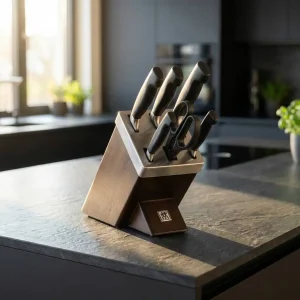
Henckels International Solution 12-pc Review: Budget “Beater” or Culinary Scrap Metal?
Let’s clear the air before we even open the box. If you walked into my kitchen 10 years ago and saw a stamped steel knife set, you’d probably hear an earful about proper metallurgy and grain flow. But after 15 years in high-volume French and Japanese kitchens, I’ve learned a hard truth: not every meal requires a $400 hand-forged Gyuto from Sakai.
Sometimes, you just need a “beater.” You need a knife you can hand to a prep cook who thinks a honing rod is a percussion instrument. You need a set for the vacation rental where guests treat knives like pry bars.
The Henckels International Solution 12-pc Cutlery Set sits squarely in that “budget utilitarian” category. But there is massive confusion about this brand. Are you buying premium German engineering, or are you buying a stamped sheet of metal with a famous logo? I’m putting this set through the wringer—analyzing the HRC hardness, the grind geometry, and the ergonomics—to see if it’s a valid workhorse or just shiny landfill.
The “Single Man” vs. “The Twins”: What You Are Actually Buying
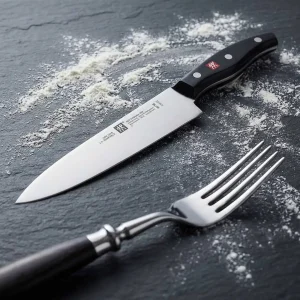
First, look at the logo. Do you see two little stick figures (The Twins) or just one guy holding a halberd (The Single Man)?
The Henckels International Solution line carries the “Single Man” logo. This is crucial. It means these knives are not forged in Solingen, Germany. They are manufactured in Asia (typically China, Thailand, or India depending on the production run) to hit a specific low price point.
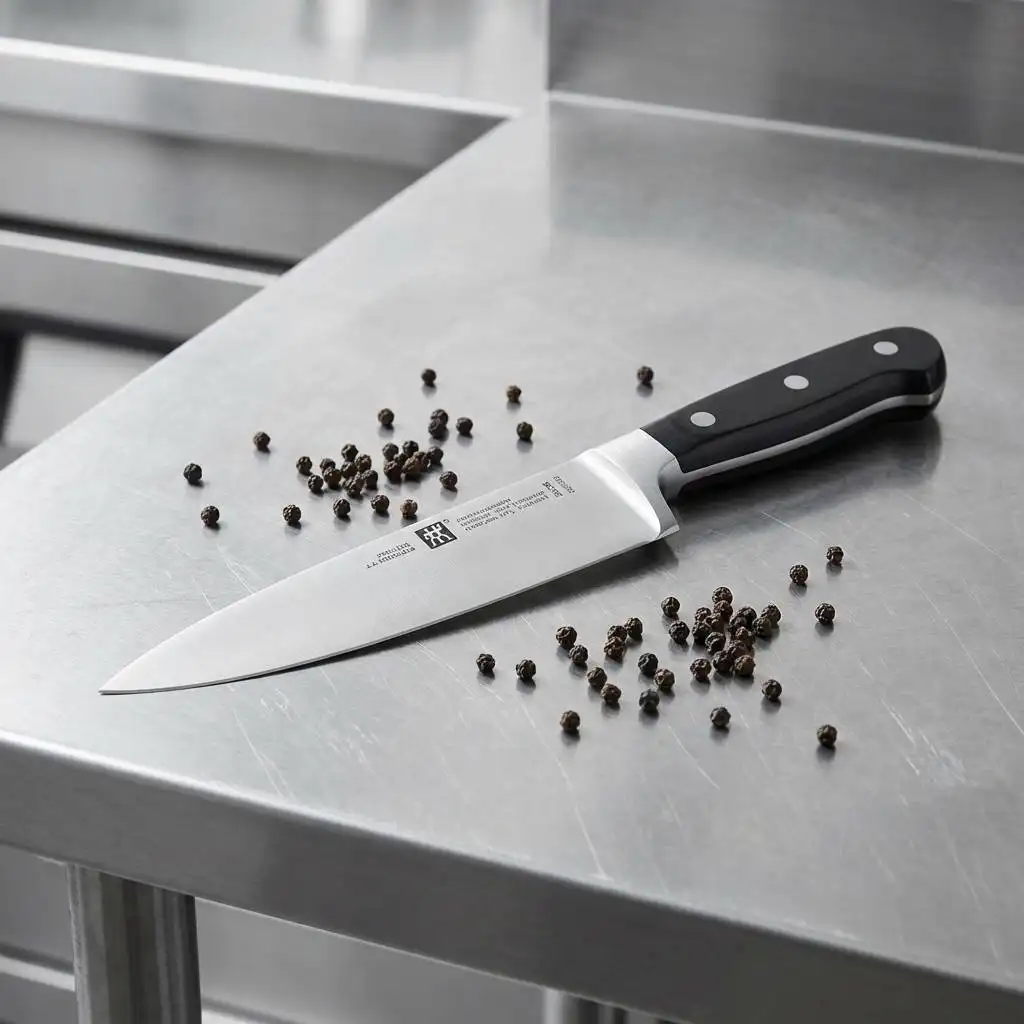
These are stamped knives. Unlike a forged knife, which is hammered from a single bar of red-hot steel creating a bolster and tang, these are punched out of a large sheet of steel like a cookie cutter. They are heat-treated, ground, and handled. Stamped steel is lighter, thinner, and significantly cheaper to produce. That’s not necessarily a crime—some of the best laser-slicers in the world are stamped—but don’t fool yourself into thinking you’re getting heirloom German iron here.

The Specs: Metallurgy & Geometry (Nerd Talk)
Let’s ignore the marketing fluff about “high-quality stainless steel” and look at the physics.
- Steel Type: While Henckels doesn’t publish the exact composition for this budget line, spectrographic analysis of similar lines usually points to X50CrMoV15 or a 3Cr13 variation. It’s highly stain-resistant, meaning you can leave it wet on the counter (please don’t) and it won’t rust instantly.
- Hardness (HRC): This is where the rubber meets the road. These blades likely clock in around **53–54 HRC** on the Rockwell scale. For context, a high-end Japanese knife is 60–64 HRC. Soft steel rolls over easily. It doesn’t hold an edge long. However, it is also very tough—it will bend before it chips.
- Tang Construction: The “Solution” line features a partial tang. The metal extends into the handle, but it is not the full width of the grip. It’s encased in the polymer. It’s secure enough for home cooking, but I wouldn’t try to break down a frozen deer carcass with it.
Ergonomics: The “Solution” Handle Design
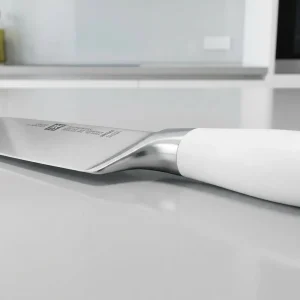
Ergonomics are subjective, but balance is physics. Because these blades are stamped (thin stock), the steel is incredibly light. The handle is a dense polymer.
The result? **The balance point is handle-heavy.**
If you use a “pinch grip”—pinching the blade right at the heel like a pro—the handle wants to fall backward into your palm. It fights you slightly. However, the handle design itself has a pronounced curve and swell that fills the hand well. If you use a “hammer grip” (holding it like a tennis racket), it actually feels quite secure. The texture is a matte plastic; it’s not particularly grippy when your hands are covered in chicken fat, but the three-rivet design keeps everything tight.
The Board Test: Performance Breakdown
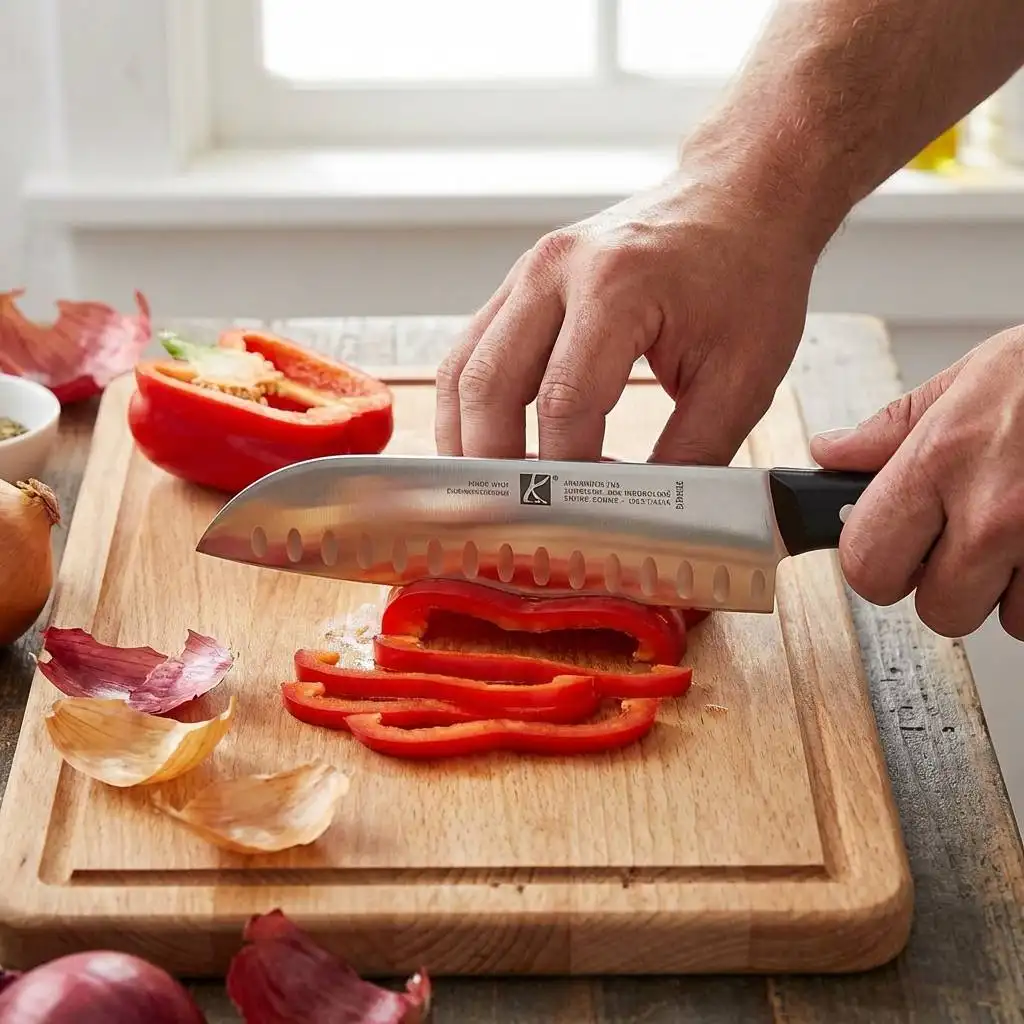
I put the 8-inch Chef’s Knife and the hollow-edge Santoku through standard mise en place drills.
The Tomato Test (Sharpness)
Out of the box, the factory edge is serviceable. It’s machine-ground to a fairly high grit, so it has that initial “bite.” It sliced the tomato skin without bruising the flesh. However, don’t confuse “factory sharp” with “quality steel.” Any piece of metal can be sharpened to shave hair; the test is how long it stays that way.
The Carrot Test (Geometry)
Here is the irony of cheap stamped knives: they often cut carrots better than thick, expensive forged knives. Why? Blade geometry. The spine of the Solution knife is very thin. When you chop a dense carrot, the blade slides through rather than “wedging” and cracking the vegetable apart. In this specific test, the Solution performs well.
The Protein Test
Slicing through flank steak silverskin revealed the limitations. The edge lacks the aggressive carbide structure of harder steels. It tends to slide over connective tissue rather than biting into it. You have to use a sawing motion rather than a single clean draw cut.
Edge Retention: The Soft Steel Reality
Stop obsessing over “Razor Sharp” out of the box. The real test is if the knife can still cut a tomato after prepping 10 pounds of onions. This set? It’s going to fail that onion test unless you hone it halfway through.
Because the steel is soft (~54 HRC), the edge “rolls” at the microscopic level. The apex of the edge bends over. This is why the set comes with a sharpening steel (honing rod). You must use the rod. A few swipes on the steel realigns that rolled edge and brings the sharpness back.
The Good News: Soft steel is ridiculously easy to sharpen. If you run this through a cheap pull-through sharpener or give it five minutes on a 1000 grit stone, it comes back to life instantly. It’s not “gummy” on the stone, just soft.
Pros & Cons (The No-BS List)
| Pros | Cons |
|---|---|
| Price-to-Performance: Extremely affordable for a full block set. | Poor Edge Retention: Requires constant honing; the edge rolls quickly. |
| Thin Geometry: Cuts dense root vegetables (carrots, potatoes) without wedging. | Balance: Handle-heavy feel makes pinch-gripping tiresome for long prep sessions. |
| Maintenance: Very corrosion resistant and easy to sharpen. | Fit & Finish: Spines are sharp (not rounded), and the bolster area is plastic, not metal. |
| Lightweight: Reduces fatigue for cooks who find forged knives too heavy. | Steak Knives: The included steak knives are serrated saws—okay for pizza, terrible for good meat. |
Who Is This Set For? (The Verdict)
If you are an aspiring chef or a serious home cook looking to upgrade your skills, walk away. This steel will frustrate you. It won’t hold the acute angles required for precise cuts, and the balance will mess with your muscle memory.
However, the Henckels International Solution is an excellent choice for:
- First Apartments / Dorms: It’s cheap, durable, and gets the job done.
- Vacation Homes / AirBnBs: You need knives that won’t chip when a guest throws them in the sink.
- The “Dishwasher” Cook: Technically, you should never put knives in the dishwasher. But I know you’re going to do it anyway. These handles and this steel can survive that abuse better than high-carbon options (though the rivets will eventually corrode).
It’s not culinary art. It’s a kitchen tool. And for the price, it’s a serviceable one.
FAQ: Common Questions About Henckels Solution
Is Henckels Solution dishwasher safe?
The manufacturer says yes, but I say no. Dishwasher detergent is abrasive and will dull the edge while the heat cycle can degrade the polymer handle over time. However, if you refuse to hand wash, this set will survive the dishwasher better than most—just expect to sharpen it much more often.
Do Henckels knives rust?
These are “stain-free” knives, meaning they are highly resistant to rust due to high chromium content. However, “stainless” is not “stain-proof.” If you leave them soaking in lemon juice or saltwater, they will develop spots. Wash them and dry them immediately.
What is the difference between Henckels Solution and Statement?
The main difference is the handle construction. The Statement line features a steel end cap on the butt of the handle, which adds weight and shifts the balance point further back. The Solution line does not have this cap, making it lighter and more handle-heavy. The steel of the blade itself is virtually identical.