Henckels International Solution 12-Pc Review: A Pro Chef’s Honest Verdict on “Entry-Level” Steel
Let’s address the elephant in the kitchen immediately: buying knives is confusing. You see the name “Henckels,” you see a price tag that looks too good to be true, and you wonder if you’re getting German engineering or just a box of shiny metal that will dull after cutting one butternut squash.
I’ve spent 15 years in professional kitchens, from high-volume French bistros to obsessive Japanese counters. My knife roll is currently full of high-carbon steel that rusts if you look at it wrong and costs more than my first car. But I started where everyone starts: in the prep pit, abusing house knives.
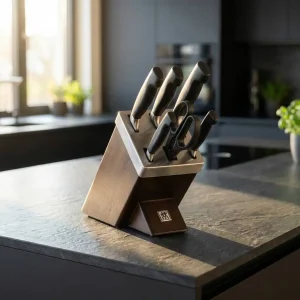
I know the value of a “beater”—a knife you don’t mind handing to a reckless line cook or a relative who thinks glass cutting boards are a good idea. Today, we’re looking at the Henckels International Solution 12-Piece Set. Is it a respectable beater for a starter kitchen, or is it just shiny landfill? Let’s put it on the board.
The “One Man” vs. “Two Men” Logo: Know What You’re Buying
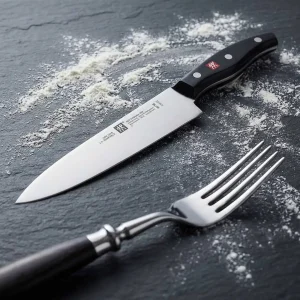
If you take nothing else away from this review, take this: Zwilling J.A. Henckels and Henckels International are not the same animal.
The “Zwilling” line features the famous “Twins” logo (two little stick figures) and is primarily manufactured in Solingen, Germany, using friodur ice-hardened, forged steel. The set we are looking at today wears the “Halberdier” logo—a single little guy with a spear. This is the Henckels International line.
The hard truth? These knives have never seen the inside of a German factory. The Solution series is manufactured in Asia (usually India or China, depending on the production batch). Does that make them garbage? No. But it means we need to adjust our expectations. We aren’t judging these against a $300 Bob Kramer masterpiece. We are judging them against the $50 mystery block you find at a big-box grocery store.
The Specs: Unpacking the Metallurgy
As a metallurgy nerd, I don’t care about the marketing on the box. I care about the grain structure and the physics. Here is what you are actually holding.
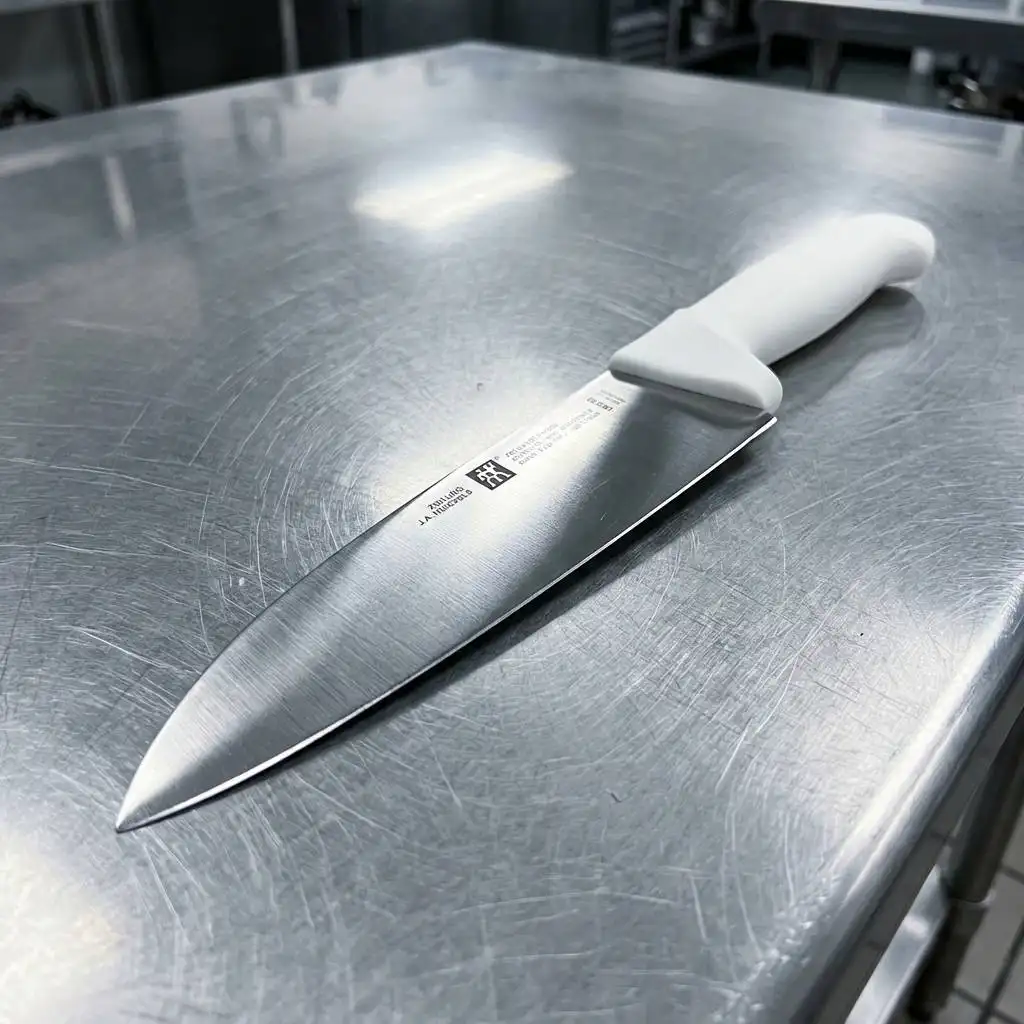
- Construction: Stamped. These blades are punched out of a large sheet of steel, unlike forged knives which are hammered from a bar. This makes them significantly lighter and devoid of a bolster (the thick metal junction between handle and blade).
- The Steel: High-quality stainless. It’s likely a variant of X50CrMoV15 or a similar proprietary blend. It’s highly stain-resistant, which is great for home cooks who forget to wipe their blades down.
- Hardness: roughly 55-57 HRC (Rockwell Scale). In plain English: this steel is “soft.” It won’t chip if you drop it, but the edge will roll over quickly. It requires constant maintenance.
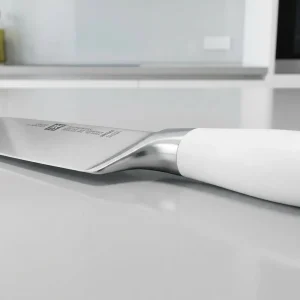
- Handle Material: Polypropylene. It’s a durable plastic molded directly onto the tang.

The 8-Inch Chef’s Knife: The Only Tool That Matters
Let’s be real: in any “12-piece” set, 90% of the value lives in the 8-inch Chef’s Knife. If this tool fails, the whole set is a wash.
The Profile
The Solution Chef’s knife features a classic German profile. It has a significant curve (belly) near the tip, designed for the rocking motion (rock-chopping herbs or garlic). It is less suited for the straight up-and-down “push cutting” style typical of Japanese blades.
The Geometry & Grind
Because these are stamped knives, the blade stock is thin. This is actually a benefit. A thin blade moves through product with less resistance. In my testing, the distal taper (how the blade thins from handle to tip) is minimal, but the spine is thin enough that it doesn’t matter much.
The “Wedge” Factor
Does it cut, or does it split? When cutting a tall, dense ingredient like a carrot or a sweet potato, thick forged knives can sometimes “wedge” (crack the vegetable open) rather than slice. The Henckels Solution, being thin stamped steel, actually performs surprisingly well here. It slides through rather than wedging.
Ergonomics
The handle is curved to fit the palm. However, in a professional “pinch grip” (where you grip the blade itself with your thumb and index finger), the spine of the knife feels a bit sharp. The corners haven’t been rounded off (crowned) during finishing. After an hour of prep, you will feel a hotspot on your index finger.
The Supporting Cast: Utility, Paring, and Steak Knives
Manufacturers love to sell you “piece count,” but let’s look at the fillers.
- The 4-inch Paring Knife: It’s decent. The handle is a bit clunky relative to the small blade, making in-hand work (like fluting mushrooms or peeling an apple) feel slightly unbalanced. But for opening packages or quick tasks? It works.
- The 5-inch Utility Knife: This is your serrated sandwich knife. It cuts tomatoes and crusty rolls well. No complaints here—it does exactly what a utility knife should do.
- The Steak Knives (The Padding): Be aware that 6 of the 12 pieces in this set are steak knives. These are stamped, serrated blades. I personally dislike serrated steak knives because they tear the meat fibers rather than slicing them, but for a backyard BBQ set, they are functional. Just know that you are essentially buying a 6-piece kitchen set + 6 table knives.
Performance Stress Test (The Board Test)
I took the Solution Chef’s knife through a standard line prep gauntlet. Here is the data.
The Tomato Test
Result: Pass.
Out of the box, the factory edge is aggressive. It bit into the skin of a ripe vine tomato without sliding off. This suggests a relatively coarse factory grind, which is good for general kitchen work.
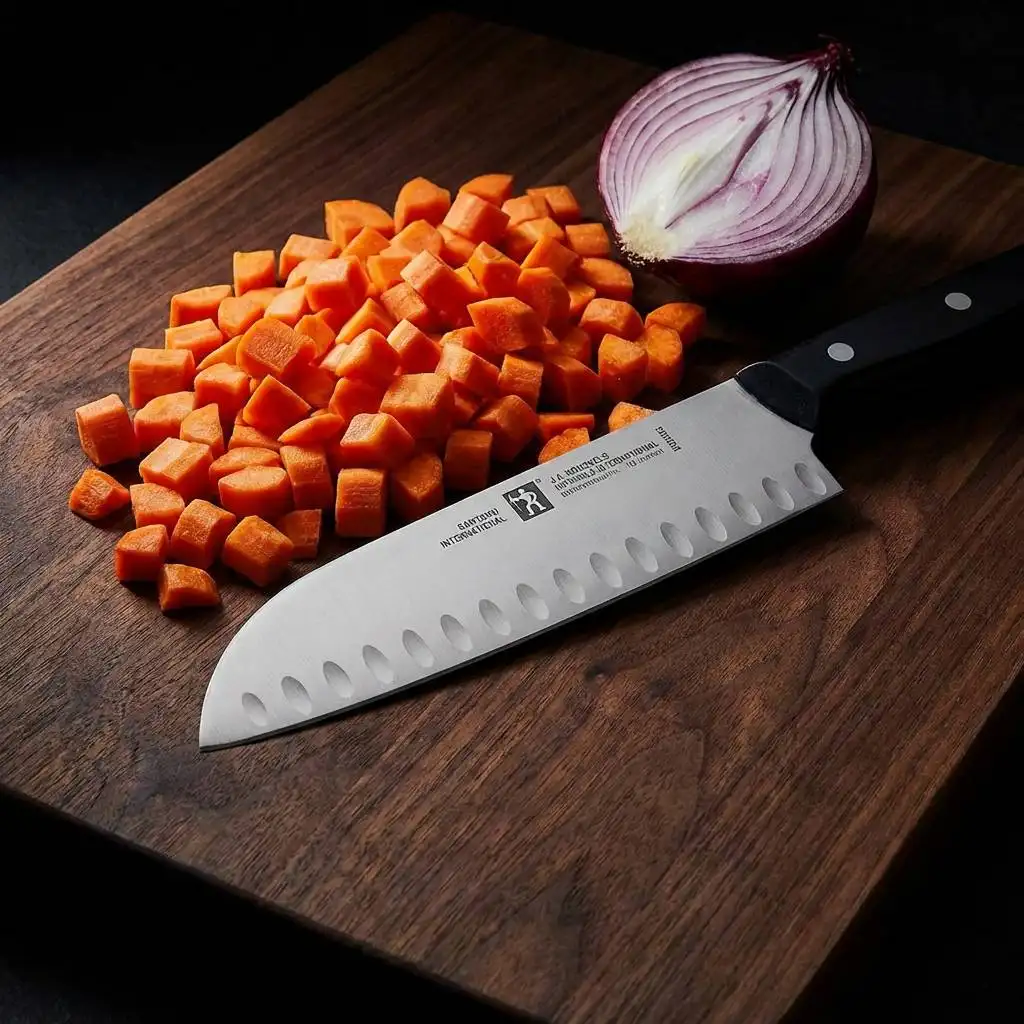
The Carrot Test
Result: Mixed.
As mentioned, it doesn’t wedge. However, because the steel is soft and thin, there is noticeable “lateral flex.” When you come down hard on a carrot, the blade can wobble slightly. It lacks the rigidity of a forged knife, which can be unnerving if you are used to a stiff tool.
The Chicken Test
Result: Caution Required.
I broke down a whole chicken. The knife handled the skin and meat fine. However, when cutting through joint cartilage, the lack of mass became apparent. You have to use more force than you would with a heavier forged knife. Do not try to hack through bone with this; the edge will roll immediately.
Maintenance: The Reality of Softer Steel
This is where the physics of the price point kicks in. At ~57 HRC, this steel does not hold an edge for long. If you are cooking every night, you will lose that razor-sharp feeling within 3 to 4 days.
The Honing Rod is Mandatory: See that metal stick in the block? You need to marry it. You should be honing this knife before every single use. Because the steel is soft, the microscopic edge bends (rolls) easily. The rod aligns it back to center.
The Silver Lining: The good news? Soft steel is incredibly easy to sharpen. You don’t need fancy diamond plates. A standard pull-through sharpener (which I usually despise, but is acceptable for this hardness) or a basic whetstone will bring the edge back in seconds. It raises a “wire edge” (burr) very quickly, making it a great knife to learn sharpening on.
Henckels Solution vs. The Competition
How does it stack up against other entry-level contenders?
| Feature | Henckels Solution | Victorinox Fibrox Pro | Mercer Genesis |
|---|---|---|---|
| Construction | Stamped | Stamped | Forged |
| Steel Hardness | ~57 HRC (Soft) | ~56-58 HRC (Standard) | ~58 HRC (Harder) |
| Handle Feel | Hard Plastic (Slightly slick) | Fibrox (Grippy/Rubberized) | Santoprene (Grippy) |
| Aesthetic | Classic Riveted Look | Utility/Commercial Look | Commercial Look |
| Chef’s Verdict | Best for looks on counter | Best pure performance | Best durability |
The Chief’s Final Cut: Who Should Buy This?
Let’s strip away the branding. This is a functional, entry-level tool set. It is not a culinary investment; it is a utility purchase.
Buy it if:
- You are outfitting a first apartment, a dorm, or an Airbnb rental.
- You have family members who insist on putting knives in the dishwasher (The Solution set handles this abuse better than high-end steel, though I still forbid it).
- You want a block that looks professional on the counter without the professional price tag.
Skip it if:
- You are serious about learning knife skills. The balance and feedback just aren’t there.
- You hate sharpening. You will be sharpening these often.
- You want a heavy knife that does the work for you.
Price-to-Performance Ratio: 6.5/10.
You are paying a premium for the “Henckels” name and the wood block. If you strictly want performance, buy a single Victorinox Chef Knife and steal a steak knife from a diner. But for a complete “looks good, cuts food” package? It’s a solid solution.