Henckels International Silvercap 14-Piece Review: Valid “Starter” Set or Just Shiny Junk?
Let’s cut the fluff and look at the facts. You’re here because you see the name “Henckels” on a block set that costs about the same as a single mid-range Japanese petty knife, and you’re trying to figure out if you’ve found a loophole in the matrix or if you’re about to buy a lemon.
I usually spend my time analyzing grain structures on Aogami Super steel or debating the merits of a convex grind on a $300 Gyuto. I don’t typically mess around with stamped blades sold in big-box stores. But I also spent years in high-volume prep kitchens where “beater” knives were the only things that survived the abuse of the dishwasher (against my orders) and the concrete floor.
The Henckels International Silvercap 14-Piece Set is one of the most popular entry-level sets on the market. But popularity doesn’t equate to performance. Is this a legitimate tool for a home cook, or is it just mystery metal polished up to look like German engineering? Let’s put it on the board.
The “International” Distinction: Managing Expectations
First, we need to clear up the branding confusion that catches about 80% of buyers. There are two Henckels.
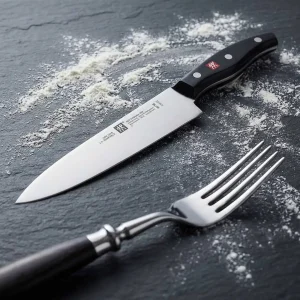
There is Zwilling J.A. Henckels, represented by the “Twins” logo. These are typically forged in Solingen, Germany, use Friodur ice-hardened steel, and cost a pretty penny. Then, there is Henckels International, represented by the single “Halberdier” (the guy with the polearm) logo. The Silvercap set falls squarely into the latter category.
“International” is code for value-driven production. These knives are not forged in Germany. They are stamped—punched out of a sheet of steel like a cookie cutter—and manufactured in factories in China, Thailand, or Spain (depending on the specific batch year). If you buy this expecting the weight, distal taper, and finish of a Zwilling Pro, you are going to be disappointed. This is the “First Home” or “College Apartment” tier. That’s not necessarily an insult; it’s just the market positioning.
The Specs: A Metallurgy Deep Dive
As a steel nerd, this is where I usually get annoyed. The marketing copy will tell you it’s “high-quality stainless steel.” That tells me absolutely nothing. In the industry, we call that “mystery meat steel.”
However, based on the behavior of the edge and Henckels’ history, this is almost certainly a variant of X50CrMoV15 or a slightly lower-carbon equivalent like 3Cr13. Here is the reality of the metallurgy:
- Hardness (HRC): These run soft. We are talking 54-56 HRC on the Rockwell scale. Why does this matter? A soft steel will not hold a razor edge for long. It rolls over. However, soft steel is incredibly tough. You can hack through a chicken joint or drop it in the sink, and it won’t chip. It bends rather than breaks.
- Construction: Stamped. These blades do not have a bolster (the thick junction between handle and blade). This means they are lightweight. Some cooks like the agility; I find they lack the authority needed to let the knife do the work. You have to push these knives; they don’t fall through food.
Data Sheet: Henckels Silvercap Specs
| Specification | Detail |
|---|---|
| Blade Material | German Stainless Steel Formula (Stamped) |
| Rockwell Hardness | Approx. 54-56 HRC |
| Handle Material | Molded Polypropylene with Stainless End Cap |
| Edge Grind | Micro-Serrated (select knives) / Fine Edge |
| Tang Style | Partial Stick Tang |
| Origin | China / Spain / Thailand (Batch dependent) |
The “Silvercap” Handle & Ergonomics: Gimmick or Balance?
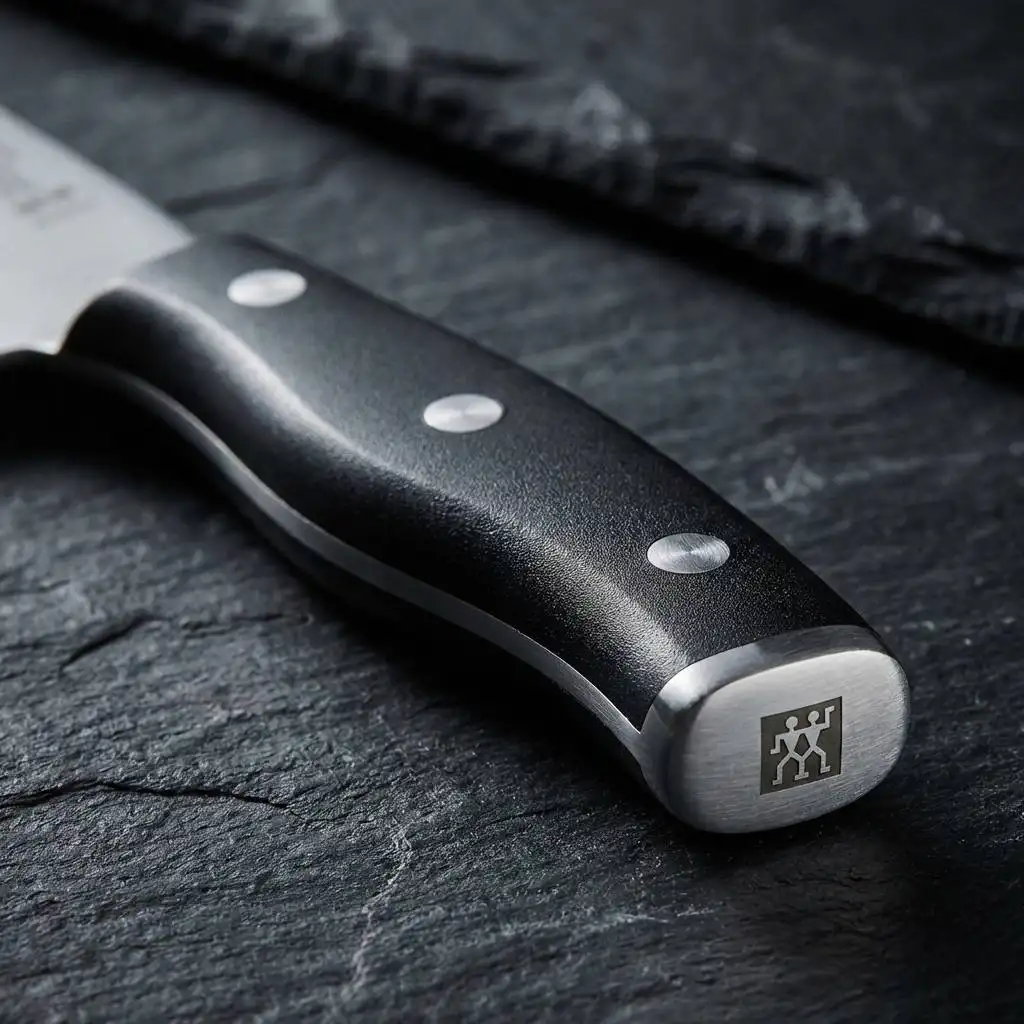
The defining aesthetic of this set is the laser-etched silver cap on the butt of the handle. It looks sleek on the counter, I’ll give it that. But functionally?
It acts as a counterweight. Since the stamped blade is so light, the handle would feel hollow and cheap without it. The cap adds a bit of rear-bias balance. However, don’t mistake this for a full-tang construction. The steel does not run the full width of the handle; it’s a stick tang inserted into molded black polypropylene.
The handle shape is ergonomic enough, but the material is slick. In a professional kitchen, we deal with animal fats, water, and vegetable slime. A textured handle (like micarta or textured nylon) provides grip. This smooth plastic? If your hands are wet, you need to grip tighter, which leads to fatigue. It feels “Micro-Lite”—very easy to move around, but lacking the tactile feedback you want when doing precision work.
And let’s look at the fit and finish. On budget sets, you often see gaps where the plastic meets the metal. That’s a bacteria trap.

Geometry & The “Never Needs Sharpening” Myth
This is where we need to have a serious talk about edge geometry. Many knives in the Silvercap line (specifically the steak knives and often the utility blades) utilize a micro-serrated edge.
Marketing teams love micro-serrations because they can legally claim the knife “never needs sharpening.” Technically, they are right. You cannot sharpen these.
A standard straight-edge knife (like a proper French Chef’s knife) cuts by push-cutting—separating fibers cleanly. A micro-serrated knife cuts by tearing. It is essentially a saw. The “teeth” protect the inner cutting groove from hitting the plate or cutting board, so it stays “sharp” (read: capable of tearing) for years.
For a pro, this is a nightmare. You can’t put this on a whetstone. You can’t hone it on a steel. When a micro-serrated knife finally goes dull, it is dead. You throw it away. But for the home cook who doesn’t own a sharpening stone and has no interest in learning angles? It’s a functional compromise. It will cut your bagel and your steak, but it will shred your basil and mangle your sashimi.
Performance: The Board Test
I took the 8-inch Chef knife (which is usually a fine-edge, not serrated, in this block) and the serrated utility knife through the standard gauntlet.
The Tomato Test
The serrated utility knife cheated. It sawed right through the tough skin of an over-ripe tomato. It works, but the slice looked ragged. The Chef knife, out of the box, was sharp enough to slice, but the “bite” was aggressive. The polish on the edge is rough—typical of a factory belt grind. It doesn’t glide; it scratches its way through.
The Carrot Test (Wedging)
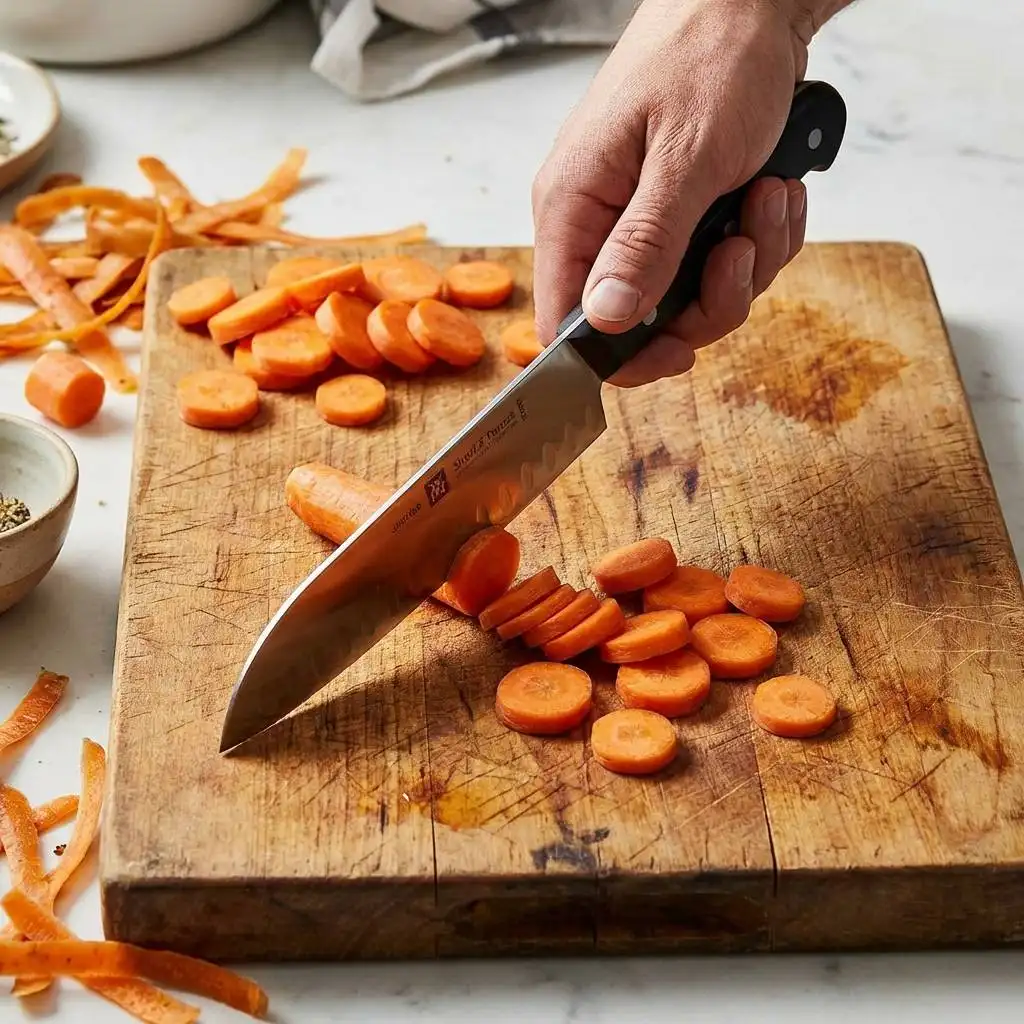
Because these blades are stamped, the spine is very thin. This is actually a benefit for dense root vegetables. A thick, forged knife can “wedge” (crack the carrot before cutting it). The Silvercap sliced cleanly because there is very little metal to get in the way. However, the blade has significant flex. If you are trying to cut perfectly uniform julienne strips, the tip tends to wander.
The Chicken Test
Breaking down a whole bird is where the soft steel shines. I hit the wishbone and scraped against the femur. A Japanese VG10 blade might have chipped. The Silvercap edge just rolled slightly. A quick swipe on a honing rod (for the straight-edge chef knife) straightened it back out. This is a durable beater.
Ergonomics Note: The lack of a bolster means the spine of the knife at the heel is sharp and thin. If you use a pinch grip (thumb and index finger on the blade), it will dig into your callus after about 20 minutes of prep. It’s not built for marathon sessions.
Block Breakdown: What’s Actually Useful?
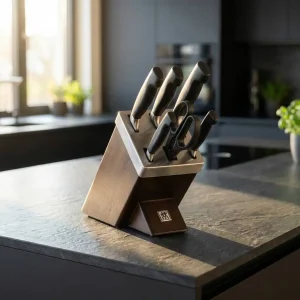
Fourteen pieces sounds like a lot. It isn’t. Here is the inventory breakdown:
- The Winners: The 8″ Chef Knife is the workhorse. The Kitchen Shears are surprisingly decent—stiff, sharp, and good for opening packaging or snipping herbs.
- The Fillers: You get a 5″ Utility knife (useful) and a Paring knife (essential). But then… the Steak Knives. There are six of them. Nearly half the block is taken up by cutlery that stays on the dining table, not the prep counter.
- The Block: The wood is usually a stained hardwood. It looks fine from a distance but feels light. The slots are standard.
You are essentially paying for a Chef knife, a bread knife (if included in your specific SKU), a paring knife, and a bucket load of steak knives.
Maintenance: The Reality of “Dishwasher Safe”
The box says “Dishwasher Safe.” The box is lying to you.
Technically, the materials won’t melt. But let me explain the physics. The high heat of the drying cycle expands the steel and the plastic handle at different rates. Over time, this causes the seal between the handle and the tang to crack. Water gets in, rust forms inside the handle, and eventually, the handle splits.
Furthermore, dishwasher detergent is abrasive. It eats away the chromium oxide layer that prevents rust. Even though this is “stainless” steel, I have seen hundreds of Silvercap knives with rust spots (pitting) after a month of dishwasher abuse.
Sharpening: As mentioned, the serrated blades are un-sharpenable for the average user. The straight-edge Chef knife is easy to sharpen because the steel is soft, but it is “gummy” on the stone. It produces a stubborn burr that is annoying to remove.
The Final Cut: Price-to-Performance Ratio
If you are a culinary student, an enthusiast, or someone who views cooking as a craft: Do not buy this. You will outgrow it in three months. The steel is too soft to hold a refined edge, the lack of bolster makes pinch-gripping uncomfortable, and the stamped feel lacks authority.
However, if you are looking for a gift for a college student, stocking a rental property, or you are a home cook who admits “I will never sharpen a knife and I might put them in the dishwasher,” then this set is a solid value.
For roughly $100, you get a complete ecosystem of tools that will cut food. They aren’t sexy, they aren’t high-performance, but they aren’t garbage. They are adequate tools for the casual kitchen.
Verdict: A valid “Starter” set for the uninitiated. A “Beater” set for the pro. Just manage your expectations.
FAQ: Common Questions About the Silvercap Set
Are Henckels Silvercap knives made in Germany?
No. The Henckels International “Silvercap” line is manufactured in countries like China, Thailand, or Spain to keep costs low. Only Zwilling J.A. Henckels knives marked “Made in Germany” come from the Solingen factory.
Can I sharpen the Silvercap knives?
It depends on the blade. The 8-inch Chef knife usually has a fine edge and can be sharpened on a stone or electric sharpener. The steak knives and utility knives often feature micro-serrations, which cannot be sharpened by standard home methods.
Do they rust?
Yes, they can. While they are stain-resistant, no steel is truly stainless. If left wet in the sink or run through the dishwasher regularly, the chromium layer can degrade, leading to rust spots (pitting).