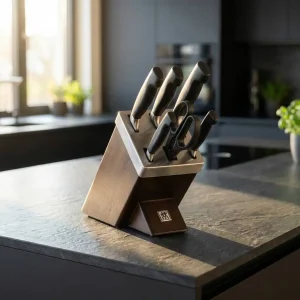
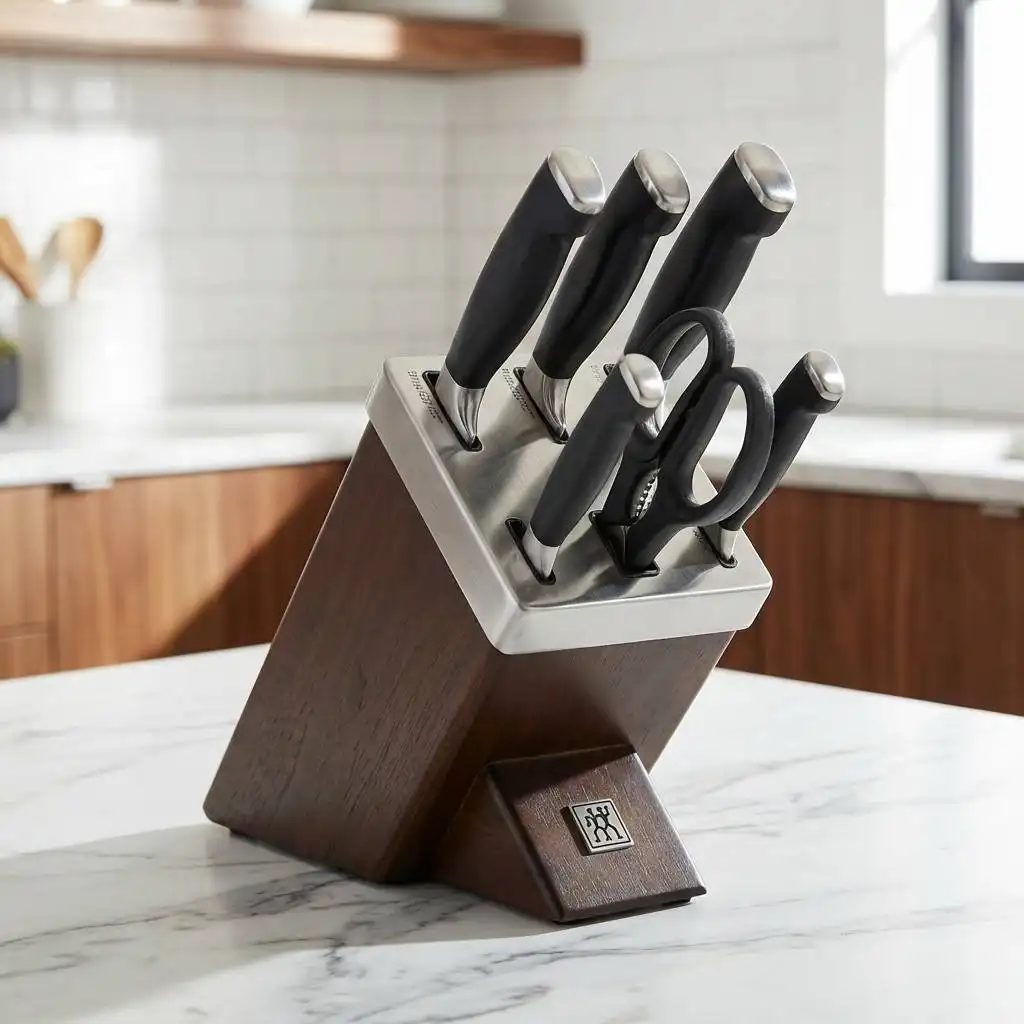
Henckels International Premio 14-Piece Review: Legit German Steel or Just a Shiny Budget Trap?
By “Chief” | 15-Year Culinary Veteran & Steel Nerd
Let’s get one thing straight before we open the box: there is a massive difference between what a line cook uses to prep 50 pounds of mirepoix and what looks good on a wedding registry. Usually, those two worlds don’t collide.
If you’re here, you’re likely confused. You see the name “Henckels,” you see “German Steel,” and you see a price tag that seems suspiciously reasonable compared to the $800 sets sitting next to it. You’re asking yourself: Is this the real deal, or am I paying for a brand name stamped on supermarket-quality metal?
I’ve spent the better part of my life obsessing over metallurgy, grain structure, and edge geometry. I’m usually reaching for high-carbon Japanese steel that rusts if you look at it wrong, or French profiles that cost a week’s wages. But I’m also a realist. Not everyone needs a lightsaber. Sometimes, you just need a beater—a set you aren’t afraid to hand to your mother-in-law when she decides to cut a lime directly on your granite countertop.
I put the J.A. Henckels International Premio 14-Piece Block Set through the wringer. No marketing fluff, no “unparalleled precision” nonsense. Just the ugly truth about whether this steel cuts or crushes.
The “Single Guy” vs. “The Twins”: Clearing Up the Branding Mess
If you take nothing else away from this review, take this: Henckels has a tiered identity crisis that trips up almost every home cook.
There are two main logos:
- The Twins (Zwilling J.A. Henckels): Two little stick figures. This is the premium line. Made in Solingen, Germany. Harder steel, better grind, painful price tag.
- The Single Guy (J.A. Henckels International): One stick figure holding a halberd. This is the value line.
The Premio set falls squarely under the “Single Guy” banner. While the box screams “GERMAN STEEL,” do not be fooled into thinking these were hammered out by a Bavarian smith in Solingen. The raw material (the steel alloy itself) comes from Germany, but the manufacturing—the heat treatment, the grinding, the handle assembly—happens in Asia (China or Thailand).
Is that a scam? No. It’s global supply chain economics. It allows them to sell you a 14-piece block for the price of one Zwilling Pro chef’s knife. But it means we need to lower our expectations regarding Fit and Finish (F&F). We aren’t looking for perfection here; we are looking for competence.

The Specs: Unmasking the Metallurgy
Let’s ignore the box jargon and look at the physics.
- Steel Type: X50CrMoV15. This is the industry standard for Western kitchen knives. It contains 0.5% Carbon (for hardness), 15% Chromium (for rust resistance), and small amounts of Molybdenum and Vanadium (for grain structure). It is highly stain-resistant.
- Hardness (HRC): Likely sitting between 55 and 57 HRC. In the world of pro cutlery, this is soft.
Translation: It won’t chip easily if you hit a bone (it’s tough), but the edge will roll over. You will lose that “hair-popping” sharpness quickly. - Construction: The marketing says “Forged.” In this price bracket, that usually means “upset forging” or a welded bolster assembly rather than a hot-drop forge from a single bar of steel. The bolster adds weight, but it’s not the same structural integrity as a $200 Wüsthof.
- Handle Material: Polypropylene with a stainless steel end cap. It’s plastic, folks. But the steel cap gives it a rear-heavy balance that mimics higher-end tools.
The 8-Inch Chef’s Knife: The Workhorse Review
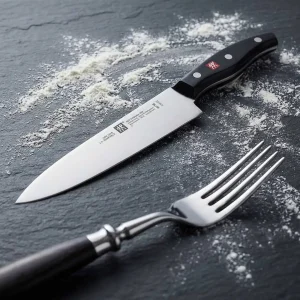
The block is just furniture; the 8-inch chef’s knife is the tool. If this knife sucks, the whole set is garbage.
The Grind & Geometry
Out of the box, the edge is serviceable. It’s ground to roughly 15 degrees per side. However, my calipers tell a different story behind the edge. The blade is thick. It doesn’t taper distally (get thinner) toward the tip as aggressively as I’d like. This means it feels less like a scalpel and more like a splitter.
The Pinch Grip
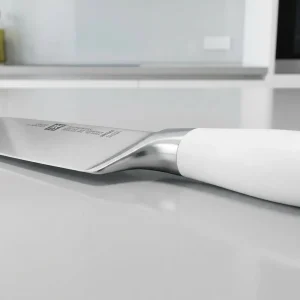
Here is where the Premio actually surprises me. The bolster (the metal junction between handle and blade) is curved. In the industry, we call this a “half-bolster” or an angled bolster. It allows for a proper pinch grip—thumb on one side of the blade, index finger on the other—without a sharp metal corner digging into your callus. It’s surprisingly comfortable for a budget knife.
Balance Point: The steel end cap on the handle shifts the center of gravity backward. The knife feels handle-heavy. Some people like this because it feels “substantial” in the hand. I prefer a neutral balance, or slight blade-heaviness, so the tool does the work falling through the food. With the Premio, you have to drive it.
The “Board Test”: Putting the Premio Through Hell
I took the chef’s knife to the cutting board for the standard trinity of tests. Here is the tactile feedback.
1. The Tomato Test (Sharpness)
The Goal: Slice horizontally through a ripe tomato skin without holding the tomato.
The Result: Passed, but barely. It bit into the skin, but I felt drag. It wasn’t the “ghost-like” glide of a Japanese laser. It required a slight sawing motion to initiate the cut. The factory edge is polished, but slightly toothy.
2. The Carrot Test (Geometry)
The Goal: Vertical chopping to test for wedging.
The Result: CRACK. That’s the sound of the carrot snapping before the cut is finished. Because the blade is thick behind the edge, it wedges the carrot apart rather than slicing through it cleanly. If you’re doing fine brunoise (tiny dice), this knife will fight you.
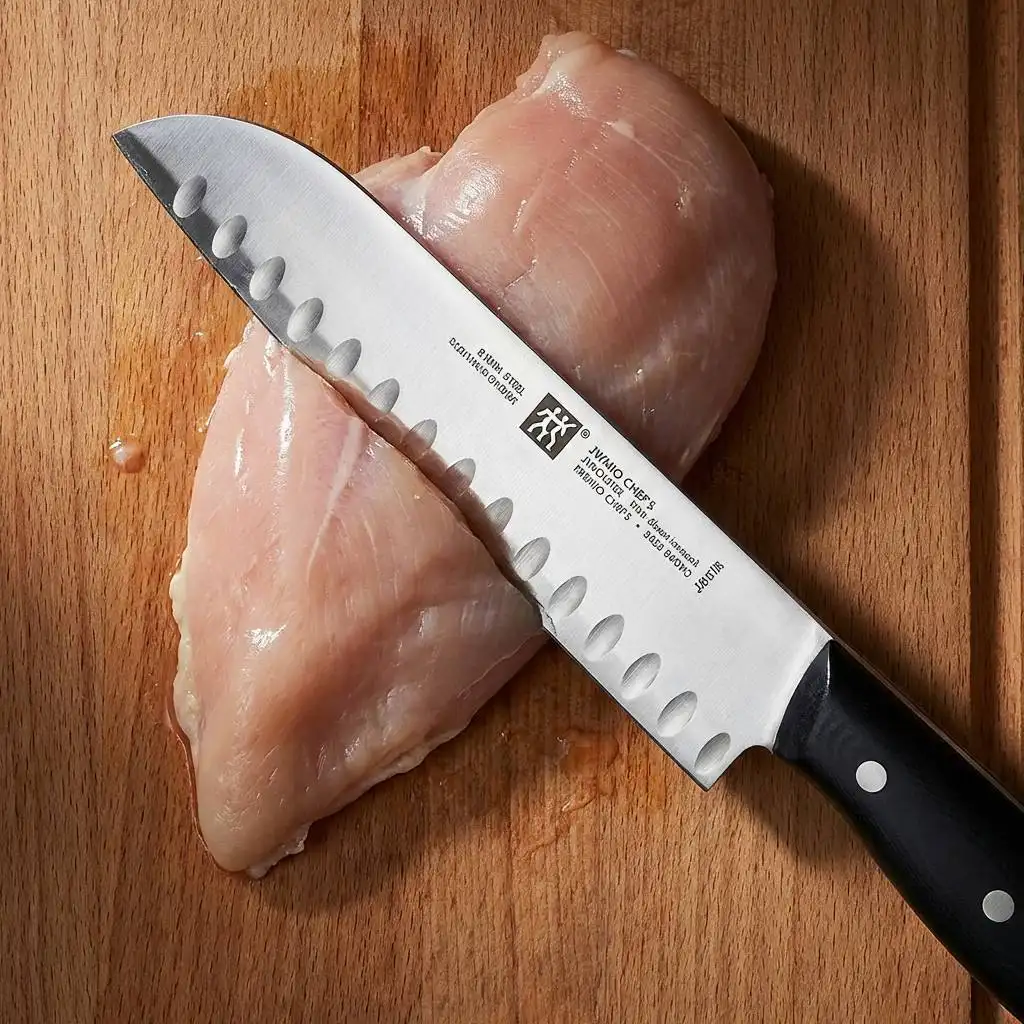
3. The Chicken Test (Utility)
The Goal: Breaking down a raw chicken. Greasy hands, bones, cartilage.
The Result: This is where the soft German steel shines. I hit the breastbone, and the edge didn’t chip. It rolled slightly, but no catastrophic failure. The plastic handle, however, gets slick when covered in chicken fat. The ergonomic curve helps lock your hand in, but the texture is smooth plastic. Be careful.
The Rest of the Block: Filler or Functional?
Standard 14-piece blocks are usually a scam to sell you 11 items you don’t need to inflate the price. Let’s look at the supporting cast.
- The Steak Knives (6x): Serrated. I hate serrated steak knives—they tear the meat rather than slicing it. However, for a family dinner, they are low maintenance. They will never need sharpening because they function like saws.
- The Bread Knife: Adequate. The serrations are aggressive. It handles a crusty sourdough without crushing the crumb, though the blade length feels a bit short for large artisan loaves.
- The Shears: Disappointing. They do not come apart. In a pro kitchen, if shears don’t disassemble, we can’t clean the pivot point properly. Bacteria trap.
- The Honing Steel: Essential. Since this steel is soft, you will need to learn to use this rod. It’s not just decoration; it’s the life support system for this set.
Edge Retention & Maintenance: The Reality of Soft Steel
Here is the physics of the Premio: Low HRC = Low Edge Retention.
After prepping dinner for four people (onions, peppers, carrots, flank steak), the edge was noticeably duller. It stopped biting into pepper skins. This is normal for X50CrMoV15 steel. It forms a “wire edge” or rolls over.
The Fix: You must hone this knife. Every two or three uses, take the steel rod and give it 4-5 swipes per side. If you do this, the knife stays sharp indefinitely. If you neglect it, it will become a butter knife in a month.
Sharpening: The good news? This steel is gummy and soft. It is incredibly easy to sharpen on a whetstone. You don’t need expensive diamond plates. A cheap 1000 grit stone will bring this edge back to screaming sharp in five minutes. It’s a great knife to learn sharpening on because it responds quickly.
Comparisons: Premio vs. The World
Is it better than the competition? Let’s look at the data.
| Model | Construction | Origin | Feel | Price Tier |
|---|---|---|---|---|
| Henckels Premio | Forged Bolster | Asia | Heavy, Solid, Handle-Heavy | $$ |
| Henckels Definition | Stamped | Asia | Light, Flimsy, Thin | $ |
| Zwilling Pro | Forged | Germany | Balanced, Premium, Sharp | $$$$ |
| Mercer Renaissance | Forged | Taiwan | Utilitarian, Balanced | $$ |
The Premio sits in a weird middle ground. It feels much more expensive than the “Definition” line because of the bolster and end cap. But it lacks the refined grind and perfect balance of the Zwilling Pro or the Mercer Renaissance.
Chief’s Verdict: Who Should Buy This?
I wanted to hate this set. I wanted to call it a shiny object for people who don’t know better. But honestly? It’s… fine. Actually, for the price, it’s solid.
The Pros:
- Durability: You can abuse these. Frozen food, bones, dishwasher (don’t do it, but if you do, they might survive).
- Aesthetics: They look like $500 knives on the counter. The metal end cap adds a touch of class.
- Maintenance: Very easy to sharpen.
The Cons:
- Edge Retention: Prepare to hone constantly.
- Geometry: Too thick for precision work. Wedges in carrots.
- Shears: Sanitary nightmare (non-separable).
Final Price-to-Performance Ratio: If you can get this set on sale (often around $150-$200), it is a steal. If you are paying full MSRP, look at Mercer. But if you want a block that looks great and handles 99% of home cooking tasks without making you cry if you chip a tip, the Premio is a respectable choice.
Frequently Asked Questions (FAQ)
Are Henckels International knives made in China?
Yes. The “International” line (Single Guy logo), including the Premio set, is manufactured in Asia (typically China or Thailand) using German steel. This reduces labor costs significantly compared to the Zwilling line made in Solingen, Germany.
Can I put the Henckels Premio set in the dishwasher?
Technically, the marketing says yes. Practically? Absolutely not. Dishwasher detergent is abrasive and will dull the edge immediately. The high heat causes the plastic handle to expand and contract, eventually separating it from the steel tang. If you do this, you deserve rusty knives.
Is the Premio line forged or stamped?
They are marketed as forged. In reality, they likely utilize a welding process where the bolster is fused to the blade blank, rather than being hot-drop forged from a single steel billet. This provides the weight and feel of a forged knife at a stamped knife price.