Henckels International Graphite 7-Piece Review: Are “Self-Sharpening” Blocks a Gimmick or a Savior?
Let’s talk about the “Drawer of Shame.” You know the one. It’s full of dull, stamped metal tools that mash your tomatoes into paste rather than slicing them. You’ve probably bought a cheap sharpener at some point, used it once, ruined the edge, and threw it in the back of the cupboard.
Henckels International knows this. That’s why the Graphite 7-Piece Self-Sharpening Block Set exists. The marketing pitch is seductive: you never have to learn the geometry of a whetstone or understand burr removal because the block does the work for you every time you pull a knife out.
I’m going to be honest with you right out of the gate. As someone who spent 15 years in professional kitchens, finding zen in soaking a 1000-grit water stone, the concept of a mechanical grinder inside a wood block makes me cringe. Ideally, you treat your tools with respect. But I also live in the real world.
I know you aren’t going to soak stones for 15 minutes before making a Tuesday night stir-fry. You want to cook, eat, and get on with your life. So, I’m putting my steel snobbery aside to answer one specific question: Does this system actually work for the home cook, or is it just a fast way to grind your knives into dust?
The “Self-Sharpening” Technology: Engineering vs. Marketing
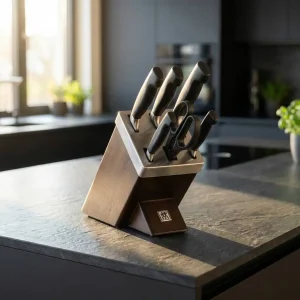
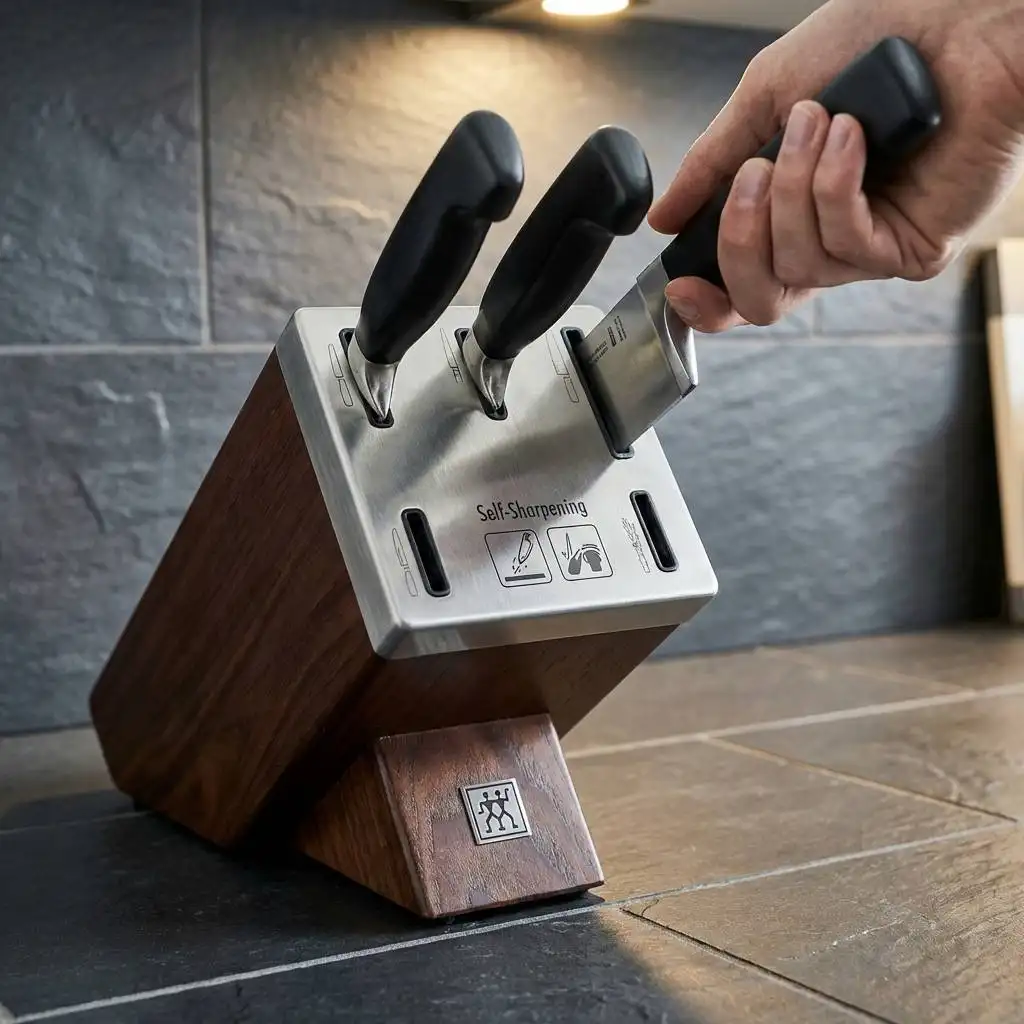
Let’s strip away the fluff and look at the mechanics. This isn’t magic; it’s friction. Inside the slots of the stained ash wood block (specifically the slots for the fine-edge knives), there are built-in ceramic honing wheels set at a specific angle.
Every time you withdraw the knife, the edge drags against these ceramic rods. When you put it back, it drags again. In a professional kitchen, we use a honing steel (that long metal rod) to realign the microscopic “teeth” of the blade that get bent during use. This block automates that process.
The Ugly Truth: This is a “knife-eater” system. Because the mechanism engages every single time you use the knife, you are constantly removing a micro-layer of steel. Over five or ten years, you will notice the profile of your chef’s knife changing—it will get narrower. However, this is the trade-off. You trade longevity for consistency. If the alternative is using a dull knife that slips and cuts your finger, let the block eat the steel. A shorter life for a sharp knife is safer than a long life for a dull one.

The Steel Specs (Data Block)
Henckels International is the “value” brand of the Zwilling J.A. Henckels group. That means these aren’t coming out of the Solingen, Germany factory. They are likely manufactured in China or Spain. Does that make them trash? Not necessarily, but we need to look at the metallurgy.
- Steel Type: High-Quality German Stainless Steel (Likely X50CrMoV15).
- Hardness: Approx. 55-57 HRC (Rockwell Scale).
- Construction: Fully Forged Bolster.
- Grind: Standard European V-edge.
Why Soft is Good Here: In the world of high-end Japanese cutlery, we chase hardness (60+ HRC) for edge retention. But if this Graphite set were made of hard VG10 steel, the self-sharpening block would be a disaster. Hard steel chips; soft steel rolls.
The steel used in the Graphite series is relatively soft. This is intentional engineering. Because the steel is softer, it responds very well to the ceramic wheels in the block. It allows the mechanism to easily realign the edge without chipping it. It’s a closed loop system where the weakness of the steel (softness) is mitigated by the frequency of the sharpening.
The “Graphite” Handle: Ergonomics & The Wet Hand Test
The handle is where this set tries to punch above its weight class. The “Graphite” moniker refers to the aesthetic—a sleek, dark grey finish on the handle cap. It’s designed for modern, open-concept kitchens where the knife block is a piece of decor.
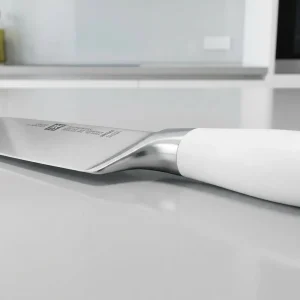
The Feel: The transition from the handle to the bolster is fully forged. This is rare at this price point. Usually, you get a stamped blade glued into a handle. Here, you have a solid piece of steel providing a counterweight. The balance point sits right at the bolster, which is exactly where it should be for a pinch grip.
The Grip: The handle is contoured for comfort, but the material is a smooth synthetic. During my “Wet Hand Test”—simulating a busy prep session with damp hands—it held up okay, but it lacks the tactile traction of a textured G10 or even a classic POM handle. If your hands are covered in chicken fat, you’re going to need to wipe them before grabbing this.
The 7-Piece Loadout: What You Get vs. What You Need
Knife sets are notorious for fluffing the piece count with useless items. Let’s break down the utility of this 7-piece setup.
| Tool | Verdict | Sharpening Slot? |
|---|---|---|
| 8″ Chef’s Knife | The primary workhorse. It features a significant belly, ideal for the rock-chopping motion common in Western cooking. It feels substantial in the hand. | Yes |
| 6″ Utility Knife | Too big for handheld work, too small for a roast. It’s the “sandwich knife.” Good for slicing a hero sub or cutting blocks of cheese. | Yes |
| 5″ Serrated Utility | Essential for tomatoes and baguettes. Crucial Note: This slot is NOT self-sharpening. You cannot mechanically sharpen serrations with a simple V-slot. | No |
| 3″ Paring Knife | Decent geometry, though the heel is a bit thick. Good for coring strawberries or peeling apples in the air. | Yes |
| Kitchen Shears | Standard issue. They work, but check if they separate for cleaning. If not, they are bacteria traps. | No |
Performance: The Board Test
I pulled the 8″ Chef’s Knife fresh from the block to run it through the standard battery of kitchen abuse.
The Tomato Test (Edge Bite)
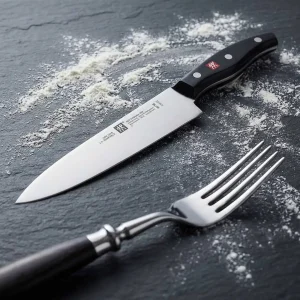
The factory edge on Henckels International knives is usually polished to a medium grit. It sliced the tomato skin without slipping, but it didn’t have that “ghostly” feel where the skin simply separates. It required a slight draw motion. However, after five passes through the sharpening slot, the “bite” actually improved. The ceramic wheels created a micro-serration that grabbed the skin aggressively.
The Carrot Test (Geometry & Wedging)
Here is where the “forged” construction shows its double-edged nature. The spine thickness at the bolster is significant. When chopping carrots, the knife cuts well initially but tends to “wedge” or crack the carrot near the bottom of the cut due to the thickness of the blade. It’s not a laser. It’s a splitter. You’ll feel resistance on dense root vegetables.
The Protein Test
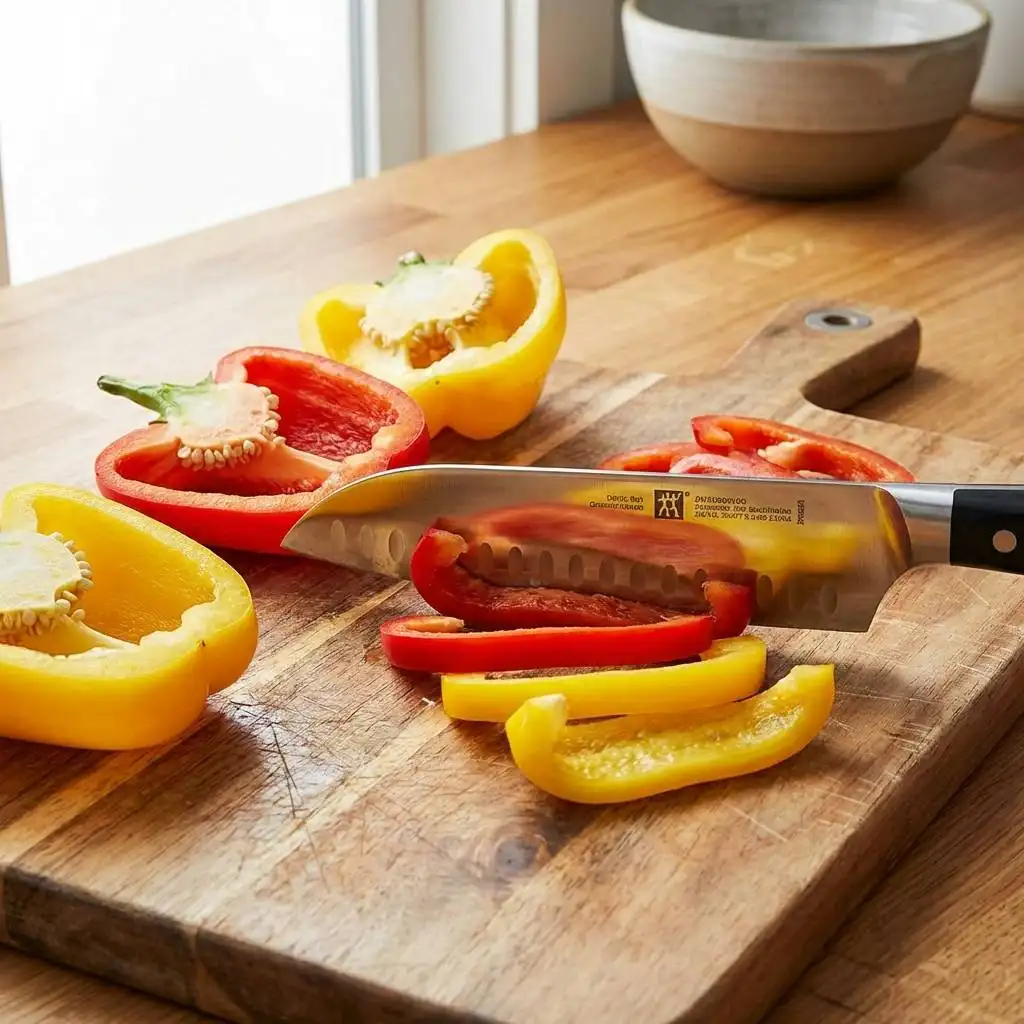
I took the knife to a flank steak to remove silver skin. The curve of the belly made this easy. The edge retention is low, but again, the system saves you. As soon as I felt the edge dragging on the connective tissue, I rinsed it, ran it through the block twice, and was back to razor sharp in 6 seconds. That is the undeniable convenience factor.
Who is this Set For? (And Who Should Run Away)
If you are an aspiring culinary student or a steel nerd who obsesses over grain structure and Japanese water stones, run away. This set will frustrate you. The grind is too thick, the steel is too soft, and the aggressive sharpening mechanism will offend your sensibilities.
However, if you are a home cook who is tired of dull knives and knows—deep down—that you will never buy a whetstone, this set is a solid investment. It solves the number one problem in home kitchens: safety. A sharp knife is a safe knife.
The Verdict
- Pros: Zero maintenance curve, aesthetically pleasing block, fully forged durability, excellent warranty support.
- Cons: Aggressive sharpener reduces knife lifespan, softer steel requires constant honing, synthetic handles can be slippery when greasy.
- Price-to-Performance: High. You are paying for the convenience of the block mechanism more than the steel itself, but for 90% of households, that is a trade worth making.
Frequently Asked Questions
Q: Can I put Henckels Graphite knives in the dishwasher?
Technically, the manufacturer might say “dishwasher safe,” but as a professional, I forbid it. Dishwasher detergent is abrasive and high-heat cycles can warp the handle scales and cause corrosion (rust) even on stainless steel. Hand wash only.
Q: How long do the sharpening slots last?
The ceramic wheels inside are durable, but they will eventually load up with metal shavings. They typically last the life of the knife set (10-15 years) given normal home use.
Q: Is Henckels International the same as Zwilling J.A. Henckels?
No. This is the most common confusion. Zwilling J.A. Henckels (the “Two Man” logo) is the premium German line. Henckels International (the “Single Man” logo) is the entry-level value line. The Graphite set falls under the International brand.
Q: Can I put other knives in the self-sharpening slots?
I strongly advise against this. The sharpening angle is set specifically for the geometry of the Graphite series. If you put a Japanese knife (15-degree angle) or a thick German beater into that slot, you will ruin the edge geometry.