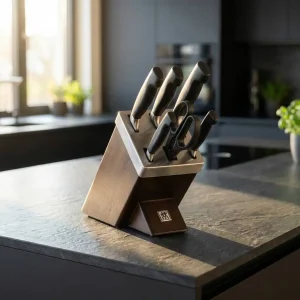
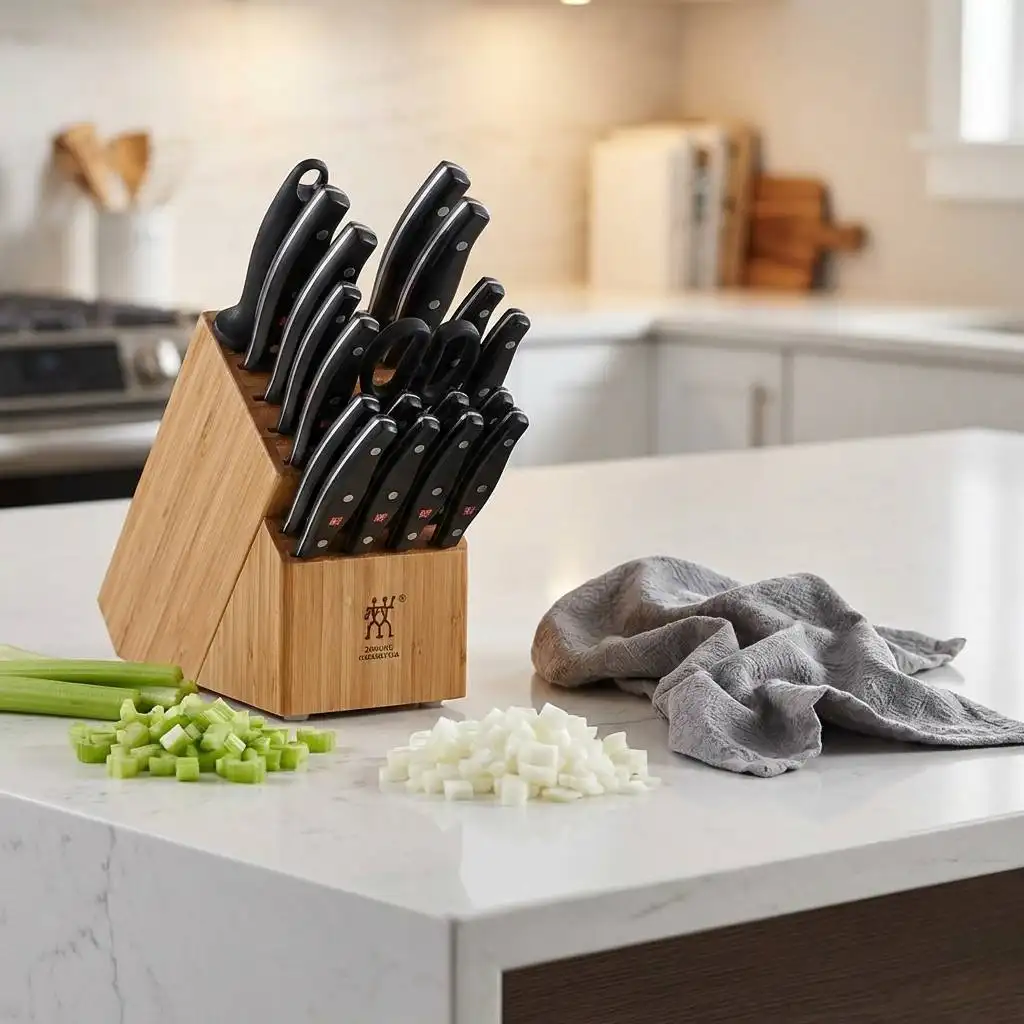
Henckels International Definition 14-Piece Self-Sharpening Block Set: Gimmick or Sharp Solution?
The Hook: A Line Cook’s Perspective on “Automatic” Maintenance
In the professional kitchen, if you touch another chef’s knife without asking, you risk losing a finger. If you run that knife through a pull-through sharpener, you risk losing your job. So, when Henckels International drops a “Self-Sharpening” block on the counter, my cynicism immediately spikes. We generally view these mechanisms as steel-eaters—aggressive ceramic wheels that grind away your edge every time you retrieve the tool.
However, I’m looking at the Henckels International Definition 14-Piece Self-Sharpening Cutlery Set not through the lens of a Michelin prep line, but for the home cook who thinks a “honing rod” is a magic wand they don’t know how to use. This set targets the “set it and forget it” crowd. These aren’t forged heirlooms; they are stamped workhorses designed to solve the number one complaint in domestic kitchens: dull knives. Let’s see if the steel can handle the grind.

The Specs
Here is the data sheet. We are dealing with Henckels International (the “single man” logo), which means value-oriented production, distinct from the premium Zwilling (two men) line.
| Steel Type | High Carbon Stainless Steel (Likely X50CrMoV15 equivalent). Stain-resistant, decent toughness. |
| Hardness (HRC) | ~55-57 HRC. Soft enough to withstand the abuse of the self-sharpening slots without chipping, but won’t hold an edge like VG10. |
| Construction | Precision Stamped (Single piece of steel). Lighter than forged counterparts. |
| Block Mechanism | Built-in ceramic honing wheels in the slots for the Chef, Santoku, and Paring knives (serrated slots are non-sharpening). |
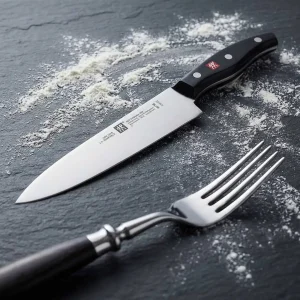
| Handle Material | Traditional Triple-Rivet Polymer. Full tang visible. |
The Geometry & Grind
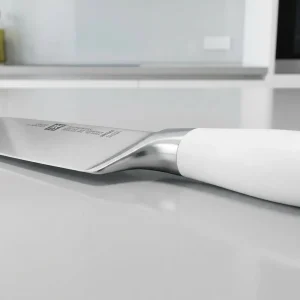
Because these are stamped blades, they lack the thick bolster and distal taper of a forged Messer. The blade stock is relatively thin from spine to edge. This is actually a benefit for performance in this price bracket. Thick, cheap knives wedge; thin, cheap knives cut.
The grind is a standard flat V-grind. Out of the box, the finish is satin—functional, hiding scratches well. The thinness behind the edge is acceptable. It’s not a laser that will ghost through a daikon radish, but it won’t crack a sweet potato apart like a splitting maul either.
Ergonomics: The Hand Feel
Picking up the 8-inch Chef’s knife, the first thing you notice is the weight—or lack thereof. Without a forged bolster, the balance point shifts forward toward the blade, but because the steel is thin stamped stock, the whole package feels incredibly light. For a pro used to the authoritative “thud” of a Wüsthof Classic, it feels toy-like. For a home cook with arthritis or smaller hands, this lightness is a major selling point.
The handles are classic three-rivet style. They are contoured comfortably enough, but the polymer feels a bit slick compared to higher-end POM composites. The spine corners are not rounded—they are sharp at 90 degrees. If you use a proper pinch grip, you will feel that spine digging into your index finger after about 20 minutes of heavy prep.
Performance: The Board Test
I put the primary edges through the standard battery to see if the geometry holds up.
The Tomato Test
The factory edge bites. The “Definition” series comes sharp. It sliced the skin without sliding. However, the real test is after a month of using that block. The self-sharpening mechanism keeps the edge toothy, which is actually ideal for tomato skins. It acts like a micro-serration.
The Carrot Test
Vertical chopping revealed minimal wedging due to the thin blade stock. It doesn’t crack the carrot; it slices. However, because the steel is on the softer side (~55 HRC), I noticed the edge rolling slightly after aggressive chopping on a hard bamboo board. You need to let the knife do the work; don’t force it.
The Protein Test
On a flank steak, the slicing knife performed adequately. The lack of a granton edge on the slicer meant some friction and sticking, but the length allowed for clean, single-stroke cuts. The stamped steel lacks the rigidity of a forged blade, so there was some flex when trying to get precise cuts on denser meat.
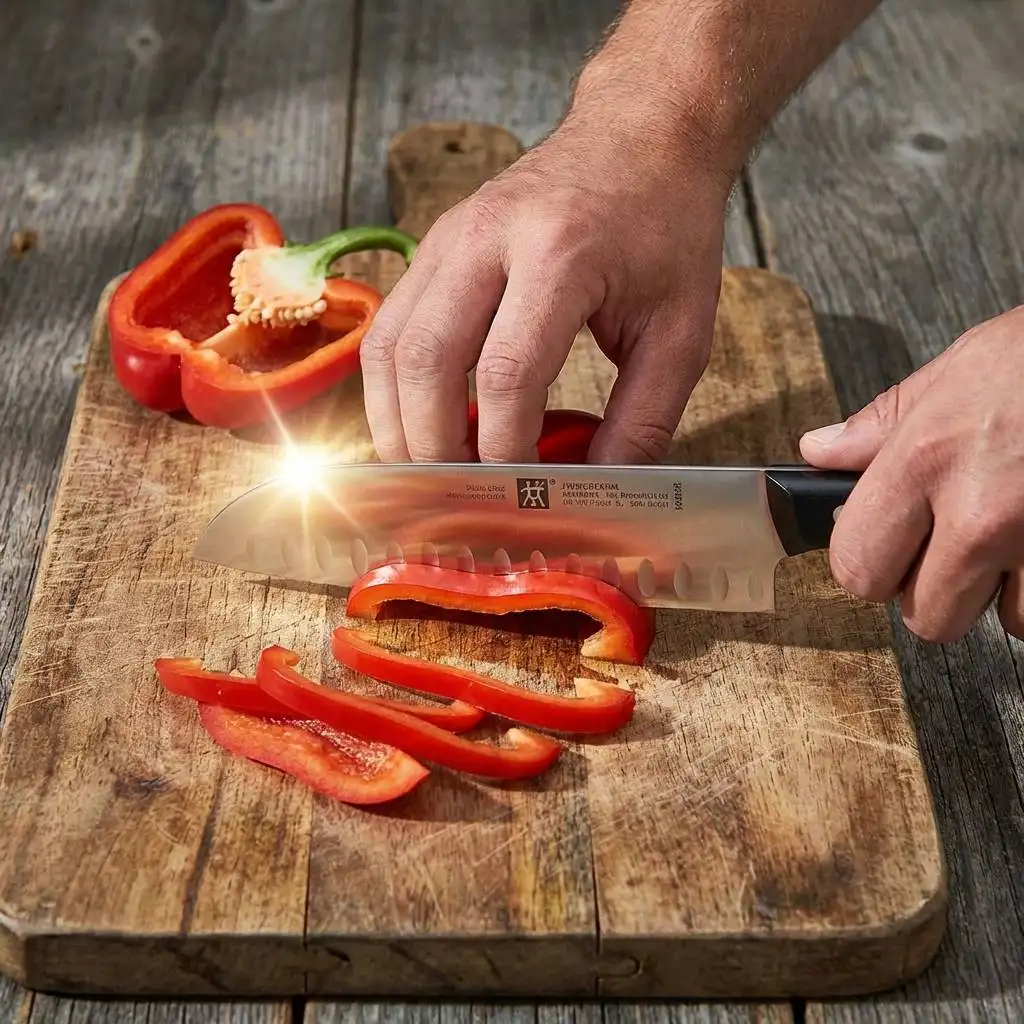
Edge Retention & Maintenance
Here is where we address the elephant in the room: The Self-Sharpening Block.
The Reality: This block does not “hone” (re-align) the edge; it sharpens (removes metal). Every time you pull the knife out or put it back, ceramic rods scrape a fresh bevel.
The Good: You will always have a sharp knife. For the average user who uses a dull butter knife to cut onions, this is a revelation.
The Bad: It drastically reduces the lifespan of the knife. Over two or three years of daily use, you will notice the blade profile changing—receding backward as the block eats the steel. It effectively turns your chef’s knife into a utility knife over time.
The steel itself is soft. Without the block, these knives would go dull in a week of heavy use. With the block, they stay functional, but at the cost of the steel’s longevity.
The Final Cut
The Henckels International Definition 14-Piece Set is a calculated compromise. It trades the longevity and soul of a forged blade for the immediate convenience of a constantly sharp edge.
Pros
- Zero Maintenance: The block does the work for you.
- Lightweight: Easy to handle for quick tasks.
- Price-to-Performance: You get a full arsenal for the price of one high-end Gyuto.
Cons
- Metal Removal: The block eats your knives over time.
- Fit and Finish: Sharp spines and stamped feel lack premium tactility.
- Soft Steel: Edge retention relies entirely on the block mechanism.
Verdict: If you are a culinary enthusiast who enjoys whetstone rituals, run away. But if you are buying this for a busy family kitchen where knives are thrown in the sink and nobody knows what a honing steel is, this set is a functional, problem-solving investment.