Henckels International Definition 14-Piece Review: Kitchen Hack or Dull Gimmick?
We need to talk about your “Drawer of Shame.” You know the one. It’s that chaotic jumble of mismatched blades, chipped ceramic peelers, and dull knives that crush tomatoes into salsa rather than slicing them. You are looking at the Henckels International Definition 14-Piece Self-Sharpening Set because you are terrified of whetstones. You want a “set it and forget it” solution.
I get it. But let me introduce myself properly. I’ve spent 15 years in high-volume French and Japanese kitchens. I am a steel nerd. I obsess over carbide distribution and grain structure. Usually, when I see a “14-piece block set” for the price of one decent petty knife, I roll my eyes. I’ve fired line cooks for bringing knives this soft into my kitchen because they can’t hold an edge through a single dinner service.
However, I’m putting my biases aside for a moment. Why? because most home cooks are “flying blind” with dull tools, which is dangerous. I’m here to determine if this self-sharpening technology is a legitimate kitchen hack for the busy parent, or just another piece of marketing garbage destined for the landfill. Let’s put it on the board.
The Elephant in the Room: “International” vs. “Zwilling”
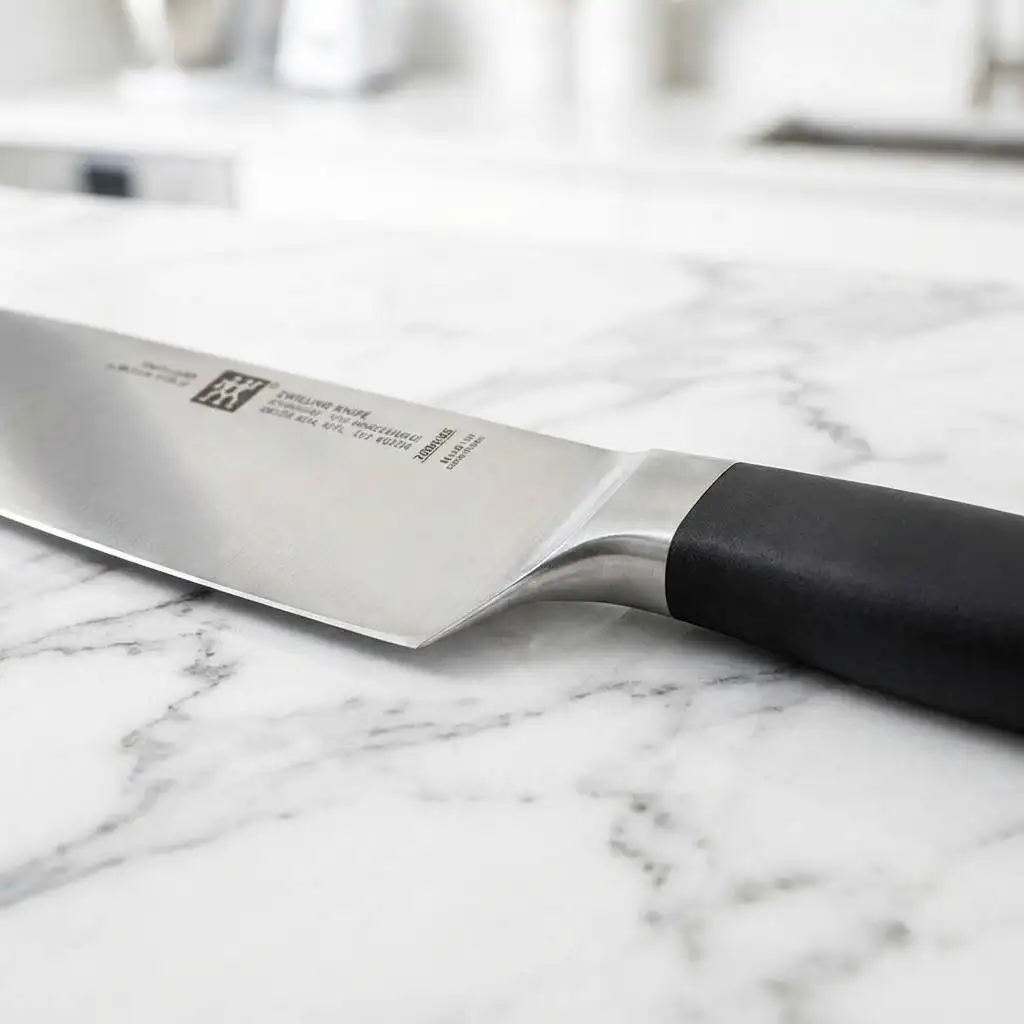
Before we look at the specs, we have to clear up the branding confusion that tricks 80% of buyers. If you look closely at the logo on the blade, you will see a single stick figure holding a spear (a halberd, technically).
This is Henckels International.
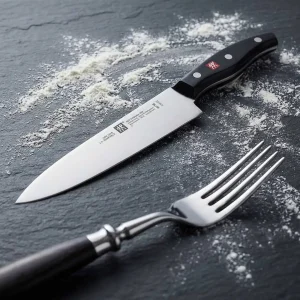
This is not Zwilling J.A. Henckels, which sports the famous “Twins” (two figures) logo. Why does this matter? The “Twins” represent premium, forged German cutlery made in Solingen, Germany. The “Single Guy” (International) is the value brand. These knives are not forged in Germany. The Definition line is manufactured in Asia (typically China or Thailand) using stamped construction.
I’m telling you this so you adjust your expectations. We aren’t judging these against a $300 Bob Kramer carbon steel blade. We are judging them against other budget-tier stamped sets. If you think you are getting heirloom German steel for this price, you are mistaken. You are getting a workhorse set designed for mass production.
The “Definition” Specs: What Are You Actually Buying?
Let’s look under the hood. As a metallurgist enthusiast, the first thing I look for is the steel composition.
- Steel Type: High Carbon Stainless Steel. While Henckels doesn’t always list the exact alloy for the International line, it behaves exactly like X50CrMoV15 or a similar 1.4116 equivalent. It’s stain-resistant, but soft.
- Hardness (HRC): You are looking at roughly 53-55 HRC. For context, a high-end Japanese knife is 60-64 HRC. Soft steel rolls over easily, meaning it loses sharpness quickly.
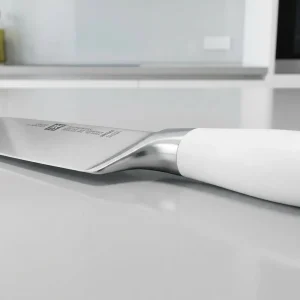
- Construction: These are “single-piece stamped.” A sheet of steel is punched like a cookie cutter. They lack the thick steel bolster (the junction between handle and blade) found on forged knives.
- Handle Material: Black polymer with a traditional triple-rivet look. It’s a full tang design, meaning the metal runs all the way through the handle, which is a rare “plus” for a stamped knife.
The “Definition” handle breaks from the rounded, traditional shape of the “Classic” line. It’s more geometric. It feels slicker in the hand than high-end composites like Micarta, but it’s durable.

The “Self-Sharpening” Block: Genius or Metal Eater?
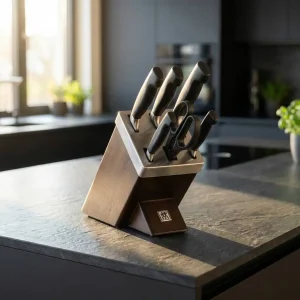
This is the main selling point. The wooden block has brushed stainless steel faceplates labeled for each knife (Chef, Santoku, Paring, etc.). Inside the slots for the fine-edge knives, there are two built-in ceramic rods positioned at a specific angle.
How It Works
Every time you pull the knife out or push it back in, the edge rubs against these ceramic rods. In a professional kitchen, we call this “honing” or “touching up.” It realigns the microscopic teeth of the blade.
The Chief’s Critique
Here is the reality: Because the steel is soft (53-55 HRC), the edge will roll after cutting through a pile of onions. If you didn’t have this block, the knife would feel dull within a week. The block forces you to hone the knife every time you use it.
Does it work? Yes. It keeps a “working edge” on the knife. However, it creates a very specific type of edge. It’s not a polished, razor-smooth edge; it’s a “toothy” edge (think of a microscopic saw). This is actually great for biting into tomato skins, but it’s aggressive.
The Danger Zone: Do not use this block as a fidget spinner. If you compulsively slide the knife in and out, you are grinding away metal. Over 5 years, you will notice the profile of your knife shrinking (recutting) much faster than normal. It’s a tool, not a toy.
The Blade-by-Blade Breakdown
You’re getting 14 pieces, but let’s be real—you only care about three of them. Here is how they perform.
The 8″ Chef’s Knife
The workhorse. Because it is stamped, the spine is thin. This means it slices through carrots with less “wedging” (cracking the vegetable) than a thick, cheap forged knife might. However, it lacks the weight to do the work for you. You have to push. It has a decent belly for rock-chopping herbs.
The Santoku
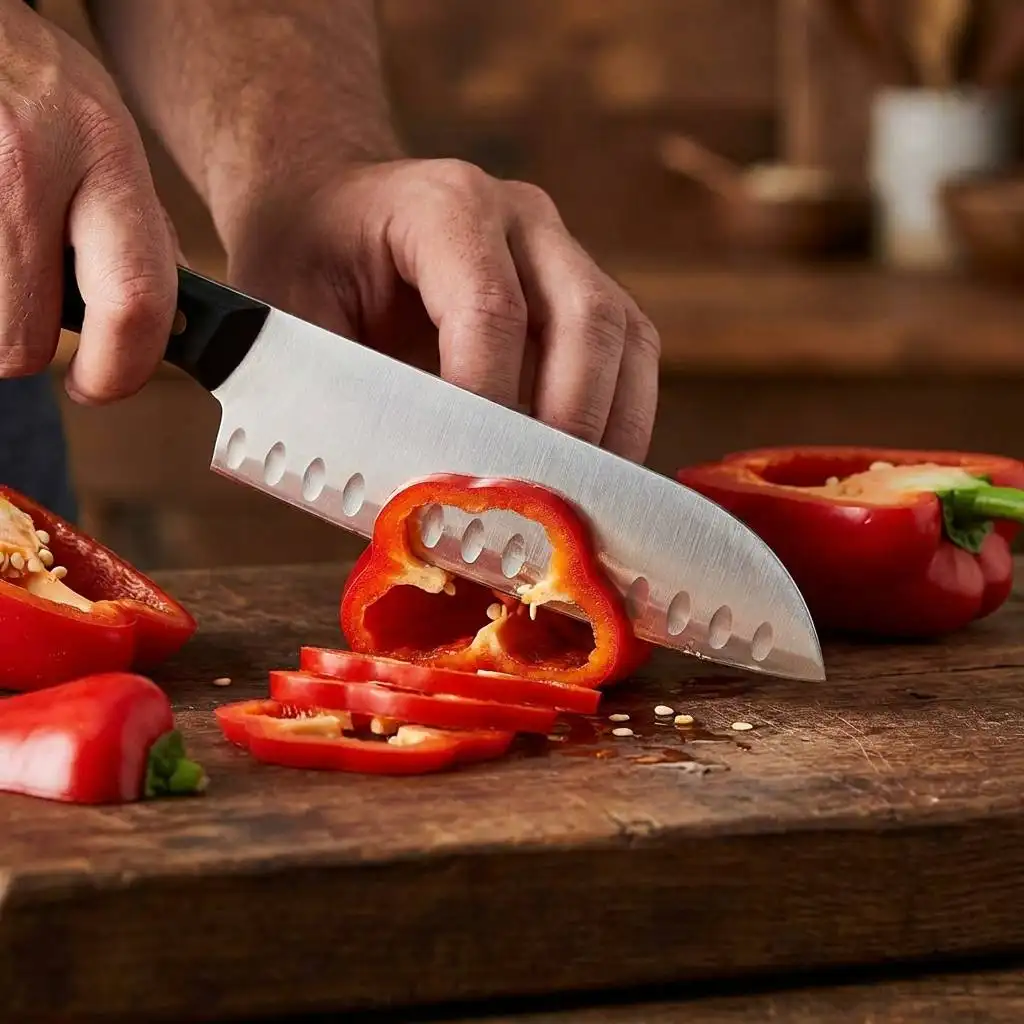
This features “grantons” (the hollow dimples on the side). Theoretically, these create air pockets to stop potatoes from sticking. In practice, on stamped knives, these dimples are often too shallow to be effective. It’s a lighter, more agile alternative to the Chef’s knife.
The Steak Knives (x6)
Pay attention: The steak knife slots are usually not self-sharpening. These are serrated blades. You cannot sharpen serrations on straight ceramic rods. They are competent table knives, but they tear meat rather than slicing it cleanly like a straight edge would.
Ergonomics & The “Pinch Grip” Test
I grabbed the 8-inch Chef’s knife and went into my standard pinch grip (thumb and index finger on the blade, remaining fingers on the handle). Here is the sensory feedback:
- Balance: The knife is handle-heavy. Stamped steel is very light, so the balance point sits behind the choil, back into the handle. This makes the tip feel “floaty.” Some people like this for speed; I prefer a neutral balance for control.
- The Spine: On budget knives, manufacturers often skip rounding the spine. The Definition series has relatively sharp 90-degree angles on the spine. After 20 minutes of heavy prep, you will feel a hotspot on your index finger.
- Agility: Because they are light, they are fast. If you have weak wrists or arthritis, the lack of weight compared to a forged Zwilling Pro might actually be a benefit for you.
Performance: The Board Test
I put the Definition set through my standard mise en place gauntlet.
The Tomato Test
Out of the block, the Chef’s knife sliced the tomato skin without slipping. The “toothy” edge created by the ceramic rods grabs the skin effectively. It didn’t crush the fruit.
The Carrot Test
Vertical chopping. The thin blade geometry is actually a plus here. It passed through dense carrots easily. However, on harder squashes, the blade has some flex. I don’t like flexible blades for hard veg—it feels unstable.
The Protein Test
Trimming silver skin off a tenderloin. The factory edge was acceptable, but the lack of stiffness in the blade made it harder to get a laser-straight trim compared to a stiff boning knife. It works, but it’s not precise.
Pros & Cons (The Chief’s Summary)
| The Good (Pros) | The Bad (Cons) |
|---|---|
| Always Ready: The block masks the soft steel’s poor edge retention by honing it every use. | Metal Eater: The mechanism removes more metal than a manual hone, shortening the lifespan of the knife. |
| Lightweight: Reduces fatigue for casual cooks who aren’t used to heavy forged steel. | Stamped Feel: Lacks the distal taper, weight, and premium feedback of a forged blade. |
| Price Point: You get a full setup for the price of one entry-level Japanese knife. | No Bolster: The transition from handle to blade is abrupt, which can be uncomfortable in a pinch grip. |
| Aesthetic: The metal cap on the block looks sharp on a granite countertop. | Confusion: “Definition” is entry-level; don’t expect “Pro” performance. |
Who Is This Set For? (And Who Should Run Away)
Honestly, for 90% of home cooks, a cheap knife that is mechanically sharpened every day is safer and more effective than a $200 Japanese Gyuto that hasn’t seen a stone in six months. I hate to admit it, but the gimmick works if you have zero skills.
Buy It If:
- You cook 3-4 times a week for a family.
- You realistically know you will never, ever buy a whetstone or learn to use a honing rod.
- You want a uniform, clean look on your counter without spending $500.
Skip It If:
- You are a budding culinary enthusiast. If you care about “grain structure” or “heat treat,” this soft steel will frustrate you.
- You prefer a heavy knife that falls through food.
- You want a “laser” sharp edge capable of transparent slices of radish. This block produces a utility edge, not a surgical one.
FAQ: Questions from the Floor
Can I put these in the dishwasher?
The box says yes. I say absolutely not. If you put these in the dishwasher, I will find you. The high heat expands the handle rivets, leading to cracks, and the detergent is abrasive enough to dull the edge you just sharpened. Hand wash only, dry immediately.
Does the self-sharpening block ruin the knives?
Ruin? No. Wear them down faster than manual sharpening? Yes. It is a trade-off. You are trading longevity for daily convenience. For a knife at this price point, that is a fair trade.
Can I use other knives in this block?
Generally, no. The slots are designed for the specific width and thickness of the Definition series. A thicker forged knife won’t fit, and a thinner knife might not make proper contact with the ceramic rods.
What is the difference between Fine Edge and Serrated in this set?
The Chef, Santoku, and Paring knives are Fine Edge (straight). The steak knives and the 5″ utility (often) are serrated. Only the Fine Edge slots have the sharpening mechanism. Serrated knives function like a saw and tear through tough exteriors like crusty bread.