Henckels International Definition 14-Pc Self-Sharpening Review: Genius Innovation or Steel-Eating Gimmick?
Let’s talk about the biggest shame in the home kitchen: dull knives. You know the drill. You buy a shiny set, use it for six months, and suddenly you’re not slicing tomatoes—you’re crushing them into a sad, watery paste. You know you should learn how to use a whetstone or at least a honing steel, but life gets in the way. You want a “set it and forget it” solution.
I’ll be honest with you right out of the gate. As someone who spends Sunday mornings meditating over 1000/6000 grit whetstones to get a mirror polish on my carbon steel Gyuto, the idea of a block grinding my knives every time I holster them makes my skin crawl. It feels… mechanical. Violent, even.
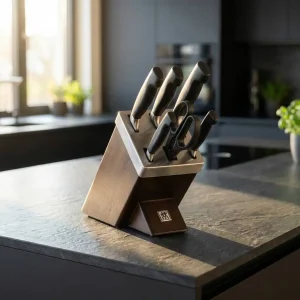
But here’s the reality check: my sous chef doesn’t have time for a stone session at home with two kids screaming in the background, and neither do you. I bought the J.A. Henckels International Definition 14-Piece Self-Sharpening Cutlery Set to see if the mechanics actually work, or if they just chew up your edge until there’s no steel left.
First Things First: “International” vs. “Zwilling” (Know What You’re Buying)
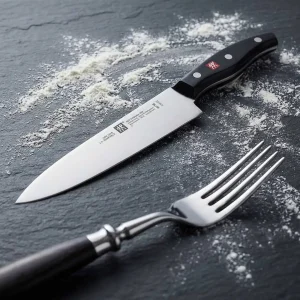
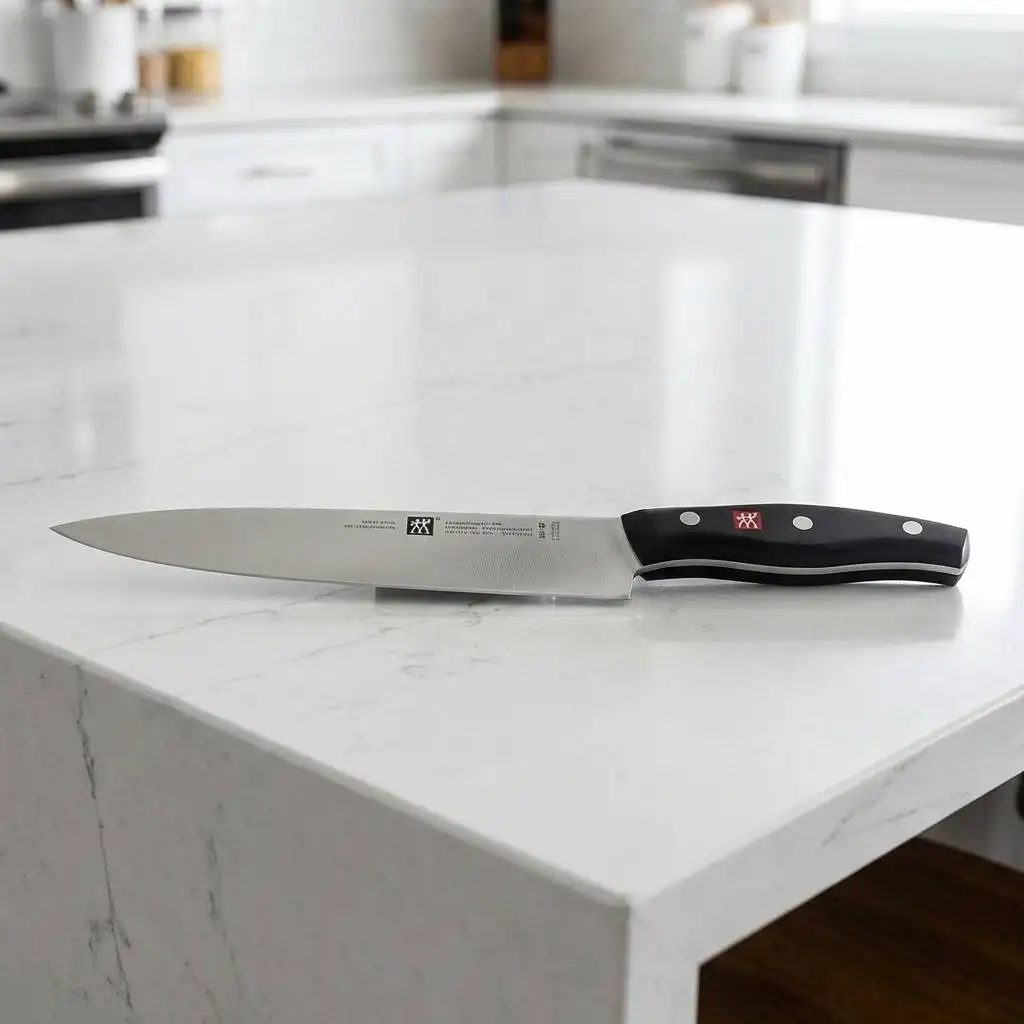
Before we look at the edge retention, we need to clear up the branding confusion that tricks 80% of buyers. In the world of Henckels, there is the “Two Men” logo (Zwilling J.A. Henckels) and the “One Man” logo (Henckels International).
This set is the “One Man” variety.
This means these knives are not forged in the premium Solingen, Germany factory. They are manufactured in facilities likely in China, India, or Spain (depending on the specific batch). Why does this matter? It manages expectations. These aren’t family heirlooms you’ll pass down to your grandchildren. They are utilitarian, high-volume tools designed for the rough-and-tumble of a daily kitchen.
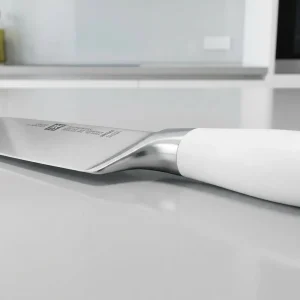
The “Definition” line specifically is a stamped blade series. They are lighter and thinner than their forged cousins. If you are expecting the hefty, weighted feel of a $200 German chef’s knife, you will be disappointed. If you want a nimble, lightweight tool that doesn’t tire your wrist out, keep reading.
The Specs: Metallurgy and Geometry
Let’s get nerdy for a second. If you don’t care about the steel grain, skip to the next section. But if you want to know why this knife cuts, here is the data block.
- Steel Type: High Carbon Stainless Steel (Likely a standard X50CrMoV15 or equivalent proprietary blend). It’s stain-resistant and tough.
- Hardness (HRC): Estimated 55-57 HRC. This is on the “softer” side of the spectrum.
- Construction: Single-piece stamped construction.
- Grind: Standard Western hollow grind, approx. 15 degrees per side.
Because the steel is relatively soft (compared to Japanese VG10 which sits around 60-61 HRC), it is durable. You can accidentally hit a chicken bone or drop it in the sink, and the edge will likely roll rather than chip. A rolled edge can be fixed; a chipped edge is a disaster. However, softer steel loses its edge faster—which is exactly why the self-sharpening block exists.

The “Self-Sharpening” Block: Engineering Analysis
This is the main event. The block features slots with built-in ceramic honing wheels set at a specific V-angle. Every time you pull the knife out or put it back in, the edge drags across these ceramic rods.
The “Chief’s” Critique
Marketing calls it “Self-Sharpening.” I call it “Aggressive Maintenance.” There is a difference between honing (realigning the microscopic teeth of the edge) and sharpening (removing metal to create a new edge). This block does a bit of both.
The friction is audible. When you slide the Chef’s knife in, you hear the grind. It works, undoubtedly. The knives stay functionally sharp for a very long time because you are constantly refreshing the apex of the edge. However, there is a cost: Steel consumption.
You are paying for convenience with the lifespan of the steel. Over 3 to 5 years of daily use, you will notice the profile of the blade changing—the heel might recede, or the belly might flatten out because the block is constantly shaving off micro-layers of metal. It’s not a dealbreaker for a $150 set, but it’s physics.
Ergonomics & The “Definition” Handle
The handle on the Definition line utilizes a classic triple-rivet design, but with a composite aesthetic. It’s contoured to fit the hand, which is a nice upgrade from the blocky handles of cheaper sets.
The Pinch Grip Test:
As a professional, I use a pinch grip (thumb and index finger on the blade spine). Because this is a stamped knife, there is no thick steel bolster to cushion your finger. The spine corners are a bit sharp—a common issue with stamped blades. After prepping 50 lbs of onions, you’d feel a callous forming on your index finger.
Balance Point:
The knives are handle-heavy. The stamped blade is light, shifting the center of gravity back toward the rivets. This isn’t inherently bad, but it lacks that “forward momentum” that helps a heavy forged knife fall through a squash. You have to provide the force.
The Board Test (Performance Review)
I put the “Big Three” from the set through a standard line cook prep list. Here is how they handled the board.
The Tomato Test (The Glider)
The serrated utility knife is the MVP here. It bit into the tomato skin immediately without slipping. The Chef’s knife, fresh out of the sharpening slot, also managed to slice paper-thin rounds without crushing the internal structure. The “factory edge” combined with the block’s maintenance creates a toothy edge that grabs food well.
The Carrot Test (The Wedging)
This is where geometry matters. Because the Definition blades are stamped and relatively thin, they actually perform well here. Thick forged knives sometimes “wedge” (crack) hard root vegetables. These sliced through cleanly. The lack of weight meant I had to push harder, but the cut was clean.
The Protein Test
I broke down a whole chicken. The blade is nimble enough to get between joints, but when my hands got greasy, the polymer handle got a little slick. The texture is smooth—great for cleaning, bad for grip when things get messy.
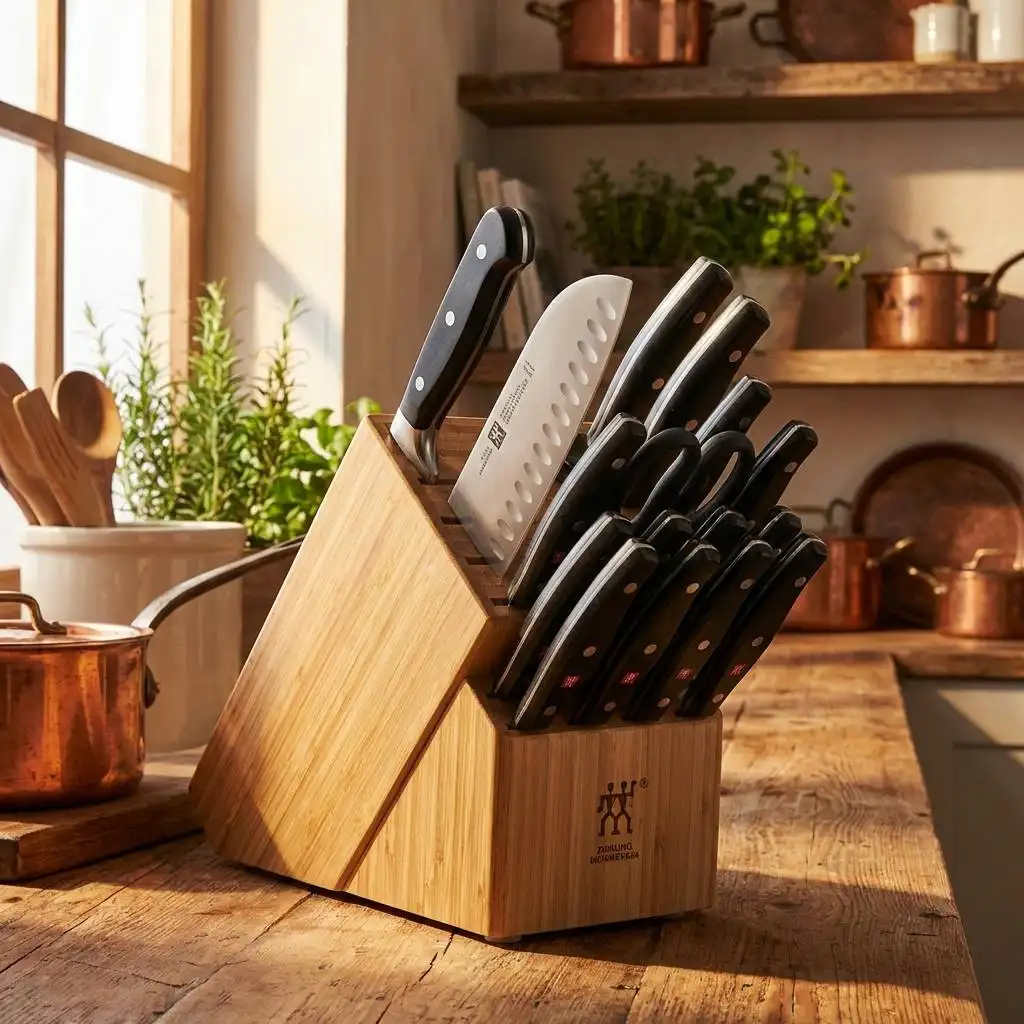
What You Actually Get (The 14 Pieces Broken Down)
Sets are notorious for “fluff” pieces to get the count up. Let’s look at the roster.
| Tool | Verdict |
|---|---|
| 8″ Chef’s Knife | The workhorse. Serviceable geometry, good belly for rock chopping. |
| Santoku | Includes hollow “granton” edges. Supposed to stop potatoes from sticking. It rarely works perfectly, but the flatter profile is great for push-cutting veggies. |
| Paring Knife | Standard. Good for coring strawberries or peeling apples. |
| Serrated Utility | Unexpectedly useful. Great for bagels, tomatoes, and citrus. |
| Steak Knives (x6) | Stamped, serrated blades. They will tear through a steak rather than slice it cleanly, but for a casual dinner, they are fine. Note: The steak knife slots are not self-sharpening. |
| Kitchen Shears | Often the unsung hero. Good for opening packages or snipping herbs. |
Maintenance: The Reality of “Self-Sharpening”
You might think this set requires zero maintenance. You are wrong.
1. The Metal Dust Issue:
Since the block is grinding your knives, fine metal dust accumulates inside the slots and on the blade. Before you cut that sandwich, wipe the blade off after pulling it from the block. Occasionally, you need to turn the block upside down and shake it out. You’d be surprised what falls out.
2. The Dishwasher is a Death Chamber:
I don’t care what the box says. Do not put these in the dishwasher. The heat expands the metal, the detergent eats the edge, and the water pressure bangs the blades against the cutlery basket. If you dishwasher these, the self-sharpening block won’t be able to save you.
Verdict: Who Should Buy This?
Is the Henckels International Definition Self-Sharpening set a scam? No. Is it high-performance culinary art? Also no. It is a brilliant piece of engineering for a specific demographic.
The Pros:
- Zero learning curve for sharpness maintenance.
- Lightweight, fatigue-free usage for light prep.
- Complete ecosystem (you don’t need to buy anything else).
The Cons:
- “Self-Grinding” mechanism reduces the lifespan of the knife over years.
- Stamped steel lacks the premium feel of forged options.
- Handles can be slippery when wet.
Price-to-Performance Ratio:
Honestly, “Self-Sharpening” is a marketing lie. It’s “Self-Grinding.” A whetstone creates an edge; this block maintains a working edge by aggressively removing material. But for a home cook who cuts on a glass cutting board (please don’t) or throws knives in a drawer, this block might actually save your dinner. If you want a sharp knife every single time you reach for it, and you don’t care about the physics of how it happens, buy this set.
FAQ
Can I put other knives in the self-sharpening slots?
Technically, yes, if they fit the thickness of the slot, but I highly advise against it. The angles of the ceramic rods are set specifically for the grind of the Definition series (approx. 15 degrees). If you put a thick German forged knife or a thin Japanese blade in there, you will ruin the edge geometry.
Do the steak knife slots sharpen the steak knives?
No. In almost all self-sharpening blocks, the steak knife slots are standard storage slots. Since the steak knives in this set are serrated, they cannot be sharpened by the simple V-shape ceramic mechanisms used for the straight-edge chef’s knives.
What is the difference between Henckels Definition and Henckels Statement?
Both are stamped, entry-level lines under the Henckels International brand. The main difference is the handle aesthetics and the end cap. The “Statement” line usually features a metal end cap on the handle for a bit more weight and balance, whereas the “Definition” is lighter with a composite end. The steel quality is virtually identical.