Henckels Forged Contour 14-Piece Review: A Pro Chef’s Honest Take on “Self-Sharpening” Blocks
We all know the drawer of doom. You reach in for a knife, dodge a jagged serrated edge, and pull out a dull chef’s knife that mashes a tomato into salsa rather than slicing it. It’s the universal kitchen nightmare. That’s exactly the pain point the Henckels Forged Contour 14-Piece Self-Sharpening Cutlery Set promises to fix. The pitch is seductive: knives that sharpen themselves every single time you put them away. No whetstones, no honing rods, no skill required.
To a home cook, that sounds like magic. To me? It sounds like a potential grinding nightmare.
I’m “Chief.” I didn’t learn about knives from unboxing videos; I learned about them during 15 years on the line in high-volume French and Japanese kitchens. I’ve spent thousands of hours with a knife in my hand, obsessing over Rockwell hardness, grain structure, and edge retention. Generally, I despise block sets. They’re often graveyards for bacteria and filled with useless “filler” knives you’ll never use. But, I’m putting my professional snobbery aside to answer the metallurgical question that matters: Does this “Self-Sharpening” technology actually maintain a functional edge, or does it just eat your steel alive?
The “Self-Sharpening” Gimmick: Genius or Destructive?
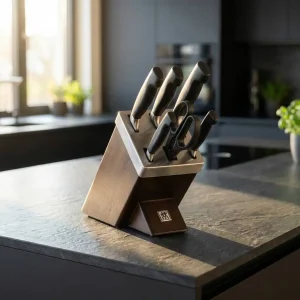
Let’s look under the hood of this block. The “Self-Sharpening” slots aren’t utilizing some complex AI or laser alignment. It is rudimentary mechanical friction. Inside the specific slots (usually for the chef’s knife, santoku, and prep knives), there are built-in ceramic honing wheels set at a specific angle.
Every time you slide the knife in or pull it out, the edge drags against these ceramic rods. In a professional kitchen, we use a ceramic rod to hone a blade—realigning the microscopic teeth of the edge that get bent during use. However, honing and sharpening are different beasts. Sharpening removes metal to create a new bevel. These blocks sit somewhere in the aggressive middle.
The physics here are simple but brutal. If you pull that knife out five times while prepping dinner, you are grinding that edge ten times. Over a year, you are aggressively removing micro-layers of steel. For a high-end Japanese blade hardened to 62 HRC, this would be a crime. But for the softer German-style steel used here, it’s a calculated trade-off. You are trading the lifespan of the knife for the convenience of never having to learn how to use a whetstone. It ensures the knife is always “utilitarian sharp,” but it will eventually alter the profile of the blade, wearing it down faster than traditional maintenance.

The Specs: Metallurgy and “Forged” Claims
Henckels likes to throw around the word “Forged,” but let’s clarify what you’re actually buying. In the knife world, there is “Hot Drop Forged” (a single bar of steel pounded into shape) and there is “Upset Forged” (where the bolster is welded onto a stamped blade). The Forged Contour series sits in the Henckels International line—this is their value brand, distinct from the premium Zwilling J.A. Henckels twin-man logo.
- Steel Identity: Likely X50CrMoV15 or a similar German stainless variant. It’s the standard kitchen workhorse steel.
- Hardness (HRC): Expect a Rockwell hardness around 55-57. This is “soft” compared to Japanese steel. The upside? It’s tough. You can drop it, bang it, and cut near bones without it chipping. The downside? It rolls its edge constantly—which explains why they paired it with a self-sharpening block.
- Geometry: These aren’t lasers. The spine thickness is substantial. It feels sturdy, but don’t expect it to glide through a dense squash without some resistance.
The “Contour” Handle & Ergonomics
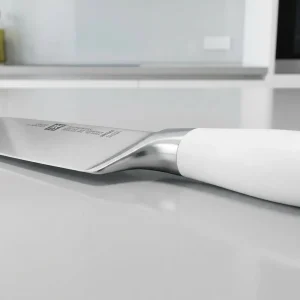
The “Contour” in the name refers to the handle shape, and honestly, it’s one of the better features of this budget-friendly set. We are looking at a classic three-rivet design with exposed full tang—meaning the steel runs all the way through the black polymer handle. This adds necessary weight and shifts the balance point backward.
However, we need to talk about the bolster. The transition from handle to blade features a partial bolster in some descriptions, but on the Forged Contour, it mimics a traditional germans style. My gripes with bolsters are well documented. If the bolster extends down to the heel of the blade, it acts as a finger guard. Safety nerds love this. Chefs hate it.
Why? Because you can’t sharpen the entire length of the blade. Over time, as the self-sharpening block eats away the edge, the blade recedes, but the thick steel bolster does not. Eventually, the bolster will hit the cutting board before the blade does, leaving you with an accordion-cut onion that’s still attached at the bottom. The ergonomic curve is comfortable for a hammer grip, but if you use a pinch grip like a pro, the fit and finish on these handles can sometimes feel a bit blocky compared to higher-end Zwilling lines.
The Lineup: Analyzing the 14 Pieces
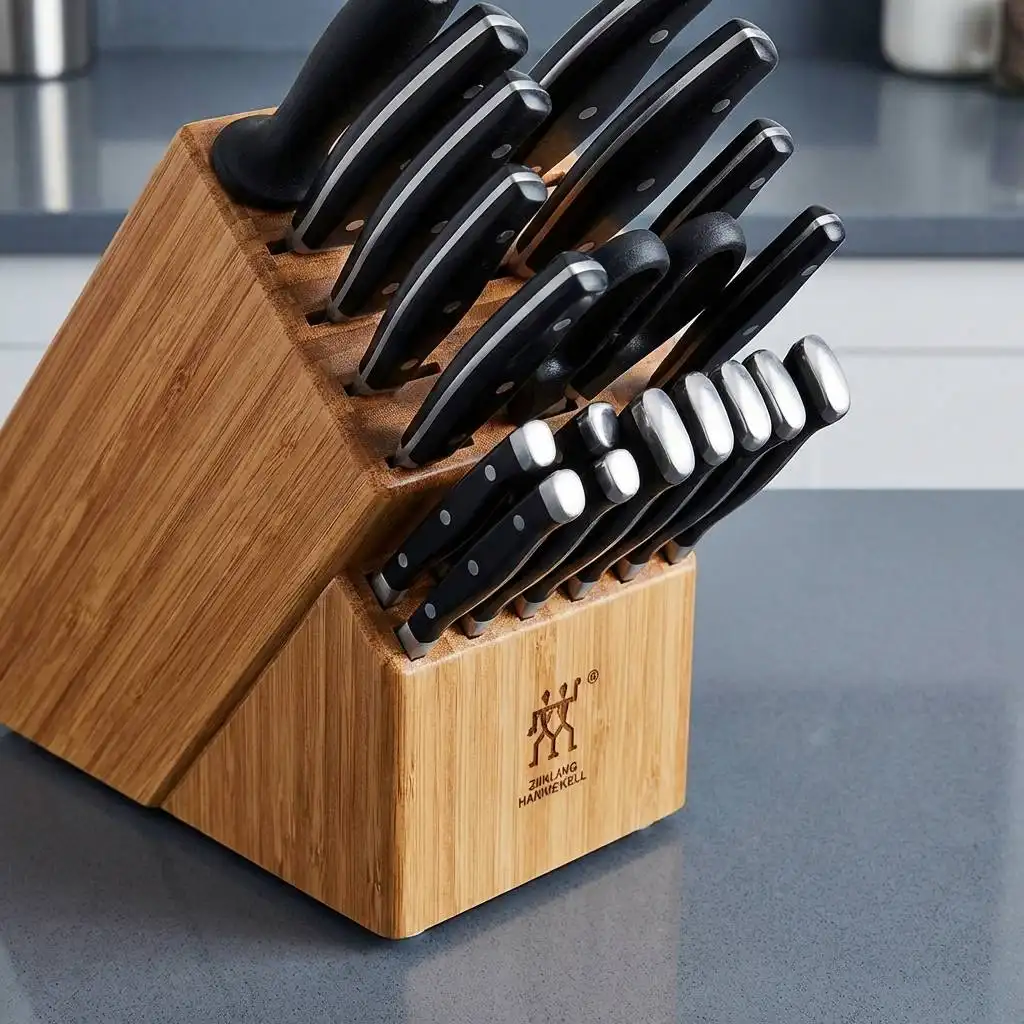
Block sets are notorious for inflating the piece count with garbage you don’t need. Let’s break down the roster.
The Workhorses
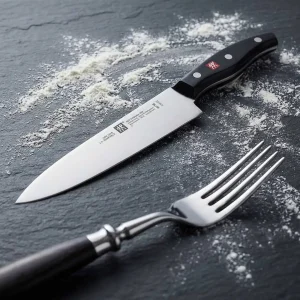
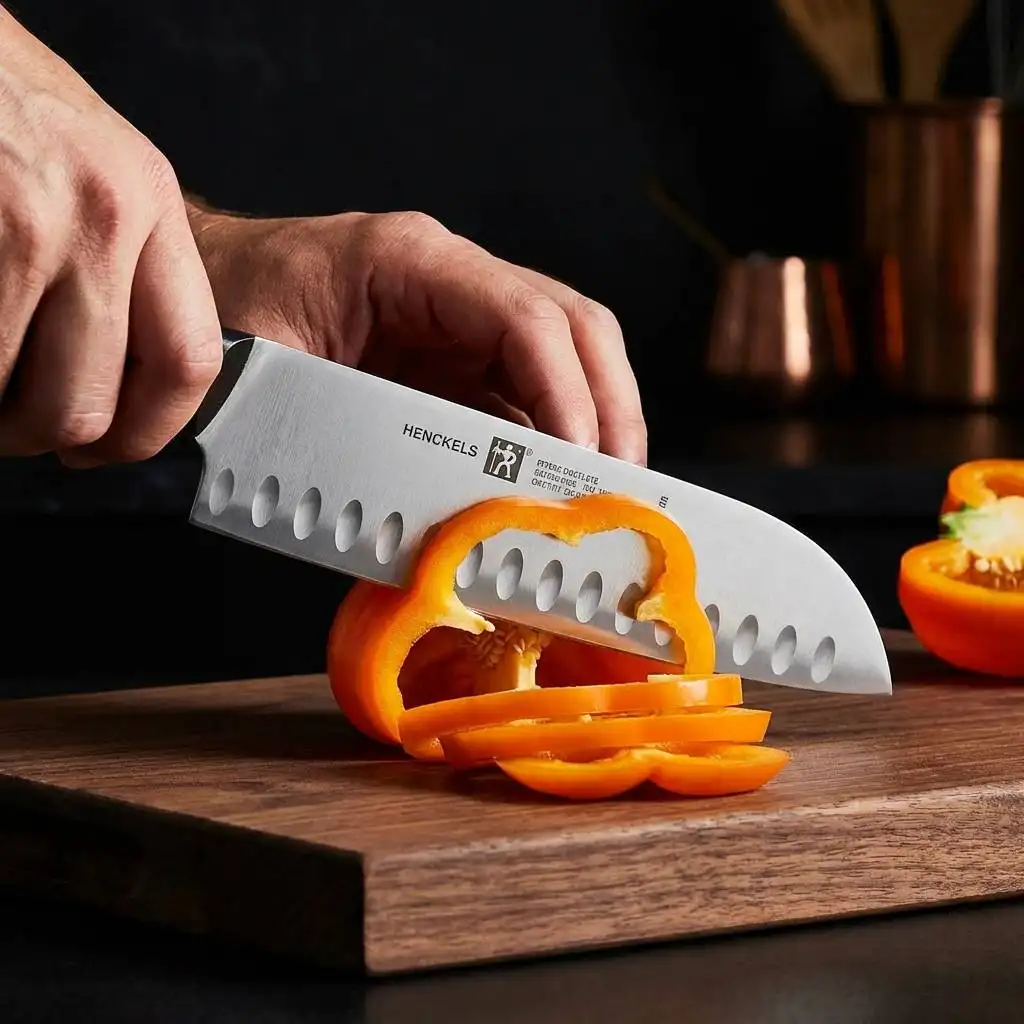
You get an 8″ Chef’s Knife and a Santoku. In a pro kit, having both is often redundant—they do the same job. But for a home cook, the Santoku offers a shorter, less intimidating blade for chopping veg, while the Chef’s knife handles the heavy lifting. They are the stars of the show here.
The Filler
The set includes six steak knives. Let’s be real: usually, in these sets, the steak knives are not forged; they are stamped from sheets of metal. They are likely serrated to death so they never need sharpening. They feel significantly lighter and cheaper than the main knives. They’ll cut a steak, but they feel like diner cutlery.
The Bread Knife
The serrated utility or bread knife in this set is usually aggressive. It will tear through a crusty baguette just fine, but don’t try to use it for delicate cake layers—it produces a lot of crumbs.
Performance: The Board Test
I took the primary 8-inch chef’s knife for a spin on a standard wooden cutting board. Here is the sensory data.
The Tomato Test
Out of the box (or rather, out of the block), the edge is toothy. It bites into the tomato skin immediately. The self-sharpening mechanism leaves a somewhat rough, micro-serrated edge rather than a polished mirror edge. For tomatoes, this is actually good—it grabs and slices without slipping.
The Carrot Test (Wedging)
Here is where the geometry shows its price point. When chopping thick carrots, I felt significant wedging. The blade is thick behind the edge. Instead of silently separating the vegetable, you hear a loud *crack* as the steel splits the carrot apart. It’s a “beater” performance—it gets the job done, but it lacks finesse.
The Protein Test
Trimming silver skin off a tenderloin requires a gliding motion. The Henckels steel is a bit “gummy” here. It doesn’t have the aggressive bite of carbon steel, so you find yourself sawing a bit more than you should. However, for breaking down a chicken where you might hit a joint? I’d trust this steel not to chip.
Long-Term Durability & Maintenance
The knives themselves are tanks. They are virtually indestructible under normal kitchen use. Rust isn’t a huge concern with this alloy, though I will say this loud and clear: Do not put these in the dishwasher. I don’t care what the box says. Dishwasher detergent is abrasive and the heat cycles will expand the handle rivets, eventually causing the scales to crack or separate.
The real durability concern is the block. Those sharpening slots will eventually fill with metal dust. There is no easy way to clean them out. Once the ceramic rods load up with metal residue, they stop sharpening and start just grinding dull friction against your blade. The block has a finite lifespan.
Verdict: Who Should Buy This?
If you are an aspiring chef looking for “the one” knife to start your journey, walk away. Buy a single, high-quality Gyuto and a whetstone. This set will teach you bad habits and the bolster will annoy you.
However, if you are a busy parent or a cook who knows, realistically, you are never going to hand-sharpen a knife? This set is a solid solution. It solves the “dull knife” problem with brute force engineering. It is a workhorse set for a busy household that values speed over surgical precision.
- Pros: Knives are always sharp enough to work. Durable steel. Comfortable handles for average hands. Full tang construction feels solid.
- Cons: The sharpening mechanism removes excessive metal over time. The bolster prevents proper sharpening of the heel. Steak knives feel cheap.
- Price-to-Performance: Fair. You are paying for the convenience of the block technology more than the steel quality.
Frequently Asked Questions
Is Henckels Forged Contour made in Germany or China?
The “Henckels International” brand (identified by the single stick-figure logo) typically manufactures its products in China or Spain. The Forged Contour line is generally made in China using German stainless steel. If you want German manufacturing, you need to look for the “Zwilling” brand (two stick figures), which costs significantly more.
Can I put Henckels Forged Contour knives in the dishwasher?
Technically, the marketing says yes. Professionally, I say absolutely not. The high heat, harsh detergents, and vibration will dull the edge you just sharpened and degrade the polymer handles. Hand wash and dry them immediately to keep them alive.
Do the self-sharpening slots ruin the knives over time?
They won’t “ruin” them instantly, but they will wear them down much faster than traditional methods. The slots grind away a small amount of steel every use. Over 5 to 10 years, you will notice the blade becoming narrower and the profile changing. It is a trade-off for convenience.