Henckels Dynamic 12-Piece Review: A Pro Chef’s Brutally Honest Take (Is It Just Cheap Steel?)
Let’s address the elephant in the kitchen. You’re staring at the price tag of the Henckels Dynamic 12-piece set, and then you’re looking at the brand name. “Henckels” is supposed to be the gold standard of German cutlery, right? So why does this set cost less than a single paring knife from their high-end lines? The confusion is real. You are wondering if you just found the deal of the century, or if you are about to buy a block full of fancy butter knives that will rust before you finish paying off your credit card.
I’ve spent the last 15 years in high-volume French and Japanese kitchens. I’ve built my career on high-carbon Japanese steel—lasers that can slice a grape without moving it. But I also know the reality of the home kitchen. Not everyone needs a $300 Gyuto that requires a theology degree to maintain. Sometimes, you just need a “beater.” A set you can abuse, hand to a clumsy relative during Thanksgiving, or use to crack a lobster shell without crying.
I bought the Henckels Dynamic set to put it through the grinder. I wanted to see if the famous “Single Man” logo still holds up on a budget, or if they are just trading on a legacy name to sell soft steel.
The “Zwilling” vs. “Henckels” Trap: Know What You’re Buying
Before we look at the metal, we need to clear up the branding mess. If you think you are buying the same knives used in Michelin-star kitchens in Berlin, stop. You aren’t.
There are two main entities under the corporate umbrella:
- Zwilling J.A. Henckels (The “Twins”): This is the premium line. Forged in Germany, Friodur ice-hardened, expensive.
- Henckels International (The “Single Man”): This is the value brand. Manufactured in places like China, Spain, or India.
The Henckels Dynamic series falls squarely into the “Single Man” category. These are stamped blades, not forged. That means they are punched out of a large sheet of steel like a cookie cutter, rather than being hammered into shape from a single bar. This isn’t inherently evil—some great knives are stamped—but you need to adjust your expectations. You are not buying an heirloom. You are buying a mass-produced tool designed for economy, not longevity.

The Specs (Data Block & Metallurgy)
Let’s strip away the marketing fluff. Henckels likes to use terms like “High-Definition Stainless Steel.” As a metallurgy nerd, that makes my teeth itch. There is no such thing as “High-Definition” steel. It’s marketing speak for “standard stainless that won’t rust easily.”
- Steel Type: Likely a variant of X50CrMoV15 or a similar Chinese equivalent (5Cr15MoV). It’s a standard German-style stainless alloy.
- Hardness: Approximately 55-57 HRC (Rockwell Scale). This is soft.
- Construction: Stamped full-tang (technically), but the tang is encased in the handle.
- Grind: Standard European V-edge, roughly 15 degrees per side.
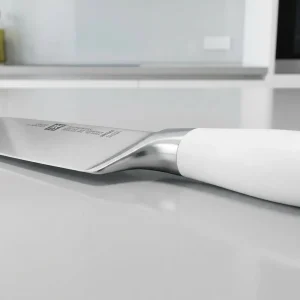
The construction lacks a bolster—that thick junction of metal between the handle and the blade found on forged knives. Without a bolster, the knife is significantly lighter. This shifts the balance point forward, which we will discuss in the ergonomics section. The grind is decent out of the box, but because the steel is relatively soft, don’t expect it to hold that razor edge after a week of heavy prep without maintenance.
Ergonomics & The “Hand Feel” (The Pinch Grip Test)
I picked up the 8-inch chef’s knife and immediately noticed the weight—or lack thereof. It feels airy. For some home cooks, light is good. For a pro, light often means a lack of authority when cutting through dense product.
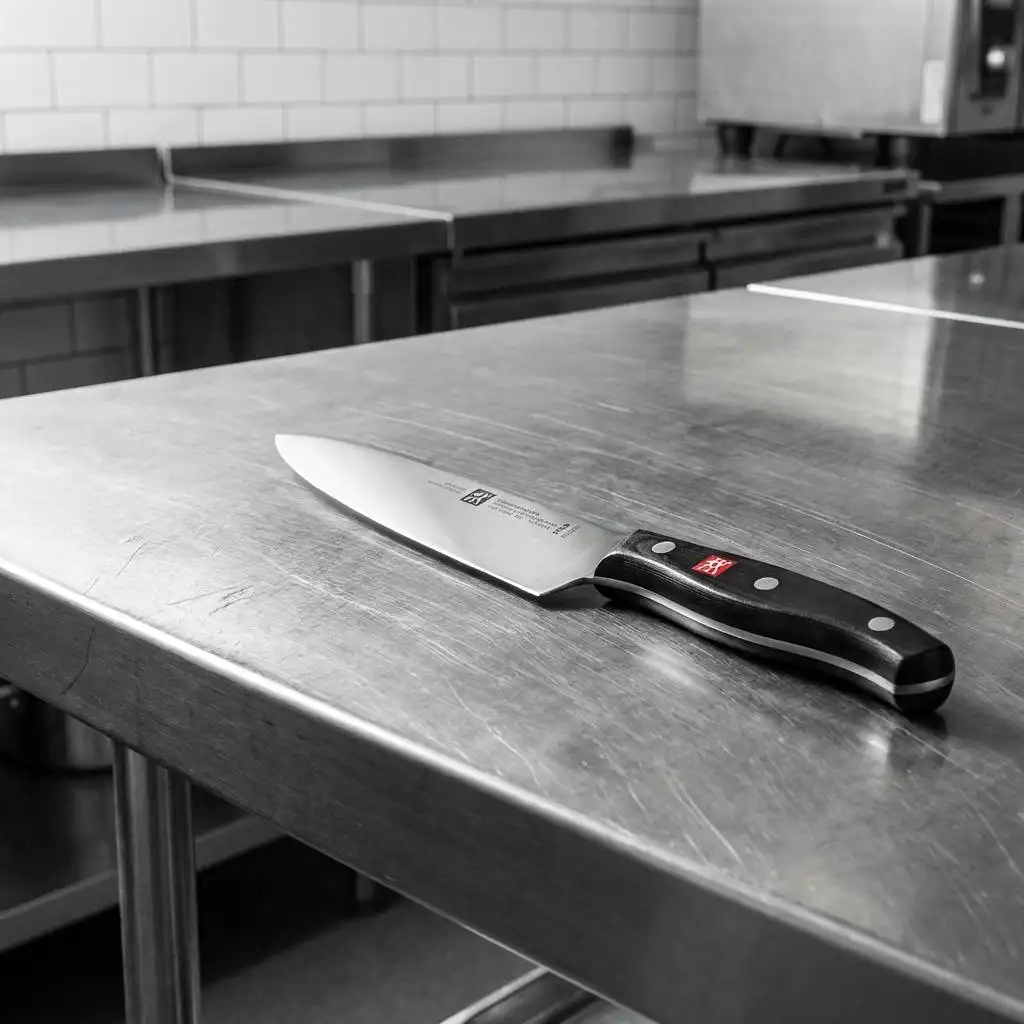
The handles are made of molded polypropylene (plastic) with a classic triple-rivet design. It looks like the expensive Pro S line, but it feels like plastic. I did the “Greasy Hand Test”—coating my hand in olive oil and gripping the knife. The result? It’s slippery. The texture is smooth, which is great for cleaning but terrible for grip security during a frantic mise en place.
However, my biggest gripe is the fit and finish. On the set I tested, the rivets weren’t perfectly flush with the handle scales. I could feel the metal lip catching on my skin. If you use a proper “pinch grip” (thumb and index finger on the blade spine), the lack of a smooth bolster means the spine of the knife digs into your index finger. After chopping 10 pounds of onions, you’re going to have a blister where your callus should be.
The Performance Test: Does It Cut or Crush?
I ran the Dynamic set through my standard gauntlet. Here is how the metal met the meat.
The Chef’s Knife (8-inch)
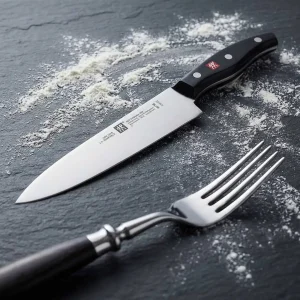
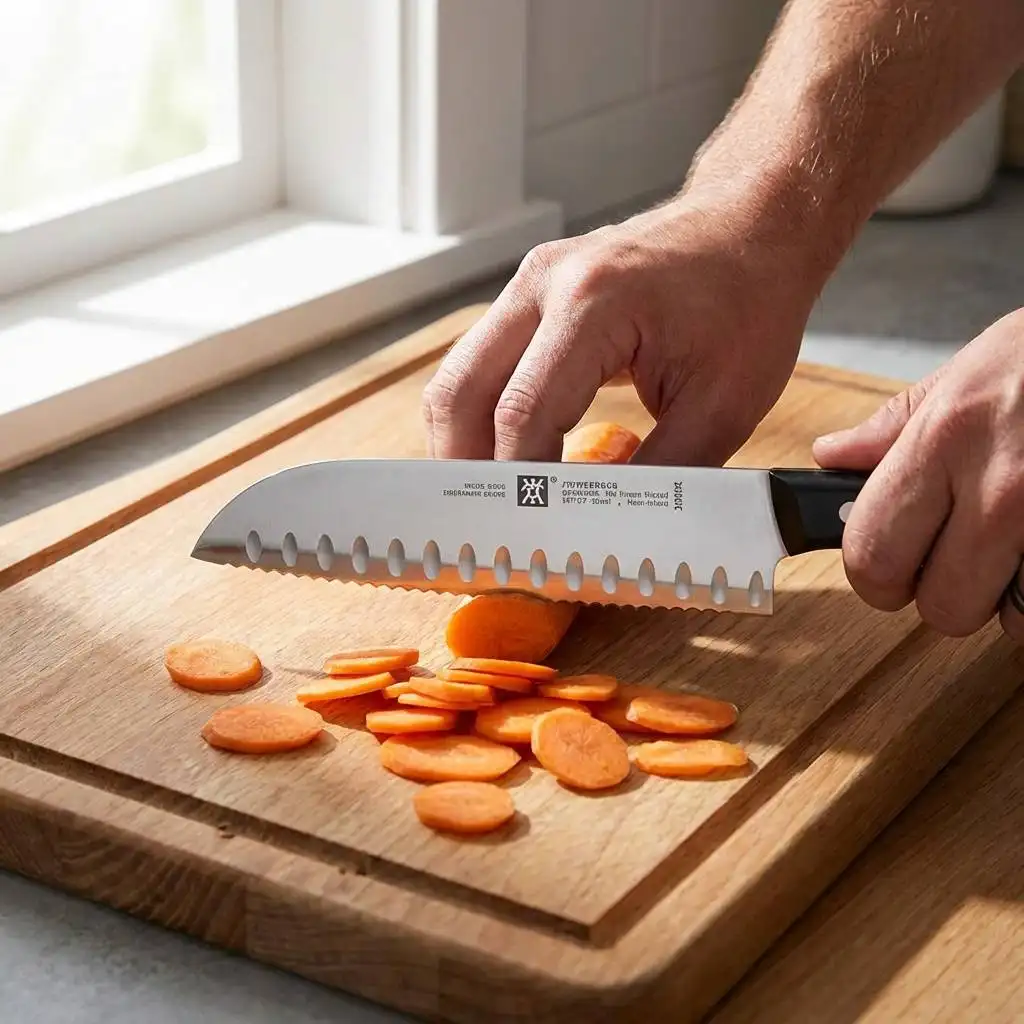
I started with the Carrot Test. A good knife cuts; a thick knife wedges. When I pushed the Dynamic blade through a large carrot, I heard a loud crack halfway through. That is “wedging.” The blade geometry is thick enough behind the edge that it splits the vegetable open rather than slicing it cleanly. On the Herb Rock test, the curved belly performed adequately. It has enough curve to rock-chop cilantro without slamming your knuckles into the board.
The Santoku
The set includes a Santoku with a hollow edge (those little dimples on the side). The theory is that air pockets prevent food from sticking. The reality? Potatoes stick to this knife just as bad as they stick to a flat blade. The grind is slightly thinner than the chef’s knife, making it the better performer of the two for vegetables, but don’t buy it for the dimples.
The Steak Knives
Here is my controversial take: The serrated steak knives in this set aren’t designed to cut meat cleanly; they are designed to saw through overcooked leather because the average user doesn’t know how to sharpen a straight edge. It’s a solution to a problem that shouldn’t exist. They tear the fibers of a medium-rare ribeye rather than slicing them. However, for the average family dinner, they will stay “sharp” forever because serrations protect the cutting edge from the ceramic plate.
Edge Retention & Maintenance (The Reality Check)
Because the steel is soft (~55 HRC), the edge is going to roll over. In a pro kitchen, this knife would be dull by the end of lunch service.
The Honing Rod Reality: You absolutely must use the honing steel included in the block. You should be honing this knife every 2-3 uses. The soft steel is prone to rolling, and the rod realigns the microscopic teeth of the edge.
Sharpening: The silver lining of soft steel is that it is incredibly easy to sharpen. It’s not “chippy” like hard Japanese VG10. It feels “gummy” on a whetstone, but you can get a screaming sharp edge on it in five minutes. It just won’t stay that way.
Dishwasher Durability: The box says “Dishwasher Safe.” I am telling you: ABSOLUTELY NOT. Dishwasher detergent is abrasive and will dull the edge immediately. The high heat cycles will eventually cause the plastic handles to crack around the rivets. If you want this set to last more than a year, wash it by hand.
Included Accessories: Block & Shears
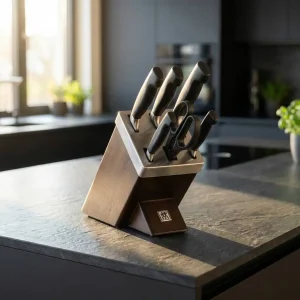
The Block: It’s a standard wood block, likely stained rubberwood. It looks decent on a counter, but check the slots. On my unit, the slots were rough-cut, meaning sawdust stuck to the blade the first few times I pulled it out.
The Shears: Kitchen shears are the unsung heroes of prep. The shears in the Dynamic set are… adequate. They do not separate for cleaning, which is a major hygiene red flag for me. If you use these to cut raw chicken, bacteria will get into the pivot screw, and you can’t get it out. Use them for opening packages, not for food prep.
Comparison: Henckels Dynamic vs. The Competition
How does it stack up against other budget titans?
| Feature | Henckels Dynamic | Mercer Culinary Millennia | Victorinox Fibrox |
|---|---|---|---|
| Steel Origin | German Formula (Stamped) | Japanese High-Carbon (Stamped) | Swiss (Stamped) |
| Handle | Hard Plastic (Slippery) | Santoprene (Grippy) | Fibrox (Non-Slip) |
| Esthetic | Classic Triple Rivet | Utility / Commercial | Utility / Ugly |
| Performance | Adequate | High | Very High |
| Price Point | Budget Set | Budget Individual | Mid-Range Individual |
If you care purely about cutting performance, the Victorinox Fibrox destroys the Henckels Dynamic. It’s uglier, but the steel is superior. The Mercer Millennia is the standard for culinary students because the handle is rubberized and safe. You buy the Henckels Dynamic because you want the “look” of a traditional knife block on your counter without the price tag.
The Final Verdict: Who Is This Set For?
After abusing this set, I have a clear picture of its place in the world. It is not a professional tool, and it is not for the serious home enthusiast.
The “No-Go” List
- Culinary students.
- Home cooks who enjoy the “art” of prep.
- Anyone who knows what “whetstone” means.
The “Green Light” List
- First-time apartment renters: It’s a complete kit for a low price.
- Airbnb Hosts: It looks premium enough for guests, but it’s cheap enough that you won’t cry when someone puts it in the dishwasher.
- The “Non-Cook”: If you cook three times a week and just need something sharper than a spoon, this works.
Pros: Classic aesthetic, lightweight, very affordable, easy to sharpen.
Cons: Soft steel requires constant honing, handle finish is mediocre, shears are not sanitary, significant wedging on dense vegetables.
FAQ: Common Questions About Henckels Dynamic
- Where are Henckels Dynamic knives made?
- They are manufactured in countries with lower production costs, typically China, India, or Spain, depending on the production batch. They are not made in Germany.
- Do these knives rust?
- They are stain-resistant, not stain-proof. If you leave them in a sink full of water or put them in the dishwasher, they can develop rust spots. Dry them immediately after washing.
- Can I sharpen these with a pull-through sharpener?
- I usually hate pull-through sharpeners because they strip way too much metal. However, for this specific steel and hardness, a carbide pull-through sharpener is acceptable. The steel is soft enough that the damage is minimal compared to the convenience for the target user.