Henckels Cutlery Sets: The Truth About “The Twins” vs. “The Single Guy” (A Chef’s Guide)
You’re standing in the aisle of a department store, or maybe you’re scrolling through Amazon at 11 PM. On one tab, you see a Henckels block set for $120. On the next tab, a set that looks almost identical is listed for $799. Confused? You should be. That confusion is exactly what the marketing department is banking on.
They want you to buy the “German Engineering” prestige without realizing you might be getting a box of stamped sheet metal made in a factory in Ningbo, China. I’ve spent over 15 years in professional kitchens, from high-volume French bistros to obsessive Japanese omakase counters. I know the sound a cheap knife makes when it hits a prep board—that hollow, tinny clack that tells me the steel is too soft and the tang is non-existent. Compare that to the solid, dull thud of a forged blade, and you understand why line cooks protect their knife rolls with their lives.
I’ve sharpened enough abused Henckels knives to tell you exactly how the grain structure holds up after five years of dishwasher abuse (which you should never do, by the way). We are going to cut through the noise. No fluff. Just steel, physics, and the truth about whether you’re buying an heirloom or a beater.
The Tale of Two Brands: Zwilling vs. International
This is the most critical distinction you need to understand. If you take nothing else away from this article, remember this: Count the people in the logo.
The brand is split into two distinct tiers that share a name but offer completely different performance metrics.
- Zwilling J.A. Henckels (The Twins): Look for the red square logo with two stick figures. This is the premium stuff. These knives are usually manufactured in Solingen, Germany. They are forged from a single piece of steel, treated with their proprietary Friodur ice-hardening process, and designed for serious work.
- Henckels International (The Single Guy): The logo has only one stick figure holding a halberd. This is the budget line. These are often manufactured in Spain, China, or Thailand. With few exceptions (like the Forged Synergy line), these are stamped knives. That means they are punched out of a large sheet of metal like a cookie cutter, rather than hammered into shape.
If it has one guy on the logo, it’s a beater knife. It’s fine for a college apartment or an Airbnb rental where you expect guests to use the chef’s knife to open a paint can. But if you are looking for heirloom performance, “The Single Guy” is not it.
The Metallurgy: What is “German Steel” Anyway?
Marketing brochures love to throw around the term “German Steel” or “Surgical Steel.” In the kitchen, “surgical steel” usually means cheap mystery metal that can’t hold an edge. However, the standard formula for real German cutlery (Zwilling lines) is X50CrMoV15.
Let’s break down the specs of this alloy:
- Carbon (0.5%): This is relatively low compared to Japanese steels like VG10 or Aogami (Blue Paper), which hit 1.0% or higher. Carbon is what allows steel to get hard and stay sharp.
- Chromium (15%): This is high. It makes the knife incredibly resistant to rust and acid. You can leave a lemon wedge on this blade overnight, and it probably won’t pit.
- Hardness (57 HRC): Henckels aims for a Rockwell Hardness of about 57. In the knife nerd world, we call this soft.
But here is the reality: for a home cook, softness is a feature, not a bug. At 57 HRC, the steel is tough. If you accidentally whack a chicken bone or twist the blade while cutting a squash, the edge will roll over rather than chipping. A rolled edge can be realigned in ten seconds with a honing rod. A chipped edge on a hard Japanese knife requires 45 minutes on the whetstones to grind out. It’s a trade-off: you lose edge retention (you’ll be honing constantly), but you gain durability.
Anatomy of a Henckels: Bolsters, Tangs, and Balance
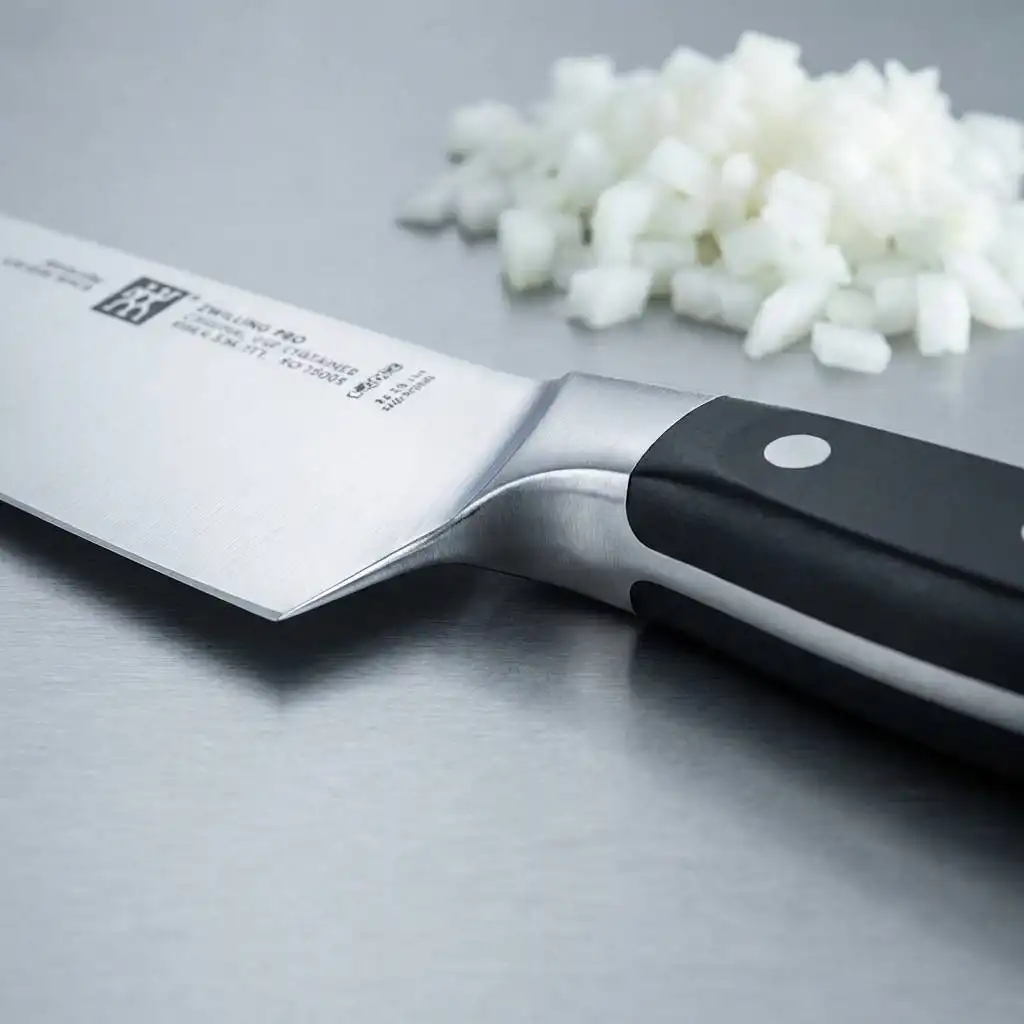
The “feel” of a knife comes down to geometry and weight distribution. This is where Henckels has made some questionable design choices over the years, specifically with the bolster—the thick junction of metal between the handle and the blade.
The Bolster Debate
The classic “Four Star” and “Professional S” lines feature a full bolster. This is a thick band of steel that runs all the way down to the heel of the blade. I hate this design. It effectively prevents you from sharpening the last inch of the heel. Over years of sharpening, the blade wears down and recedes, but the bolster does not. Eventually, you end up with a “recurved” profile where the heel hits the cutting board before the rest of the edge, leaving your onions like an accordion—connected at the bottom.
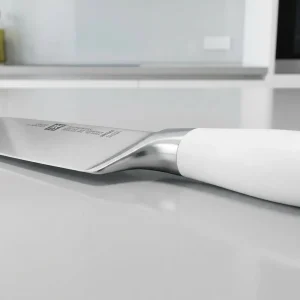
The Zwilling Pro line fixed this with a curved, angled half-bolster. This allows for a proper “pinch grip”—where your thumb and index finger grip the blade itself—without rubbing a callus onto your index finger. It also allows you to sharpen the entire length of the edge.
The Tang
You want a full tang. This means the steel of the blade runs through the entire handle. It shifts the balance point backward, toward your hand. If a knife is blade-heavy (common in stamped knives with rat-tail tangs), your wrist has to work harder to keep the tip elevated. After two hours of prep for a banquet, you feel that difference in your forearm.

The Lineup: Which Set Belongs in Your Kitchen?
Not all steel is created equal. Here is the breakdown of the lines worth your money and the ones you should avoid.
The Workhorses: Zwilling Pro & Four Star
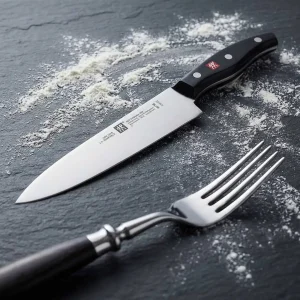
These are the industry standards. They use the Sigmaforge process (one-piece forging) and Friodur ice-hardening. The Zwilling Pro is my top pick because of the bolster geometry I mentioned earlier. It has a significant belly, meaning it’s designed for “rock chopping” herbs and garlic. It’s heavy, utilitarian, and nearly indestructible.
The Four Star is functionally identical in terms of steel, but it has that ugly, blocky molded handle that looks like it belongs in the 1980s. However, it is fully sealed and sanitary, which is why commercial kitchens still buy them by the crate.
The Aesthetic Choice: Miyabi (The Japanese Cousin)
Zwilling owns Miyabi. These are made in Seki, Japan. They use powder steels like SG2 or VG10 and hit hardness ratings of 63 HRC. They are lasers—thin behind the edge and incredibly sharp out of the box. But be warned: Do not treat this like a German knife. If you try to disjoint a chicken or twist it in a pumpkin, it will chip. These are precision instruments, not crowbars.
The Budget Traps: Solution, Definition, and Dynamic
These are the “Single Guy” lines. They are stamped. The metal is softer, the grinds are often inconsistent, and they lack distal taper (meaning the spine doesn’t get thinner toward the tip). This causes the “wedge” effect. When you cut a dense vegetable like a carrot, the knife doesn’t slice; it splits the vegetable apart like an axe splitting a log. They are cheap for a reason. Don’t pay more than $100 for a block of these.
Performance Stress Test: The Board Exam
When I test a knife, I don’t care about the polished finish. I care about the geometry.
The Tomato Test (Edge Bite)
German stainless steel is often polished to a high grit. Sometimes, it’s too polished. Out of the box, Henckels edges can be a bit slippery on tomato skin. They slide rather than bite. I usually have to take them to a 1000 grit stone or a strop immediately to give the edge some “teeth.”
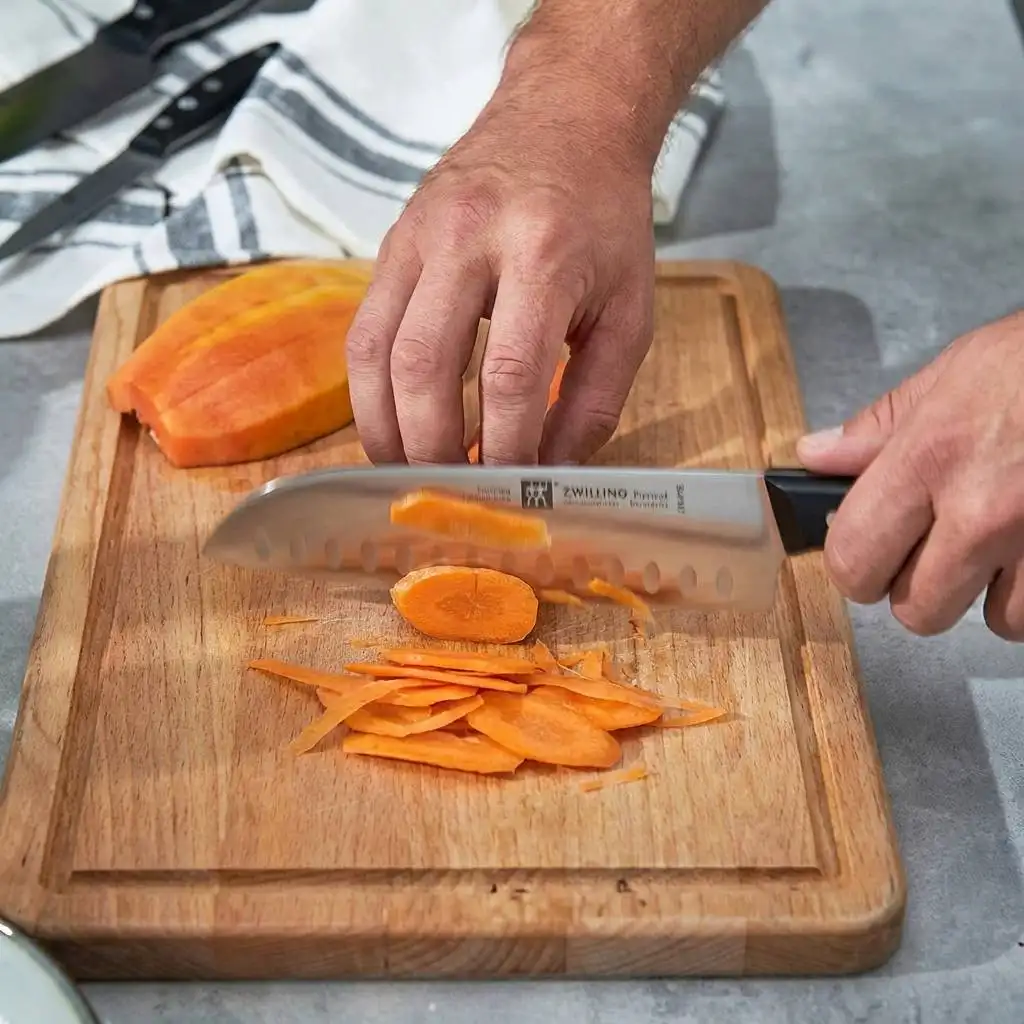
The Carrot Test (Wedging)
This is where the forged lines shine over the stamped ones. The Zwilling Pro has a decent distal taper. It glides through carrots relatively well, though not as effortlessly as a thin Japanese Gyuto. The cheaper International lines? They wedge hard. You have to push with force, and the carrot snaps loudly.
The Protein Test (Silver Skin)
I took a Zwilling Pro boning knife to a whole beef tenderloin to remove the silver skin. The flexibility was decent, but the steel felt “gummy” on the touch-up. It doesn’t have that crisp, glass-like feedback you get from carbon steel. It gets the job done, but it doesn’t bring any joy to the process.
Maintenance: The Reality of Soft Steel
Here is the hard truth about owning a Henckels set: You need to hone it every single time you use it. Because the steel is 57 HRC, the edge rolls over microscopically on contact with the cutting board.
Throw away the pull-through sharpener. You know the one—the little plastic gadget with the carbide V-notch that comes with the block set. It strips metal off your blade aggressively and leaves a jagged, tear-prone edge. It ruins the geometry of the knife.
Learn to use the honing rod (the long metal stick). It doesn’t sharpen; it realigns the burr. If you aren’t willing to use the rod for 10 seconds before you start cooking, your Henckels will feel dull within a week. When it’s time to actually sharpen (remove metal), this steel feels “gummy” on whetstones. It produces a stubborn burr that can be annoying to deburr if you don’t know what you’re doing.
Verdict: Price-to-Performance Ratio
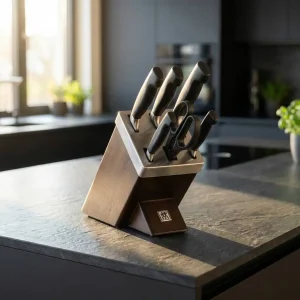
So, should you buy a set? My controversial take: Stop buying huge 18-piece blocks.
You are paying for 12 knives you will never use. You do not need a 5-inch utility knife, a 6-inch utility knife, and a 5.5-inch prep knife. It’s clutter. And those wooden blocks? They are bacteria hotels if you put a knife away slightly damp.
The Strategy: Buy a magnetic strip. Then buy three good knives:
1. Zwilling Pro 8-inch Chef’s Knife (The workhorse)
2. A cheap Victorinox Paring Knife (Don’t spend money on paring knives, you’ll lose them)
3. A serrated bread knife (Mercer makes a great one for $20)
If you absolutely must have a matching set for the countertop aesthetic, here is the breakdown:
| Feature | Zwilling Pro (The Twins) | Henckels International (Single Guy) |
|---|---|---|
| Steel | Forged X50CrMoV15 (Friodur) | Usually Stamped Stainless |
| Durability | Tank-like. Can survive a nuclear blast. | Moderate. Prone to bending. |
| Edge Retention | Solid if honed daily. | Poor. Dulls quickly. |
| Price | $$$ (Investment) | $ (Disposable) |
| Chef’s Take | Respectable workhorse. | Glorified letter opener. |
FAQ: Questions from the Floor
- Is Henckels made in China now?
- It’s nuanced. “Henckels International” (Single Guy) products are largely made in China, Spain, or Thailand. “Zwilling” (The Twins) products are mostly made in Germany, though they do have some ceramic lines and accessories made in Asia. Check the blade stamp—it will always say the country of origin.
- Can I put Henckels knives in the dishwasher?
- NO. I don’t care what the box says. The dishwasher does three things: the high heat messes with the temper, the detergent is abrasive and dulls the edge, and the water pressure bangs the knife against other cutlery, causing chips. Wash it by hand, dry it immediately.
- What is the difference between Zwilling and Henckels?
- Zwilling is the premium brand (Forged, German, superior finish). Henckels International is the value brand (Stamped, Asian/Spanish, budget finish). You get what you pay for.
- How often should I sharpen my Henckels set?
- You should hone (align) it every time you use it. You should sharpen (grind new metal) every 6 to 12 months depending on usage. If you are crushing garlic daily, do it every 3 months.