Henckels Cutlery Sets Ranked: The “Twin” vs. “Single Man” Scam (And Which Steel Actually Holds an Edge)
Let’s get one thing straight immediately: The “Henckels” name is currently the most confusing branding mess in the culinary world. You can walk into a high-end kitchen store and drop $800 on a block set that will last three generations. You can also walk into a big-box discount store and spend $80 on a set that carries the exact same name but is made of mystery metal that dulls if you look at it wrong.
I’ve seen this play out on the line more times than I care to count. I remember a green commis chef walking into my station during prep, chest puffed out, unrolling a knife roll filled with shiny, brand-new “Henckels International” knives. He thought he’d bought the German legends. Within two hours of breaking down mirepoix and processing chickens, his edges were rolled over like a curled lip. He spent the rest of the shift struggling to cut through tomato skin while I bailed him out with my beat-up petty knife.
That is the pain point. You are terrified of paying premium prices for “German Steel” that is actually soft, stamped sheet metal from a factory in Southeast Asia. Today, we are cutting through the marketing fluff. No “elevating your culinary journey” here. We are talking grain structure, Rockwell hardness, and why you probably shouldn’t buy the 18-piece block.
The “Two Henckels” Dilemma: Read the Logo or Regret the Buy
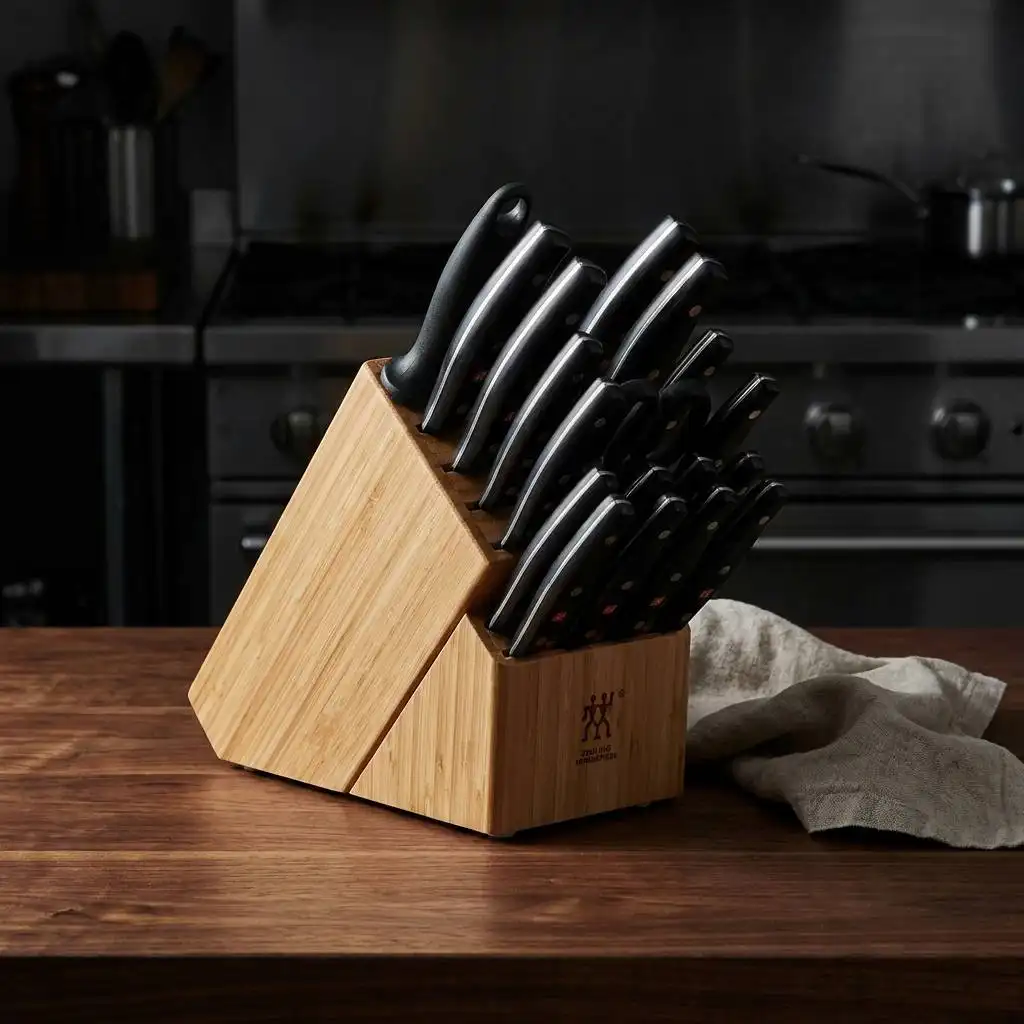
If you take nothing else away from this, memorize this rule: Count the people in the logo.
The brand has split its personality into two distinct entities to capture both the luxury market and the bargain bin hunters. If you don’t know the difference, you are the mark.
- Zwilling J.A. Henckels (The “Twin” Logo): Two little stick figures. This is the real deal. Most of these lines are manufactured in Solingen, Germany (or premium factories in Spain/Japan under strict oversight). They use the proprietary Friodur ice-hardening process which stabilizes the molecular structure of the steel.
- Henckels International (The “Single Man” Logo): One stick figure holding a halberd. This is the budget line. These are often made in China, Thailand, or Spain using standard heat treatments. The quality control is loose, and the steel is softer.
Why does this matter? It comes down to metallurgy. The premium “Twin” lines undergo a sintering and ice-hardening process that freezes the blade to -94°F. This converts retained austenite into martensite—fancy talk for making the steel significantly harder and more corrosion-resistant. The “Single Man” lines generally skip this expensive step.
And please, stop falling for the term “Surgical Steel.” It is a marketing garbage term. In the kitchen, we want carbon for edge retention. Surgical steel usually relies heavily on chromium to prevent rust (because surgeons don’t want tetanus), but it lacks the carbide structure to hold a refined edge. Scalpels are disposable. Your $200 chef’s knife shouldn’t be.
The Metallurgy Deep Dive: What Are You Actually Paying For?
Let’s look at the spec sheet. The standard German alloy used in the premium Zwilling lines is X50CrMoV15.
- X: Stainless steel.
- 50: 0.5% Carbon content. (Decent, but low compared to the 1.0%+ found in Japanese VG10).
- Cr: Chromium for stain resistance.
- MoV: Molybdenum and Vanadium for grain refinement and toughness.
The Hardness Analysis:
This steel is typically heat-treated to 57-58 HRC (Rockwell Hardness Scale). In the world of high-performance cutlery, that is effectively “soft.” A Japanese blade might hit 61-63 HRC.
However, softness isn’t always a defect. Because the steel is softer, it is incredibly tough. It has a ductile grain structure. If you slam a Japanese knife into a chicken bone, it chips (micro-fractures). If you slam a Henckels X50 blade into a bone, the edge just rolls. You can fix a rolled edge in ten seconds with a honing steel. Fixing a chip requires removing metal on a whetstone. This makes Henckels the ultimate “beater” knives for high-volume, rough prep.
The Contenders: Henckels Sets Put to the Board Test
Not all forged knives are created equal. Even within the premium “Twin” line, the geometry changes everything.

The Gold Standard: Zwilling Pro Series
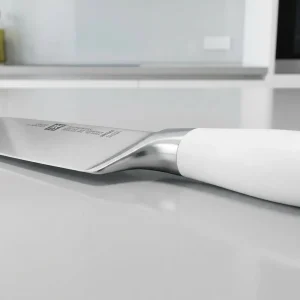
This is the only German knife I currently recommend without hesitation. Why? The bolster. Most German knives have a clunky, full bolster (that thick band of metal between the handle and blade) that prevents you from sharpening the entire length of the edge. The Zwilling Pro features a curved, half-bolster. It encourages a proper pinch grip, allowing your thumb and index finger to slide forward onto the blade for control. It feels like an extension of the hand, not a tool you are holding.
The Old Guard: Zwilling Four Star
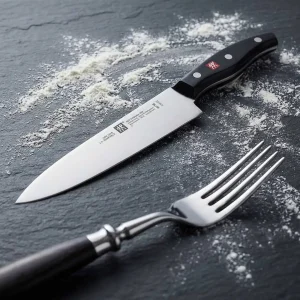
These have been around since the 70s. They are reliable, but dated. They feature the dreaded “full bolster.” As a professional sharpener, I hate these. Over years of sharpening, the blade gets recessed while the bolster stays thick, eventually preventing the heel of the knife from touching the cutting board. You end up with an accordion effect where the food doesn’t cut all the way through. Plus, the molded polypropylene handles feel handle-heavy and cheap compared to the Pro.
The “Budget” Trap: Henckels International (Forged vs. Stamped)
If you must buy the “Single Man” logo, ensure the box says “Forged.” Lines like the Forged Premio are… acceptable for a home cook who cooks three times a week. They are full tang and have decent weight.
If the box implies “Stamped” or “Statement,” walk away. Stamped knives are punched out of a large sheet of steel like a cookie cutter. The grain structure is not aligned. They are flimsy, flexible, and have terrible edge retention. These are disposable knives designed for college dorms, not serious kitchens.
Performance Analysis: The “Mise en Place” Gauntlet
So how does the X50 steel actually perform on the board? I ran these through a standard prep list.
The Tomato Test (The Bite)
German steel struggles here if polished too highly. Because the carbide distribution is sparse compared to powder steels, it doesn’t have that microscopic “toothy” aggression. If you polish a Henckels to 8000 grit, it will slide over a tomato skin without cutting. It needs a toothier finish (around 1000-3000 grit) to grab and bite into waxy skins.
The Carrot Test (The Wedge Factor)
This is where geometry matters. German knives are generally thicker at the spine. When chopping carrots, the Zwilling Pro performs decently, but you can feel the “crack” as the thickness of the blade splits the carrot apart rather than slicing through it. This is called wedging. It’s the trade-off you pay for durability.
The Chicken Bone Test (Durability)
This is Henckels’ home turf. Breaking down a whole chicken requires going through cartilage and grazing rib bones. I wouldn’t dare do this with my $400 Japanese Gyuto. With the Henckels, I didn’t hesitate. The edge rolled slightly after hitting the backbone, but five swipes on a ceramic rod brought it right back to shaving sharp. That is “line cook proof.”
The Block Set Scam: Why I Usually Hate Sets
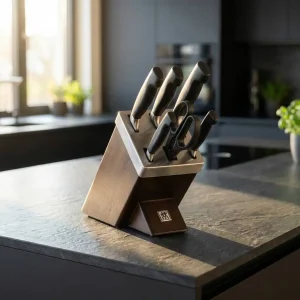
Honestly, 90% of home cooks buying the massive 18-piece “Statement” block sets are wasting their money on countertop decoration. You are paying for handle plastic and wood, not steel.
Let’s look at the economics. If a set costs $200 and has 18 pieces, you are paying roughly $11 per item. That includes the wood block, the shears, and the honing rod. How much quality steel do you think is in an $11 knife? None.
Furthermore, these sets are packed with filler:
- The 5.5-inch Prep Knife: Too big to be a paring knife, too small to be a chef knife. Useless.
- The 8-inch Bread Knife: Too short. A standard sourdough boule is wide; you need at least 10 inches to saw through without banging your knuckles.
- Steak Knives: Usually serrated disasters that tear meat rather than slicing it.
My Recommendation: Buy the 3-piece Zwilling Pro Starter Set (Chef’s Knife, Paring Knife, Serrated Utility). You will spend the same amount of money, but you will own three distinct pieces of high-performance metallurgy rather than 15 pieces of junk.
Maintenance: Keeping German Steel Alive
Because Henckels steel is softer (57 HRC), the edge retention is mediocre. It will lose that “hair-popping” sharpness after about two heavy prep sessions.
This means you must own a honing rod (steel). You need to hone this knife before every single use. You aren’t sharpening (removing metal); you are realigning the microscopic teeth of the edge that have flopped over. If you don’t hone, this knife will feel dull in a week.
The Angle: Modern Henckels are sharpened to roughly 15 degrees per side. Older German knives were 20 degrees. If you use those pull-through sharpeners set to 20 degrees, you are essentially blunting your knife every time you pull it through. Learn to use a whetstone or buy a specific sharpener designed for 15-degree edges.
The Final Cut: Who Is This For?
After putting these tools through the wringer, here is the verdict.
| Pros | Cons |
|---|---|
| Bombproof Durability: Can handle bones, frozen food, and abuse. | Mediocre Edge Retention: Requires constant honing. |
| Ergonomics (Zwilling Pro): The curved bolster is best-in-class for pinch grips. | Wedging: Thick spines can crack hard root vegetables. |
| Warranty: Excellent support from a massive company. | Confusing Branding: Easy to accidentally buy cheap “International” lines. |
The Verdict: If you are a home cook who wants a tool that you don’t have to baby, or if you have family members who tend to throw knives in the sink (heaven forbid), buy the Zwilling Pro. It balances durability with decent performance. However, if you are looking for laser precision to slice sashimi or translucent vegetable garnishes, this steel is too soft and too thick. Look toward Japan.
Frequently Asked Questions (FAQ)
Is Henckels International real Henckels?
No, not in terms of quality. Henckels International (Single Man logo) is the budget value brand manufactured in China, Thailand, or Spain with softer steel and lower quality control standards than the premium Zwilling (Twin logo) brand.
Are Henckels knives dishwasher safe?
Technically, the marketing says yes. Practically, absolutely not. The high heat and harsh detergents will corrode the edge, dull the blade by banging it against other cutlery, and eventually crack the plastic handles. If you respect your tools, hand wash them.
What is the difference between Zwilling and Henckels?
Zwilling is the premium line featuring the “Twin” logo, Friodur ice-hardened steel, and usually German manufacturing. “Henckels” generally refers to the “International” line (Single Man logo), which is the budget-friendly, mass-market option with inferior edge retention.
Why is my Henckels knife rusting?
It is stain-less, not stain-proof. The carbon required to make the knife sharp also makes it susceptible to oxidation. If you leave it wet in the sink or air dry it with water spots, it will develop surface rust. Dry your knife immediately after washing.