Henckels Cutlery Sets: A Pro Chef’s No-BS Guide (Zwilling vs. International Explained)
Let’s get one thing straight before we even look at a knife block: Not all “Henckels” are created equal. In fact, the difference between the two main lines under this brand is the difference between a tool that lasts a lifetime and a piece of stamped metal that ends up in a garage sale bin.
I remember a green line cook, fresh out of culinary school, walking into my station about ten years ago. He was proud of a “Henckels” set he snagged for $150. It had 20 pieces. It looked the part. But the first time he tried to break down a butternut squash, the edge on his chef’s knife rolled over like a wet noodle. He spent the rest of the shift struggling, and I spent the rest of the shift lending him my kit.
If you are looking at these sets, you are likely confused by the branding. Why is one block $199 and another $700? Is it just marketing markup? No. It comes down to metallurgy, geometry, and manufacturing. I’m going to walk you through the physics of these knives so you don’t waste money on “surgical steel” garbage that won’t hold an edge through a single dinner service.
The Tale of Two Henckels: Twins vs. The Single Man
Here is the easiest way to filter out the noise. Look at the logo on the blade.
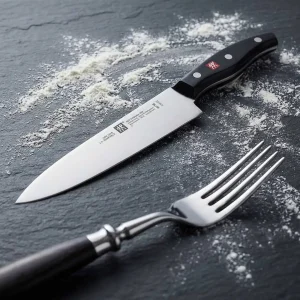
- Two Stick Figures (The Twins): This is Zwilling J.A. Henckels. This is the premium line. German steel, usually forged, made in Germany (mostly). This is the stuff that belongs in a professional kitchen.
- One Stick Figure (The Single Guy): This is Henckels International. This is the budget line. Usually made in China, Spain, or Thailand. These are almost always stamped blades.
Forged vs. Stamped: The Grain Structure
Why does it matter? It’s about the grain structure of the steel. Forging involves heating a single bar of high-carbon steel and pounding it into shape. This aligns the molecular structure of the metal, creating a blade that is stronger and holds an edge longer. It also creates an integral bolster (the thick junction between handle and blade), which acts as a fulcrum for balance.
Stamped knives are cut out of a large sheet of metal like a cookie. They are uniform, cheap to produce, and generally lack a bolster. Without that extra mass in the center, stamped knives are handle-heavy. When you are in a pinch grip for three hours doing prep, a handle-heavy knife fights you. A balanced forged knife works with you.
Metallurgy Deep Dive: What is “Friodur” Anyway?
If you buy a Zwilling set, you’re getting their proprietary “Special Formula Steel.” In metallurgical terms, it is essentially X50CrMoV15.
Let’s break down the specs:
- Carbon (0.5%): Hardness.
- Chromium (15%): Stain resistance.
- Molybdenum & Vanadium: Grain structure refinement and corrosion resistance.
Most Henckels knives are hardened to 57 HRC (Rockwell Hardness). To a steel nerd like me, this is “soft.” A Japanese VG10 blade usually sits at 60-61 HRC. However, “soft” isn’t bad—it’s a trade-off. At 57 HRC, the steel is incredibly tough. You can hack through a chicken bone, and the edge might roll (bend), but it won’t chip. Harder steels shatter; German steel dents.
The “Friodur” Ice-Hardening Process
You’ll see “Friodur” stamped on the blade. It sounds like marketing fluff, but the physics checks out. It’s a cryogenic tempering process. After heating, they freeze the blade to roughly -94°F. This thermal shock forces the retained austenite (a softer, unstable crystal structure) to transform into martensite (the hard, durable structure).
The result? A blade that takes a very sharp edge out of the box and resists corrosion aggressively. However, because the HRC is lower, that razor edge will degrade faster than Japanese steel. You aren’t buying edge retention here; you are buying durability.

The Contenders: Breaking Down the Popular Sets
The Heavyweight: Zwilling Pro & Pro ‘S’
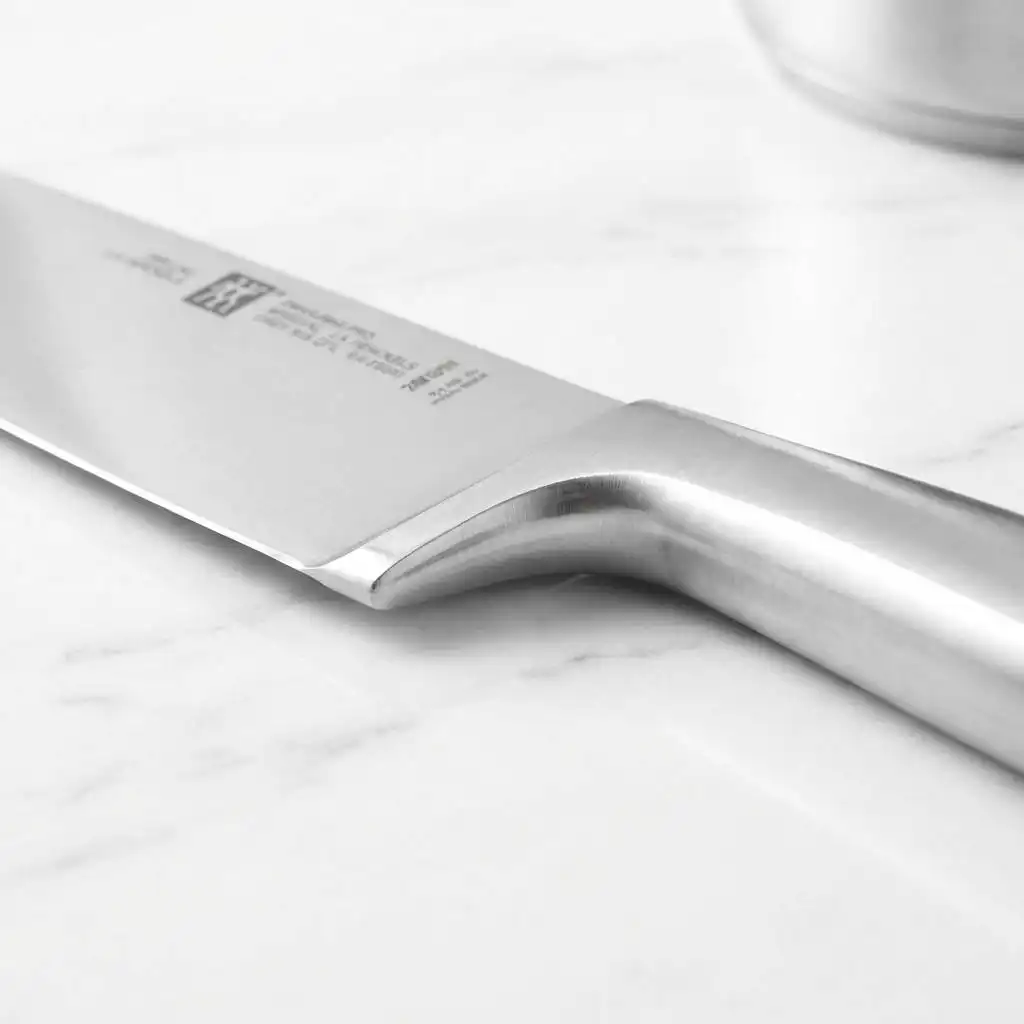
If you want the best performance, this is the line. Specifically, the Zwilling Pro (designed by Matteo Thun).
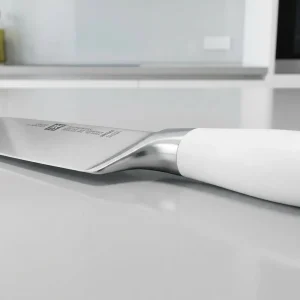
The game-changer here is the curved semi-bolster. On traditional German knives, the bolster is a thick block of steel that runs all the way down to the heel. It protects your finger, but it prevents you from sharpening the entire length of the blade. The Pro features a curved, tapered bolster that supports the “pinch grip” perfectly. It feels natural. No sharp corners digging into your index finger callus.
The Old Guard: Zwilling Four Star
This line hasn’t changed much since the 70s. It uses the same steel and forged construction as the Pro, but the handle is a molded polypropylene. It is technically seamless, which makes it very hygienic (no gaps for bacteria/chicken juice), but it lacks the weight and “soul” of the riveted Pro handles. It feels a bit lifeless in the hand, but it’s indestructible.
The Budget Pick: Henckels International
Look, if you are outfitting a rental property or a kid’s college apartment, go for the International “Statement” or “Solution” sets. But know what you are buying. The steel is often 3Cr13 or similar—much softer. You will need to hone these knives before every single use. If you skip the honing rod, these will be duller than a butter knife within a month.
Performance: The Board Test
I’ve run these knives through the standard gauntlet. Here is how the geometry behaves on the cutting board.
The Tomato Test (Edge Bite)
Out of the box, Henckels grinds their edges to roughly 15 degrees per side. They are polished well. The blade usually slides through tomato skin without snagging. However, once that initial factory polish wears off (after about 50 covers), you will find the edge starts to slide over the skin rather than bite. This is where the honing steel becomes mandatory.
The Carrot Test (Wedging)
This is where German knives struggle compared to Japanese lasers. The spine of a Henckels chef knife is relatively thick to support that durability we talked about. When you cut a tall, dense carrot, the thickness of the blade can act like a wedge, cracking the vegetable open before the edge actually slices it. It’s not a clean “ghost” cut; you can feel the resistance.
The Protein Test
On raw protein, Henckels excels. The added weight of the blade helps it fall through meat. Trimming silver skin on a tenderloin requires a sharp tip, and the distal taper on the Zwilling Pro series is sufficient to get in there without wasting expensive meat.
Ergonomics & The “Pinch Grip” Factor
I cannot stress this enough: The handle belly matters. The Zwilling Pro handles are robust. They fill the palm. If you have large hands, this is great. If you have small hands, you might find the “Pro S” or standard “Professional” lines a bit blocky.
The texture of the black polymer scales is smooth. When your hands are covered in grease or olive oil, they can get slightly slippery compared to a textured handle like Micarta or G10. However, the triple-rivet design is classic for a reason—it secures the full tang (the metal running through the handle) ensuring the knife never snaps at the neck.
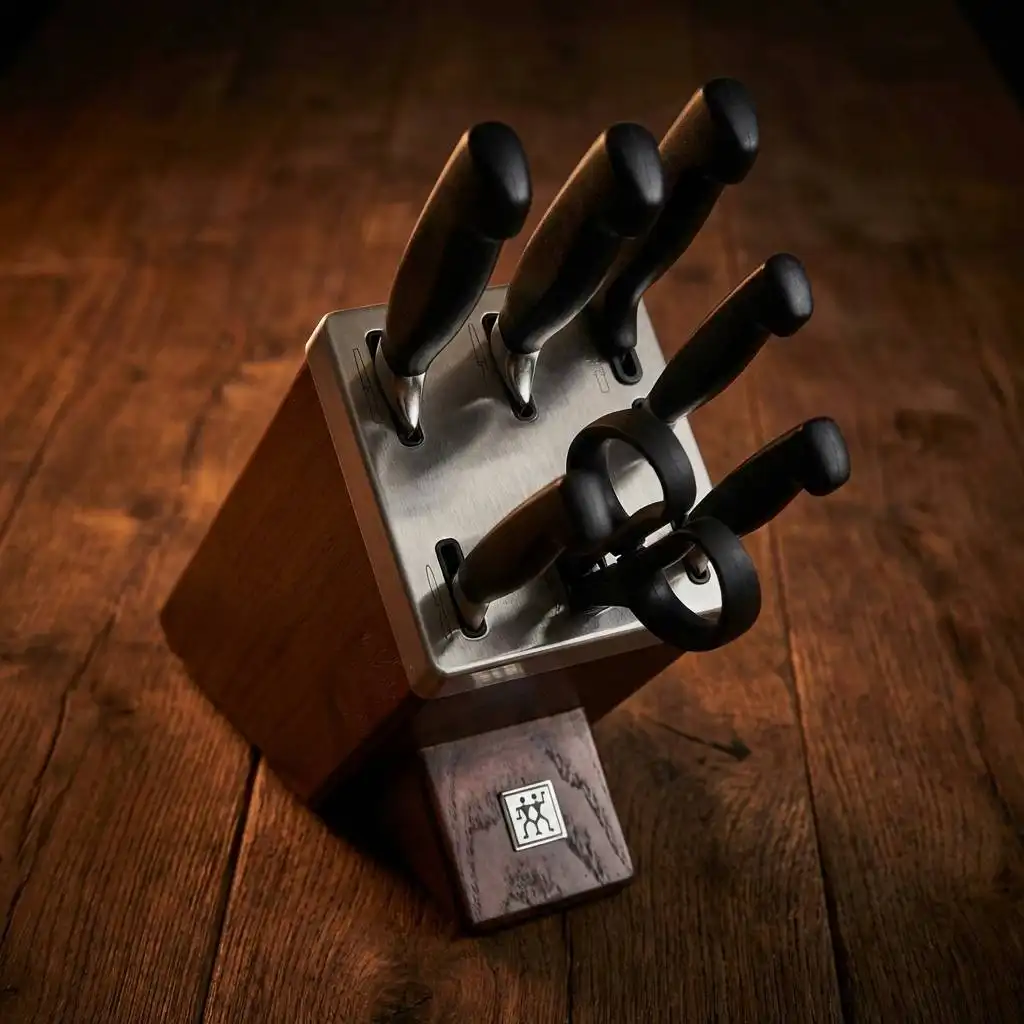
What’s Actually in the Block? (The Filler Problem)
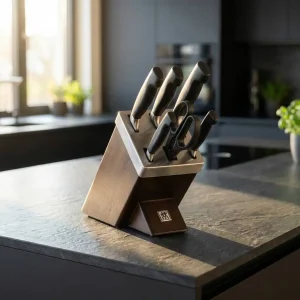
Honest truth? Most people buying the 18-piece block set are wasting money on 12 pieces of metal they will never use. Manufacturers love to fluff up the piece count to justify a higher price tag.
- The Useless: The 5-inch utility knife. It’s too big for detail work and too small for board work. It’s the “drawer queen” of the set. Also, usually, the steak knives included in these sets are lower quality than the main knives.
- The Essentials: You are paying for the 8-inch Chef’s Knife, the Paring Knife, and the Bread Knife. Everything else is distinctively secondary.
- The Honing Rod: Pay attention here. In the cheaper International sets, the honing rod is often too soft or too coarse, which can actually damage the edge. In the Zwilling sets, the rod is adequate.
Maintenance: Keeping German Steel Alive
Because X50CrMoV15 is at 57 HRC, the edge doesn’t chip—it rolls. Imagine the microscopic teeth of the edge bending over like grass in the wind. This happens every time the blade hits the cutting board.
The Protocol:
- Honing: You must use the steel rod every 2-3 uses. This realigns the bent teeth. If you don’t do this, the knife will feel dull even if it’s technically sharp.
- Sharpening: You don’t need fancy 8000 grit water stones for Henckels. The grain structure of this steel isn’t refined enough to hold that kind of polish. A standard 1000/3000 grit combo stone is all you need. Give it a few passes on the stone every 3-4 months.
Chief’s Final Verdict: Price-to-Performance
If you want a knife that you can abuse, drop, and leave wet on the counter (occasionally) without ruining it, Zwilling is the industry standard for a reason. It is the Ford F-150 of kitchen cutlery.
My Recommendation: Buy the Zwilling Pro 7-Piece Set. It cuts the fluff, gives you the superior curved bolster for ergonomics, and the block has room to grow if you decide to add a boning knife later.
| Model Line | Construction | Steel Hardness | Verdict |
|---|---|---|---|
| Zwilling Pro | Forged | 57 HRC | The Goldilocks. Best ergonomics and durability. |
| Zwilling Four Star | Forged | 57 HRC | Good steel, lifeless handle. Good for sanitation. |
| Henckels International | Stamped | 53-55 HRC | Budget only. Will frustrate serious cooks. |
FAQ: Questions from the Pass
Is Henckels made in China or Germany?
It depends on the logo. If it has two stick figures (Zwilling), it is likely made in Solingen, Germany (check the blade stamp to be sure). If it has one stick figure (International), it is made in China, Spain, or Thailand.
Can I put Henckels knives in the dishwasher?
Only if you hate your knives. The high heat expands the metal, causing the handle scales to separate from the tang. The harsh detergents are abrasive and will dull the edge immediately. Hand wash, dry immediately.
Why is my Henckels knife rusting?
Stainless steel is not stain-proof. It is stain-less. If you leave lemon juice or tomato acids on the blade overnight, the chromium oxide layer will break down and you will get pitting or rust spots. Keep your tools clean.