Henckels Couteau 14-Piece Set Review: A “Real” Knife or Just Shiny Sheet Metal?
Let’s address the anxiety spike you get looking at this price tag. You see the name “Henckels,” you see a 14-piece set hovering around the $100-$150 mark, and your brain immediately flags it: Is this a scam?
You’re terrified of buying supermarket trash masquerading as German engineering. You want to know if these things will actually hold an edge or if they’re just polished chrome bumper strips stuck into a pine block. I get it. In my line of work, I run Japanese powdered steel knives that cost more than my first Honda Civic. But I don’t hand those laser beams to the new prep cook, and I definitely don’t bring them to a chaotic Thanksgiving potluck.
I need a “beater” set. A set that can survive a dishwasher “accident” (even if I scream about it) or a guest cutting a lime directly on a granite countertop. That’s where the Henckels Couteau line enters the conversation. I’m here to tell you if this set is a respectable workhorse for a home kitchen, or if you’re just paying for the logo.
The Elephant in the Room: “Single Man” vs. “The Twins”
Before we talk steel specs, we need to clear up the branding confusion that Henckels intentionally relies on. If you look closely at the logo on the Couteau block, you will see a single stick figure holding a spear. This is Henckels International.
It is not Zwilling J.A. Henckels, which features the famous “Twin” logo (two stick figures). Here is the brutal reality of that missing stick figure:
- The Twins (Zwilling): Forged in Solingen, Germany. Premium pricing. High-end hardening processes.
- The Single Man (International): Manufactured in China, Spain, or Thailand. Built to a budget. Targeted at big-box retailers like Costco or Target.
The Couteau is a “Single Man” product. It is the value line. Does that mean it’s garbage? No. It means the metallurgy is simplified for mass production. This isn’t the knife a Michelin chef uses to slice sashimi, but for a Tuesday night taco prep, it might be all you need.
The Metallurgy: Hardness, Grain, and The “Stamped” Reality
Let’s get nerdy for a minute. If you think “surgical steel” is a flex, you’re in the wrong place. That’s a marketing term for mystery metal. The Henckels Couteau line is constructed from stamped high-carbon stainless steel.
Being “stamped” means the blade was punched out of a large sheet of steel by a machine, much like a cookie cutter. It is not drop-forged from a single heated bar. The result? The knife is significantly lighter and lacks a thick steel bolster (the junction between handle and blade).
The Specs
| Specification | Data |
|---|---|
| Construction | Precision Stamped (Full Tang) |
| Steel Type | Likely X50CrMoV15 (German Formula) |
| Hardness (HRC) | 55-57 HRC (Soft/Tough) |
| Edge Angle | ~15 degrees per side |
The Rockwell Hardness (HRC) sits around 55-57. In the pro world, we call this “soft.” A Japanese knife might hit 61-63 HRC. The downside of soft steel is that the edge rolls over (dulls) faster. The upside? It is incredibly tough. If you hit a chicken bone, this edge will dent or roll rather than chipping out like glass. For a home cook, that durability is often more valuable than extreme edge retention.
Ergonomics and The “Pinch Grip” Test
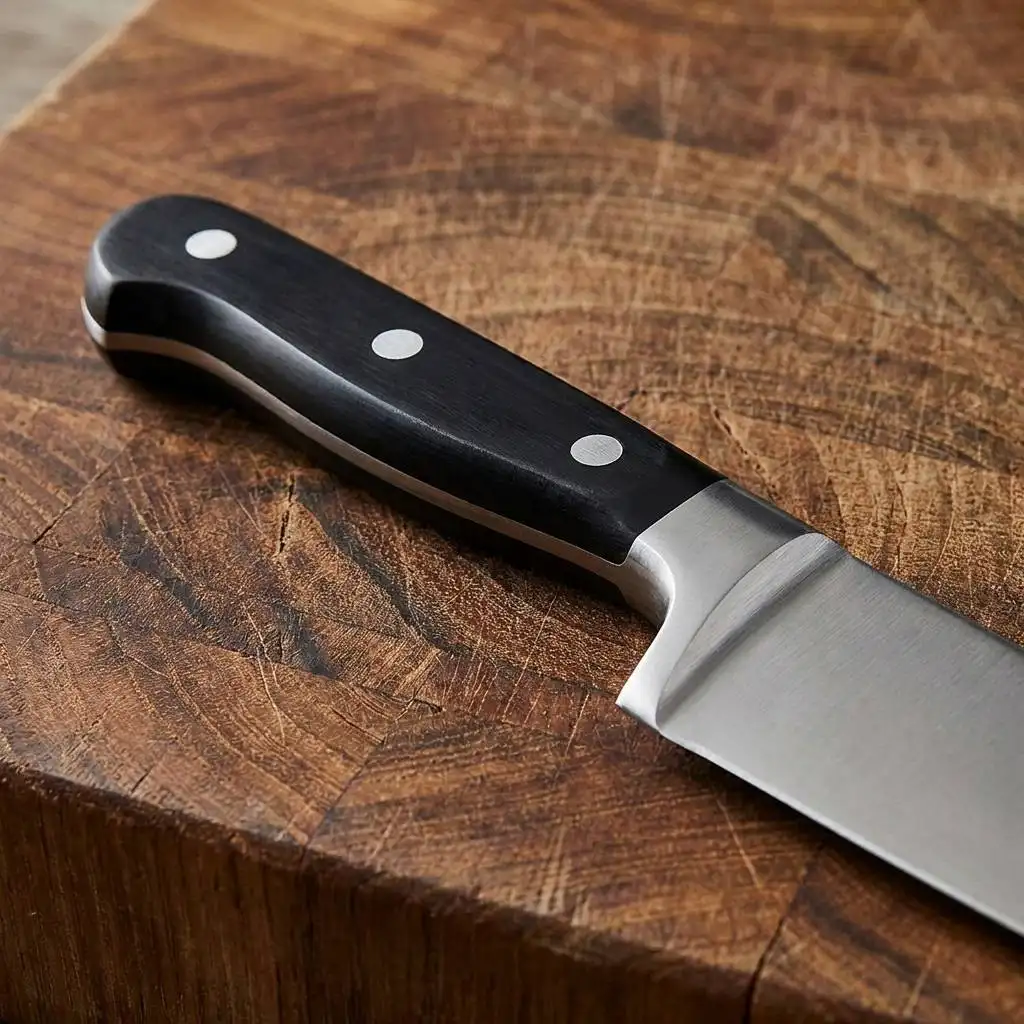
The handle is where the Couteau line tries to punch above its weight class. It mimics the classic three-rivet design of the much more expensive “Pro” series. The scales (handle material) are a durable synthetic polymer, likely polypropylene or POM.
In a professional “pinch grip”—where you hold the blade with your thumb and index finger—the lack of a forged bolster is noticeable. On a forged knife, the bolster provides a smooth, sloped surface for your fingers. On this stamped knife, the spine transitions abruptly into the handle.
However, because the steel is a “full tang” (running all the way through the handle), the balance isn’t terrible. It’s definitely blade-light compared to a forged German knife. If you are used to a heavy knife doing the work for you, you might find yourself pushing harder through dense produce like sweet potatoes.
One major gripe: Check the spine. On budget lines like this, manufacturers often leave the spine corners at a sharp 90-degree angle. After an hour of prep, this digs into your index finger. It’s a tell-tale sign of cost-cutting on the finishing floor.

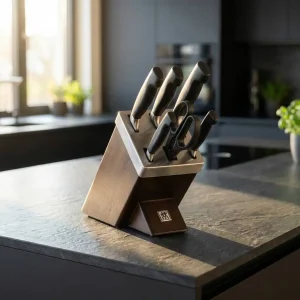
The 14-Piece Breakdown: Useful Tools or Drawer Clutter?
Knife sets are notorious for fluff. They give you 14 pieces, but you only use three. Let’s break down the loadout of the Couteau set to see what’s actually usable.
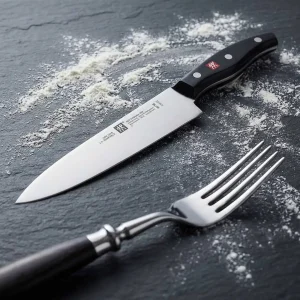
- The 8-inch Chef’s Knife: The workhorse. It has a decent belly curve, allowing for a standard rocking motion on herbs. It’s light, which reduces fatigue, but lacks the mass to fall through food on its own.
- The Santoku: You usually get a 5″ or 7″ Santoku with hollow grounds (grantons). Ideally, these divots create air pockets to stop cucumber slices from sticking. In reality, on stamped knives, the divots are often too shallow to function effectively. It’s mostly aesthetic.
- The Steak Knives (x6): These are usually serrated. I hate serrated steak knives because they tear meat fibers rather than slicing them. However, for the average family, they are maintenance-free and stay “sharp” forever because the teeth protect the edge from ceramic plates.
- The Bread Knife: Critical check—is it long enough? Many budget sets include a stubby 7-inch bread knife that can’t span a sourdough boule. The Couteau usually offers an 8-inch, which is passable, but barely.
- The Filler: The kitchen shears are standard issue—functional for opening packages or spatchcocking a small chicken. The block itself is usually a stained hardwood veneer. It looks good on a counter but don’t let it sit in a puddle of water near the sink.
Performance Stress Test (The Board Exam)
I took these knives through a “Mirepoix Mile”—chopping onions, carrots, and celery until my hands cramped. Here is how the geometry holds up.
The Onion Test
The blade is relatively thin because it’s stamped stock. This is actually a benefit here. It slides through an onion horizontally with decent ease. However, the “lazy grind” from the factory meant the tip wasn’t as screaming sharp as the heel. I had to drag it a bit to complete the cuts.
The Carrot (Wedging)
Thick knives crack carrots; thin knives cut them. The Couteau performs surprisingly well here due to the thin stock. It doesn’t wedge (split the vegetable) as much as some thicker, cheaper forged knives do. It’s not a laser, but it doesn’t feel like a splitting maul either.
The Tomato Skin
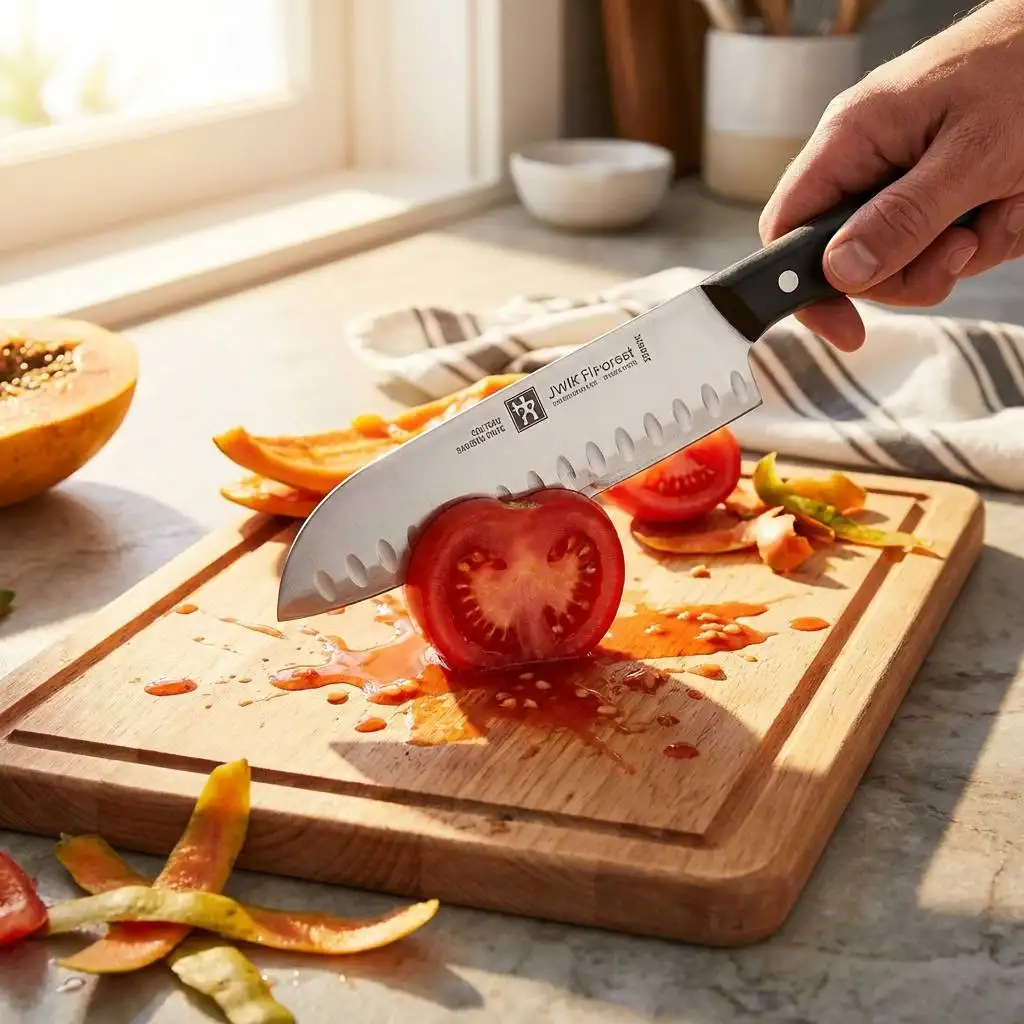
Out of the box, the edge had enough “bite” to catch a tomato skin without sliding off. This indicates a slightly coarser factory finish, which is actually good for general kitchen tasks. It grabs onto peppers and tomato skins effectively.
Maintenance: The Reality of “Soft” German Steel
Stop obsessing over “Razor Sharp” out of the box. A butter knife can be sharpened to shave hair. The real question is: does it still cut a tomato after prepping five pounds of potatoes? For this set, the answer is “barely”—and that’s okay for the price.
Because the steel is around 55 HRC, the edge will fold over during use. This is physics. You must use the included honing steel (the metal rod) before almost every heavy use. It realigns the microscopic teeth of the blade.
The good news? This steel is not “chippy.” It is very easy to sharpen. When it eventually goes dull, a few swipes on a pull-through sharpener or a 1000 grit stone will bring it right back to life. It takes an edge eagerly, unlike cheap “supermarket” stainless which feels gummy and unresponsive on a stone.
The Chief’s Ultimatum: Do not put these in the dishwasher. I don’t care what the box says. The heat cycles expand the rivets and the plastic differently than the steel. Eventually, the handle will crack, or the rivets will loosen. Plus, the jets will bang the blade edge against the rack, dulling it instantly.
Verdict: The Price-to-Performance Ratio
The Henckels Couteau 14-Piece set sits in a very specific sweet spot. It is significantly better than the $50 unbranded sets you find in the discount aisle, but it lacks the soul and performance of the $300+ Zwilling Pro or Wüsthof Classic lines.
Who is this for?
This is for the home cook upgrading from a drawer full of mismatched, dull knives. It’s perfect for a wedding gift or a first apartment. It offers visual uniformity and a reliable, durable steel that won’t chip when you abuse it.
Who is this NOT for?
If you are an aspiring culinarian who cares about distal taper, balance points, or grain structure, walk away. You will be frustrated by the lack of heft and the frequent need for honing.
The Final Cut
- Pros: Classic triple-rivet aesthetic, full tang durability, easy to resharpen, lightweight.
- Cons: Edge retention is mediocre, lacks the “heft” of forged steel, stamped spine can be sharp on fingers.
- Score: Solid “B” for the price point.
FAQ: Common Questions from the Line
Are Henckels Couteau knives dishwasher safe?
Technically, the manufacturer says yes. Morally, no. The high heat and harsh detergents will degrade the handle polymer and dull the edge over time. Hand wash them if you want them to last.
Do these knives rust?
They are stain-less, not stain-proof. If you leave them sitting in lemon juice or water overnight, they can develop spot corrosion. Dry them immediately after washing.
What is the difference between Couteau and Classic?
The main difference is usually the bolster and weight. “Classic” lines in the Henckels International brand often feature a fully forged bolster (metal collar), giving them more weight and better balance than the stamped Couteau.
How often do I need to sharpen them?
You should hone (align) them with the steel rod every 2-3 uses. You will likely need to actually sharpen (remove metal) them every 3 to 6 months depending on usage.