Henckels Couteau 14-Piece Set Review: A Pro Chef’s Honest Look at “Budget” German Steel
Look, I’ve spent 15 years in kitchens where if your knife didn’t shave hair off your forearm, the Sous Chef would send you home. I usually tell people to avoid block sets like the plague. They are the classic “registry trap”—marketing teams boast about “14 pieces,” but half of them are fillers you’ll never use, and the steel usually feels like a soup spoon after one week of heavy prep.
But my inbox is constantly full of people asking about the Henckels Couteau line. Why? Because it looks exactly like the high-end Zwilling Pro “S” knives I used back in my French culinary school days, but it costs a fraction of the price. That makes me suspicious.
So, I grabbed a set to see if the metallurgy matches the marketing, or if it’s just shiny junk designed to sit on a countertop and look pretty. I’m not here to sell you a dream; I’m here to tell you if this steel can handle a Friday night rush or if it’s going to fold the second you show it a butternut squash.
The “Single Man” vs. “The Twins”: Clearing Up the Henckels Confusion
Before we even look at the blade geometry, we need to clear up the branding mess. This is where most home cooks get ripped off.
There are two Henckels. The top-tier stuff is Zwilling J.A. Henckels—look for the logo with the “Twins” (two little stick figures). That is premium, German-forged steel, usually ice-hardened.
Then there is Henckels International—the logo is a “Single Man” holding a spear. That’s the value-driven brand. The Couteau set falls under the “Single Man” banner. Generally, this means production is outsourced (usually China, Spain, or Thailand) to keep costs down.
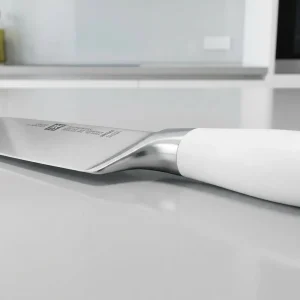
However, the Couteau line is an anomaly. Most “Single Man” knives are stamped—literally punched out of a sheet of metal like a cookie cutter. The Couteau is forged. It has a bolster (that thick band of metal between the handle and blade) and a full tang. This is huge for balance. You aren’t getting the Friodur ice-hardened steel of the $150 Chef’s knife here, but you are getting a legitimate forged construction that puts the cheaper “Statement” or “Solution” lines to shame.

The Specs: Metallurgy for Nerds (And Why It Matters)
If you don’t care about metallurgy, skip this. If you want to know why your knife gets dull, read this.
Henckels is cagey about the exact alloy, but based on the spark test and edge behavior, this is standard German High Carbon Stainless Steel, likely X50CrMoV15 or a 1.4116 equivalent.
- Hardness (HRC): It clocks in around 55-57 HRC. In English? It’s soft. A Japanese VG10 blade is usually 60-61 HRC.
- The Trade-off: Because the steel is softer, it is incredibly tough. If you drop this knife into a stainless steel sink, the tip probably won’t snap. It can take abuse. However, the edge retention is mediocre. It won’t hold a razor edge for long if you are prepping mirepoix for three hours.
- Finish: The blades have a satin finish. I actually prefer this over a mirror polish for a “beater” set because it hides scratches from the scrubby side of the sponge.
The 14-Piece Breakdown: Essential Tools vs. Block Fluff
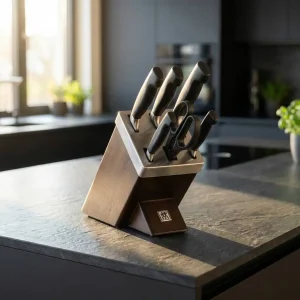
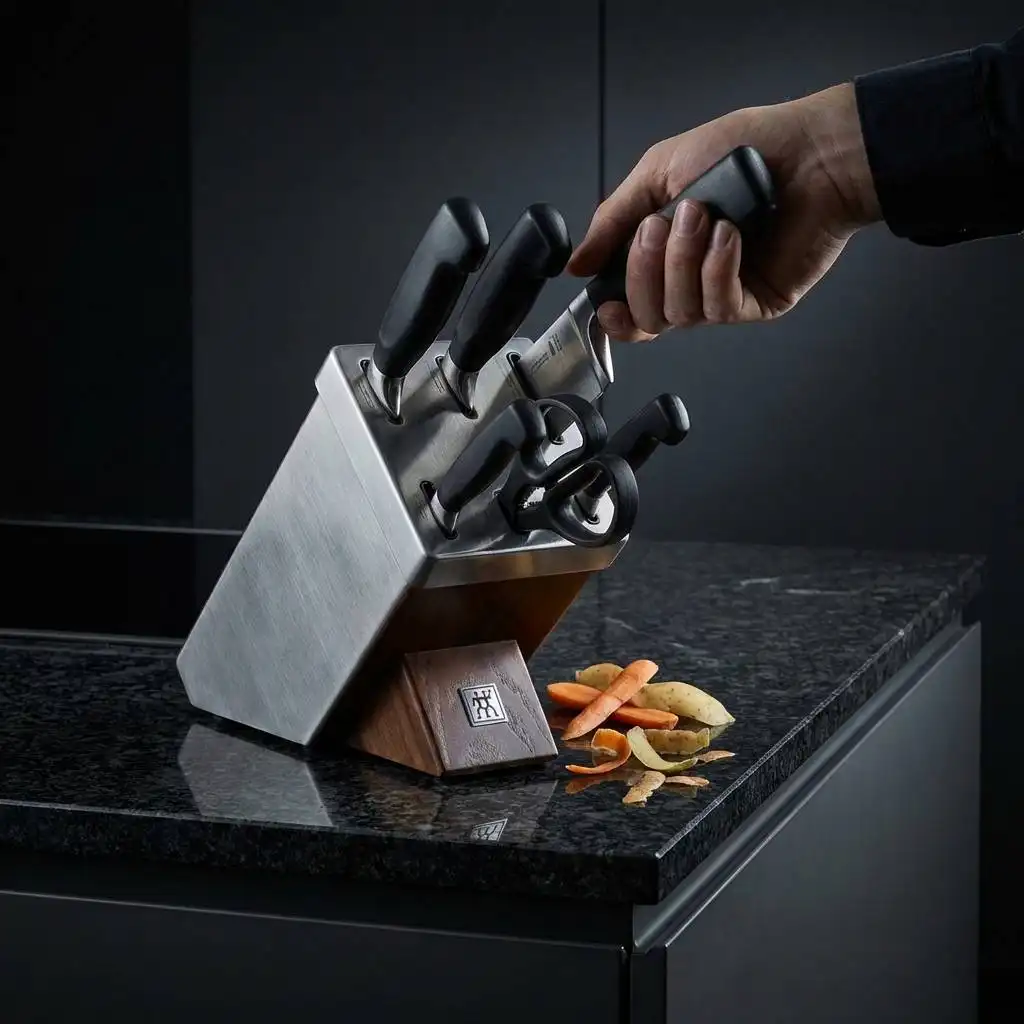
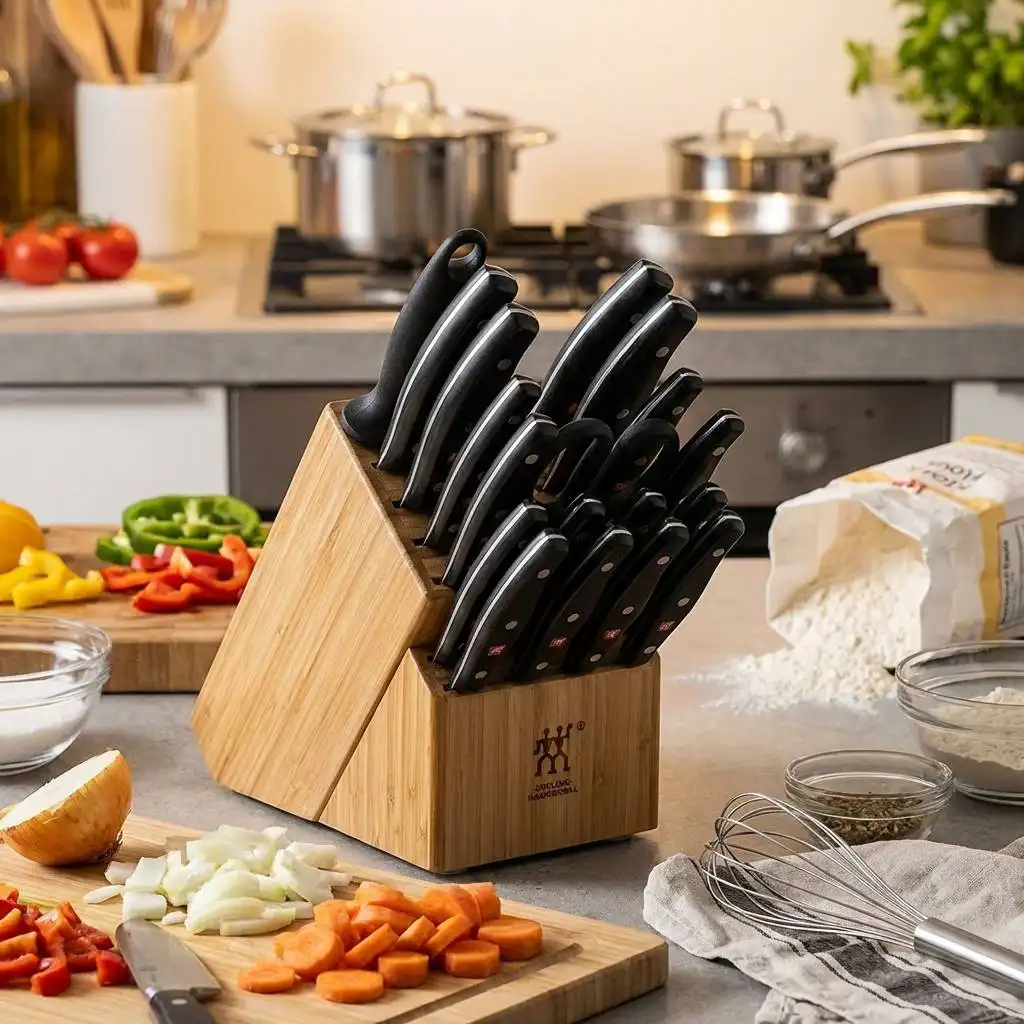
Let’s look at the “mise en place” of this block. Marketing says 14 pieces. Reality says you have about 5 useful tools, 6 dinner utensils, and a block.
The Loadout:
- 8″ Chef’s Knife (The workhorse)
- 5″ Santoku (Redundant, but okay)
- 5″ Serrated Utility (Actually useful for tomatoes/bagels)
- 3″ Paring Knife
- 8″ Bread Knife
- Steak Knives x6 (The fluff)
- Kitchen Shears
- Honing Steel
- Hardwood Block
The six steak knives are there to inflate the piece count. They aren’t cooking tools; they are table tools. Also, including both an 8″ Chef’s knife and a 5″ Santoku is a bit redundant for a starter set, though I admit the Santoku is less intimidating for people with smaller hands. I’d have preferred a flexible boning knife instead of the Santoku, but mass-market sets rarely cater to butchery needs.
Performance Test: The 8-Inch Chef’s Knife
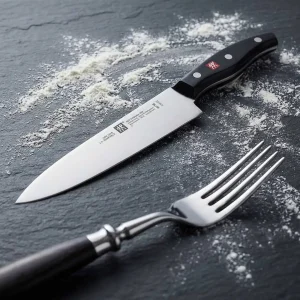
I pulled the 8-inch Chef’s knife for the standard battery of tests. Here is the sensory breakdown.
Ergonomics & The Pinch Grip
This is where the Couteau shines. Because it is forged with a proper bolster, the balance point is right at the neck. When I use a pinch grip (thumb and index finger on the blade), the knife feels neutral. It doesn’t dive forward like cheap stamped knives do. The handle is a classic triple-rivet polymer—it’s a bit boxy, but it offers plenty of traction even when my hands were covered in chicken fat.
The “Carrot Test” (Geometry)
I took it to a 2-pound bag of carrots. The spine is fairly thick at the heel. When doing vertical chops, there was audible “cracking”—this is called wedging. The blade is thick enough that it splits the hard vegetable slightly before cutting it. It’s not a laser. It’s a wedge. For a home cook, this is fine. For fine julienne work, it’s frustrating.
The “Tomato Test” (Sharpness)
Out of the box, the factory edge was decent. It sliced the skin of a ripe tomato without sliding off. However, the grind is a standard machine edge—likely polished to 2000 grit. It has bite, but it lacks that “scary sharp” feeling of a hand-whetstone finish.
The Rest of the Bench: Bread, Paring, and Utility
The Bread Knife: At 8 inches, it’s just acceptable. I prefer a 10-inch bread knife because trying to saw through a wide artisan sourdough loaf with a short blade leads to crushed bread and busted knuckles. The serrations are aggressive, which is good for crusty loaves but tears up soft brioche.
The Paring Knife: It’s a spear-point design. Solid. The tip is fine enough to hull strawberries or devein shrimp without mangling the meat.
The Shears: Finally, a win. The shears in this set separate (come apart). If your kitchen shears don’t come apart, throw them away. You cannot sanitize the pivot point otherwise, and bacteria loves to hide there.
Maintenance: Living with Softer Steel
Here is the hard truth about owning this set: You need to hone it constantly. The steel is around 56 HRC, which is “gummy.” It doesn’t chip, but the edge “rolls” over microscopically every time it hits the cutting board.
The Controversial Opinion
Honestly, the honing steel included in 90% of these block sets—including this one—is usually garbage. It’s too coarse and eats your metal faster than necessary. Use it if you must, but do yourself a favor: throw it in a drawer and buy a smooth ceramic rod for $20. Your edge will thank you. If you use the included steel, use a light touch. If you hear a grinding noise, you’re pressing too hard.
Comparison: Henckels Couteau vs. The Competition
Is this the best value on the market? Let’s look at the data.
| Model | Construction | Steel Hardness (Est.) | Chief’s Verdict |
|---|---|---|---|
| Henckels Couteau | Forged w/ Bolster | 56-57 HRC | Best “feel” for the price. Heavy and durable. |
| Henckels Statement | Stamped + Metal Cap | 54-55 HRC | Avoid. Feels hollow. Balance is off. |
| Wüsthof Gourmet | Laser Cut Stamped | 56 HRC | Better steel, but feels flimsy without a bolster. |
| Mercer Genesis | Forged w/ Bolster | 56 HRC | The culinary school standard. Ugly grip, great blade. |
The Verdict: Who Should Buy This?
The Henckels Couteau set occupies a weird middle ground. It’s too expensive to be “cheap” but too cheap to be “premium.”
Buy this if: You are upgrading from random dollar-store knives and want the weight and authority of a forged German-style knife. You want a set that looks impressive on the counter and can survive a dishwasher accident (though please, don’t dishwasher these).
Skip this if: You are a steel snob who hates sharpening. The edge retention here will frustrate you. If you want a knife that stays sharp for six months, you need to spend more on Japanese steel.
Price-to-Performance Ratio: At the typical sale price ($120-$150), it is a solid “B”. It’s a workhorse set. A beater set. It won’t inspire poetry, but it will chop onions for the next 10 years without failing.
Frequently Asked Questions (FAQ)
Is the Henckels Couteau set dishwasher safe?
Technically, the manufacturer says yes. Practically? NO. Dishwasher detergent is abrasive and will dull the edge immediately. The high heat can also cause the polymer handles to expand and crack over time. Hand wash only.
Where are Henckels Couteau knives made?
The Couteau line is part of Henckels International. They are typically manufactured in China or Thailand to Henckels’ specifications. They are not made in Germany (that is reserved for Zwilling lines).
How do I sharpen the Couteau set?
Because the steel is on the softer side, use a honing rod before every use to realign the wire edge. When it actually goes dull, a standard pull-through sharpener works fine on this steel, though a whetstone (1000/6000 grit) will give you a much better result.
What is the difference between Couteau and Statement?
Construction. Couteau is forged from a single bar of steel, giving it a heavy bolster and better balance. Statement is stamped from a sheet, making it lighter and blade-heavy. Couteau is the superior choice for durability.