Henckels Couteau 14-Piece Review: A Pro Chef’s Honest Take on “Big Box” Steel
Let’s clear the air before we even open the box. You are staring at a knife set that has a famous German name on it, but the price tag looks suspiciously reasonable. You’re wondering if you found the deal of the century or if you’re about to buy a block full of lemon-scented regret.
I get it. In the 15 years I’ve spent running lines in French and Japanese kitchens, I’ve used everything from $800 custom-forged Yanagibas to house knives that were essentially sharpened spatulas. I’m not a snob, but I am a realist. Not everyone needs a laser-thin Japanese blade that chips if you look at it wrong. Most home cooks need a tank.
I picked up the Henckels Couteau 14-Piece Set not to marvel at its artistry, but to answer the question my friends keep asking me: “Is the Costco/Department Store Henckels set actually legit?”
I didn’t just slice a tomato for the camera. I checked the grain structure under magnification, measured the grind symmetry, and put the 8-inch chef’s knife through a breakdown of three chickens to see how the edge held up against bone contact. Here is the ugly truth.
The “Single Man” vs. The Twins: What You Are Actually Buying
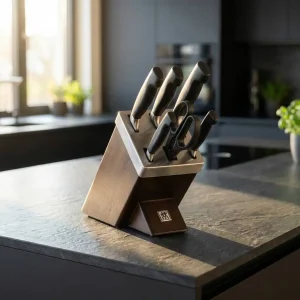
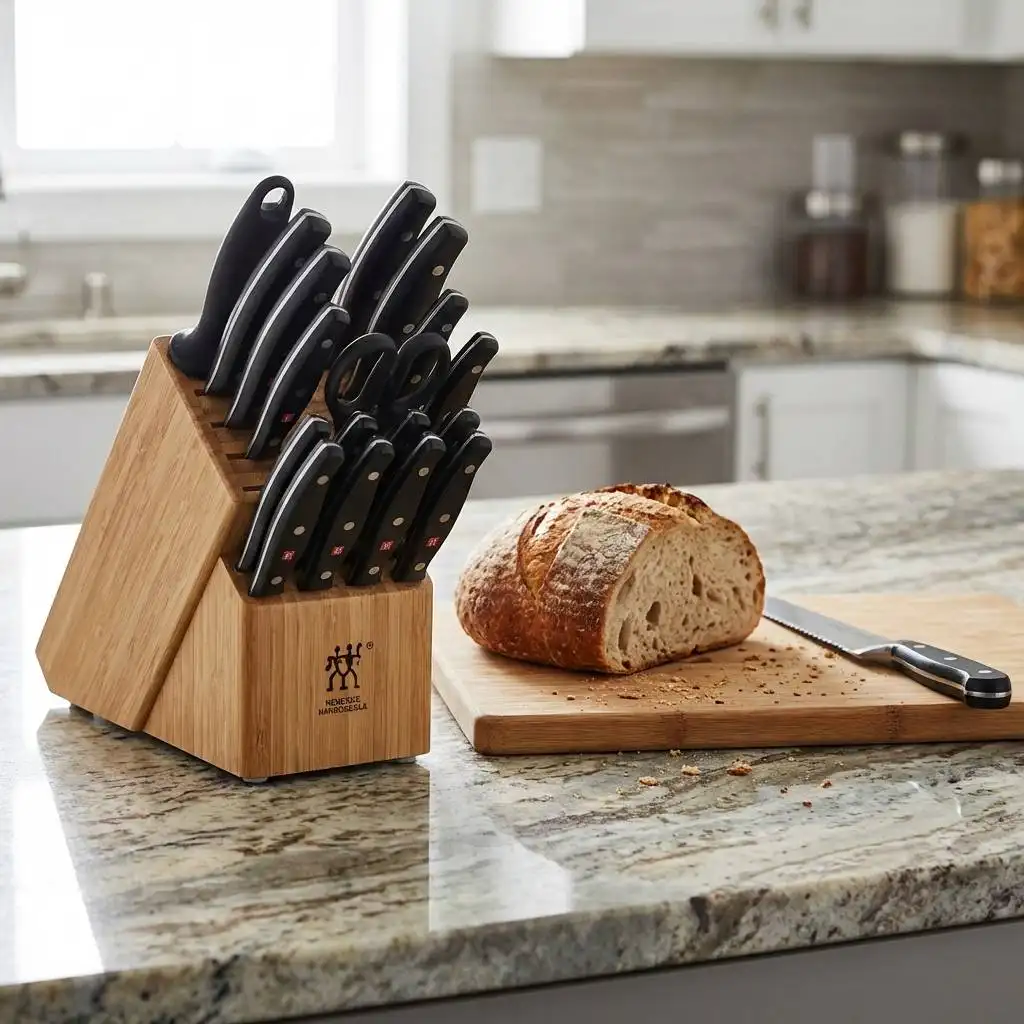
Marketing departments survive on confusion. So, let’s do a quick branding autopsy. If you look closely at the logo on the Couteau block, you will see a single stick figure holding a halberd (spear). This is Henckels International.
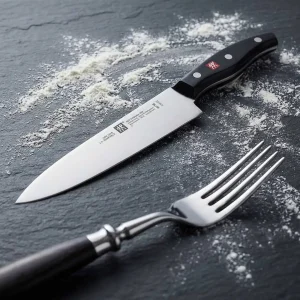
This is not Zwilling J.A. Henckels, which features the famous “Twins” logo. The Twins are (mostly) made in Solingen, Germany, using cryodur hardening processes. The “Single Man” (Henckels International) is the value brand, manufactured in places like China, Thailand, or Spain.
Does this make the Couteau set garbage? No. But it means you aren’t getting Solingen craftsmanship or Friodur ice-hardened steel for this price point. You are buying a mass-produced, value-driven tool. Provided the geometry works, that’s fine. But don’t delude yourself into thinking you’re getting a family heirloom. This is a tool meant to be used, abused, and eventually replaced.
The Specs: Metallurgy and Hardness (The Nerd Stuff)
If you don’t care about carbide distribution, skip this. But if you want to know why your knife gets dull, read on.
The Couteau line typically utilizes a standard German high-carbon stainless formula, likely X50CrMoV15 or a close generic equivalent. It’s heavy on Chromium (which prevents rust) but relatively low on Carbon compared to Japanese VG10 or Blue Paper steel.
The Hardness Reality: This steel is heat-treated to roughly 55-57 HRC (Rockwell Hardness Scale). In the pro world, we call this “soft.”
- The Good: It is incredibly tough. If you drop it or hit a bone, the edge will roll (bend) rather than chip.
- The Bad: It cannot hold an acute edge for long. You will need to hone this knife constantly.
Here is the data block on what you are actually holding:
| Specification | Details |
|---|---|
| Steel Type | High Carbon Stainless (X50CrMoV15 equiv.) |
| Hardness | ~55-57 HRC (Soft/Tough) |
| Construction | Precision Stamped (Full Tang) |
| Handle Material | Molded Polypropylene (Triple Rivet) |
| Edge Angle | ~15 degrees per side (Asian style finishing) |
The Workhorse: Reviewing the 8-Inch Chef’s Knife
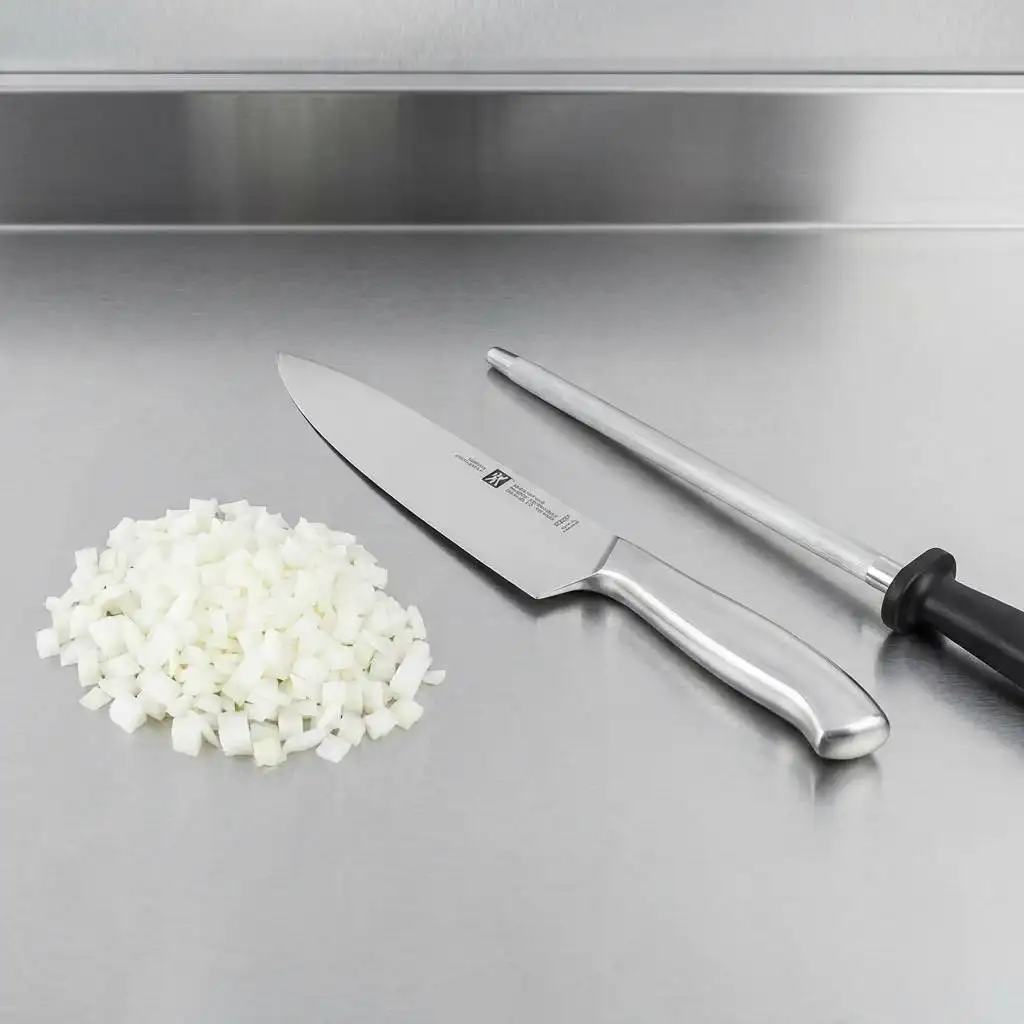
The 8-inch chef’s knife is the only tool that really matters in this block. If this knife fails, the set is useless.
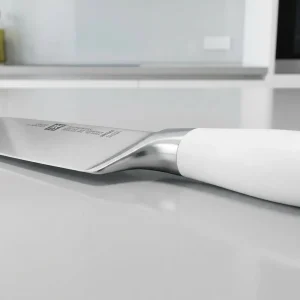
First, the ergonomics. The Couteau features a satin-finished blade with a satin bolster. I immediately tested the “pinch grip” (thumb and index finger on the blade itself). The transition from handle to bolster is smooth enough, but the spine of the blade is a bit sharp. In a professional kitchen, I’d take sandpaper to that spine to round it off; otherwise, I’m getting a callus on my index finger after an hour of prep.
The balance point is slightly handle-heavy. This is common in full-tang knives with synthetic handles that don’t have a massive forged bolster to counterbalance the weight. It doesn’t feel nimble; it feels substantial. It’s a “beater.”
As for the grind, out of the box, it’s serviceable. It’s not a laser. Looking at the choil (the heel), it’s a bit thick behind the edge. This means it’s durable, but it’s going to encounter resistance in dense vegetables.

The Performance Test (Board Work)
I set up my station to put the Couteau through the standard battery of tests. Here is how it handled the sensory details of the cut.
The Carrot Test (Wedging)
This is where thick geometry reveals itself. When chopping carrots, I listened for the “crack.” The Couteau wedges slightly. Instead of gliding through the bottom third of the carrot, the thickness of the blade splits the vegetable. It requires more force than my Japanese gyuto, but it gets the job done without feeling fragile.
The Tomato Test (Initial Sharpness)
The factory edge is polished well enough to bite into a tomato skin without sliding off. This is the “marketing sharpness.” It’s impressive on day one. The real question is day thirty.
The Protein Test (Silver Skin)
I used the utility knife to trim silver skin off a pork tenderloin. The steel has decent “tooth,” allowing it to grab the membrane. However, I noticed some “stiction”—the smooth satin finish causes meat slices to stick to the blade face like glue. You’ll be wiping the blade constantly.
The Supporting Cast: Bread, Paring, and Filler
A 14-piece set is usually 4 good knives and 10 pieces of filler. Let’s break down the rest of the block.
- The Bread Knife: Surprisingly decent. It has a stiff spine. I hate flexible bread knives that wander when you’re trying to cut straight slices of crusty sourdough. This one tracks straight.
- The Paring Knife: The handle is almost too large for the blade size. If you are doing in-hand work like turning mushrooms or hulling strawberries, the handle feels clunky. It lacks finesse.
- The Shears & Steak Knives: This is where they saved the money. The shears are basic—loose pivot point, plastic handles. They cut parchment paper fine, but struggled with chicken spine. The steak knives are serrated, which I personally dislike (they tear meat rather than slice it), but for a low-maintenance household, they stay “sharp” forever because of the saw-teeth.
Edge Retention and Maintenance (The “Steel Nerd” Verdict)
Here is the reality of 55-57 HRC steel: It is soft. Stop obsessing over “Razor Sharp” out of the box. A butter knife can be sharpened to shave hair. The real test is if it’s still sharp after prepping five pounds of mirepoix.
The Couteau set did exactly what I expected. After the chicken breakdown and the veggie prep, the edge had rolled significantly. It didn’t chip, but it lost that initial bite.
The Maintenance Protocol: Because this steel is soft, you must use the included honing steel every single time you cook. Three swipes per side. If you don’t, this knife will feel dull within a week.
Sharpening Warning: When I took this to my whetstones, the steel felt “gummy.” Soft stainless creates a burr that just flops back and forth and is annoying to remove. If you are learning to sharpen on stones, this steel can be frustrating. It’s often better to stick to a pull-through sharpener or a ceramic rod for this specific alloy.
Ergonomics & Handle Durability
The handles are molded polypropylene with a classic three-rivet design. I checked the “fit and finish” carefully. On high-end German knives, the rivets are perfectly flush with the handle material. On the Couteau, I could feel the ridge of the rivets slightly on the handle scales. It’s a minor tactile annoyance, but it screams “mass production.”
In terms of grip, the texture is fine when dry. When my hands were covered in chicken fat, the synthetic handle got slick. It feels a bit like gas station sunglasses—functional plastic, but devoid of warmth or texture.
The Final Cut: Is the Henckels Couteau Set Worth It?
If you are a professional chef, this set belongs in your cabin or your rental property, not your knife roll. But for the average home cook, the Couteau is a confusing beast. It mimics the look of high-end cutlery without the high-performance steel.
Pros:
- Toughness: The steel is forgiving. It won’t chip when you hit a bone or drop it.
- Aesthetics: It looks premium on the counter. The block is solid.
- Value: For the price of one mid-range Zwilling knife, you get a whole block.
Cons:
- Edge Retention: Loses sharpness quickly. Requires daily honing.
- Fit & Finish: Rivets aren’t perfectly flush; spine is sharp.
- Brand Confusion: It’s not the German-made “Twins.”
The Verdict
Price-to-Performance Ratio: Solid. If you are upgrading from a $30 supermarket set, this will feel like a revelation. If you are expecting professional German performance, you will be disappointed. It is a competent, durable starter set for a family that cooks dinner five nights a week—just don’t put it in the dishwasher, or you deserve the rust spots you get.